

Chennai-based Endovascular & IR Specialist, Dr. Ravindran Ramalingam offers minimally invasive, scar-free treatments ensuring faster recovery and minimal pain.

Endovascular &
IR Specialist

Center Address
- Gleneagles Health City, Perumbakkam, Chennai, TN
- Maruti Scans, Velachery, Chennai, TN

Tunneled Pleuralperitoneal Drain

Tunneled Peritoneal or Pleural Catheter

A Simple, Long-Term Solution for Repeated Fluid Drainage at Home

Some medical conditions cause fluid to build up repeatedly in the abdomen (ascites) or around the lungs (pleural effusion)—especially in cancer, liver disease, heart failure, or advanced illness. Repeated hospital visits for drainage can be tiring and uncomfortable.

A Tunneled Peritoneal or Pleural Catheter is a soft, thin tube placed under the skin that allows safe, regular fluid drainage at home, improving comfort, breathing, and quality of life.
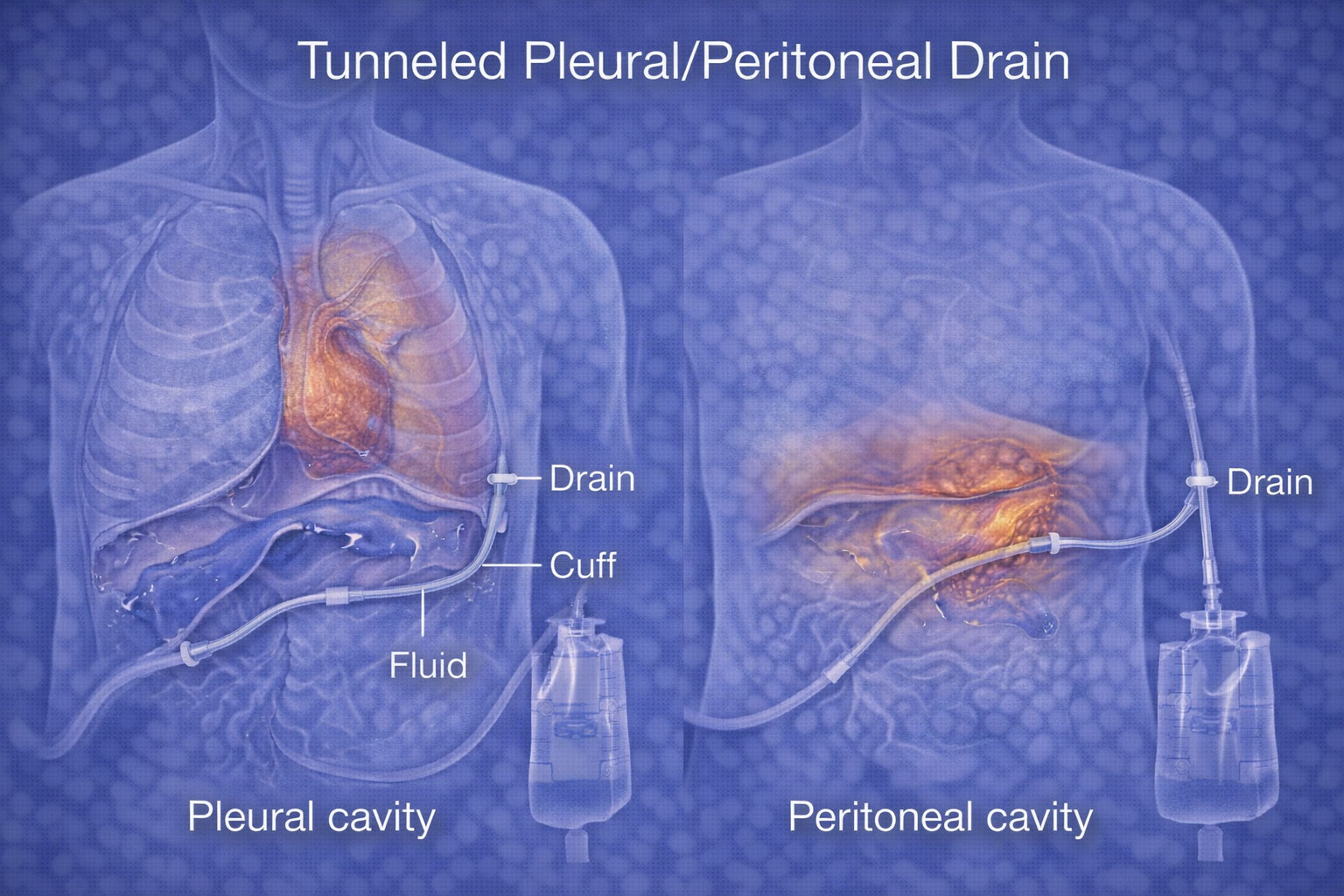
👉Tired of repeated hospital visits for fluid drainage?

What Is a Tunneled Peritoneal or Pleural Catheter?

A tunneled catheter is a small, flexible tube placed:

  • In the abdomen to drain ascitic fluid, or
  • In the chest to drain pleural fluid around the lungs

The catheter:

  • Is tunneled under the skin before entering the body cavity
  • Has a small cuff that helps prevent infection and keeps it in place
  • Allows fluid to be drained regularly at home or in the clinic
  • Reduces the need for repeated needle procedures or hospital visits
  • Long-term solution

  • Minimally invasive

  • Can be managed at home

  • Improves comfort and breathing

Why Is Tunneled Peritoneal or Pleural Catheter Insertion Done?

This catheter is used when:

  • Fluid keeps coming back despite treatment
  • You need frequent drainage for symptom relief
  • You have breathlessness due to pleural effusion
  • You have abdominal swelling or discomfort due to ascites
  • The fluid is due to cancer, liver disease, heart failure, or chronic illness
  • Repeated needle drainage is painful, inconvenient, or risky

Main goals:

  • Relieve breathlessness and pressure
  • Improve comfort and daily activities
  • Reduce hospital visits
  • Allow safe drainage at home
  • Improve quality of life, especially in long-term conditions

How Is Tunneled Peritoneal or Pleural Catheter Insertion Done?

The procedure is done by a trained doctor (often an interventional radiologist) using ultrasound or X-ray guidance.

Step-by-step:

  • You lie comfortably; local anesthesia and sometimes mild sedation are given
  • The doctor uses imaging to choose the safest spot
  • A small cut is made in the skin
  • The catheter is tunneled under the skin and placed into the fluid space
  • The catheter is secured and covered with a dressing
  • Some fluid may be drained during the same session
  • You (and your caregiver) are taught how to drain fluid safely at home

What Are the Risks?

Tunneled catheter insertion is generally safe. Possible risks with approximate incidence include:

  • Mild pain or discomfort at insertion site – common (10–20%)
  • Skin infection around the catheter – uncommon (3–8%)
  • Catheter blockage or poor drainage – uncommon (5–10%)
  • Fluid leakage around the catheter – uncommon (5–10%)
  • Bleeding – rare (<1–2%)
  • Deep infection (peritonitis or empyema) – rare (<1–3%)
  • Catheter dislodgement – uncommon (<5%)

What Are the Alternatives?

Your treatment options depend on:

  • Your underlying medical condition
  • How often the fluid comes back
  • Your overall health and personal preferences

Your clinician will help you choose the most suitable approach.

Alternative 1: No Procedure

  • Avoids undergoing any procedure
  • Limitation: the fluid is likely to return and can cause discomfort, breathing difficulty, or abdominal pressure
  • Does not address the ongoing fluid buildup

Alternative 2: Repeated Drainage or Long-Term Drainage Catheter

  • Includes:
    • Repeat paracentesis (for abdominal fluid), or
    • Repeat thoracentesis (for chest fluid), or
    • Placement of a tunneled drainage catheter
  • A tunneled catheter allows you to drain fluid at home into special containers
  • Helps relieve symptoms and reduces repeated hospital visits
  • Limitation: does not treat the root cause of the fluid buildup

Alternative 3: Denver Shunt

  • A fully internal tube placed under the skin
  • Moves fluid from the abdomen or chest back into the bloodstream through a vein in the neck
  • Similar purpose to a tunneled catheter, but no external drainage bag
  • Requires a surgical procedure and regular follow-up

Choosing the Right Option

A personalized evaluation helps decide whether repeat drainage, a tunneled catheter, or a shunt is the best way to control symptoms while planning definitive treatment for the underlying condition.

📌 For patients needing frequent drainage, a tunneled catheter is often the most comfortable long-term option.

What Happens After Your Procedure?

After catheter placement:

  • You may feel mild soreness for a day or two
  • You can usually go home the same day or next day
  • You and your caregiver will learn how to drain fluid safely
  • Drainage can be done at home, as advised by your doctor
  • Dressings should be kept clean and dry
  • You’ll have follow-up visits to check the catheter and your symptoms
  • Many patients feel better breathing, less pressure, and more comfortable
  • The catheter can be removed later if it’s no longer needed

Frequently Asked Questions (FAQs) – Tunneled Peritoneal or Pleural Catheter

A tunneled peritoneal or pleural catheter is a soft, flexible tube placed under the skin to drain fluid from the abdomen (ascites) or around the lungs (pleural effusion) regularly, often at home.

You may need it if:

  • Fluid keeps coming back despite treatment
  • You need frequent drainage for comfort
  • You have breathlessness or abdominal swelling
  • You want to avoid repeated hospital visits for fluid tapping

No. It is a minimally invasive, image-guided procedure, not open surgery.

It is done under local anesthesia and sometimes mild sedation, so pain is usually mild and temporary.

The procedure usually takes 30 to 60 minutes.

Yes. Many patients go home the same day or the next day, depending on their condition.

Yes. You or a caregiver will be trained to safely drain the fluid at home using sterile technique.

This depends on how fast the fluid builds up. Your doctor will give you a personalized schedule.

Not always. The catheter can be kept as long as needed and removed later if fluid stops collecting or your condition improves.

Possible risks include skin infection, catheter blockage, fluid leakage, mild pain, bleeding, or rarely deep infection. Serious complications are uncommon.

You’ll be taught how to:

  • Keep the area clean and dry
  • Change dressings
  • Drain fluid safely
  • Watch for signs of infection

Alternatives include repeated needle drainage, medicines, chest tubes, pleurodesis, TIPS, or surgery, depending on your condition.

The procedure is done by a trained specialist, often an interventional radiologist.

Yes. When placed and cared for properly, it is safe, effective, and widely used to manage long-term fluid buildup.

Yes. Tunneled peritoneal and pleural catheters are available in major hospitals and cancer centers across India.

Why Choose a Tunneled Peritoneal or Pleural Catheter?

  • Long-term relief from fluid buildup

  • Fewer hospital visits

  • Better breathing and comfort

  • Safe, minimally invasive procedure

  • Can be managed at home

  • Improves quality of life

Stop Letting Fluid Control Your Life

Repeated fluid buildup can make breathing, eating, and daily life difficult. A tunneled peritoneal or pleural catheter can give you comfort, control, and freedom from frequent hospital visits.

Comfort, convenience, and care—made simple.
Call Now Button