

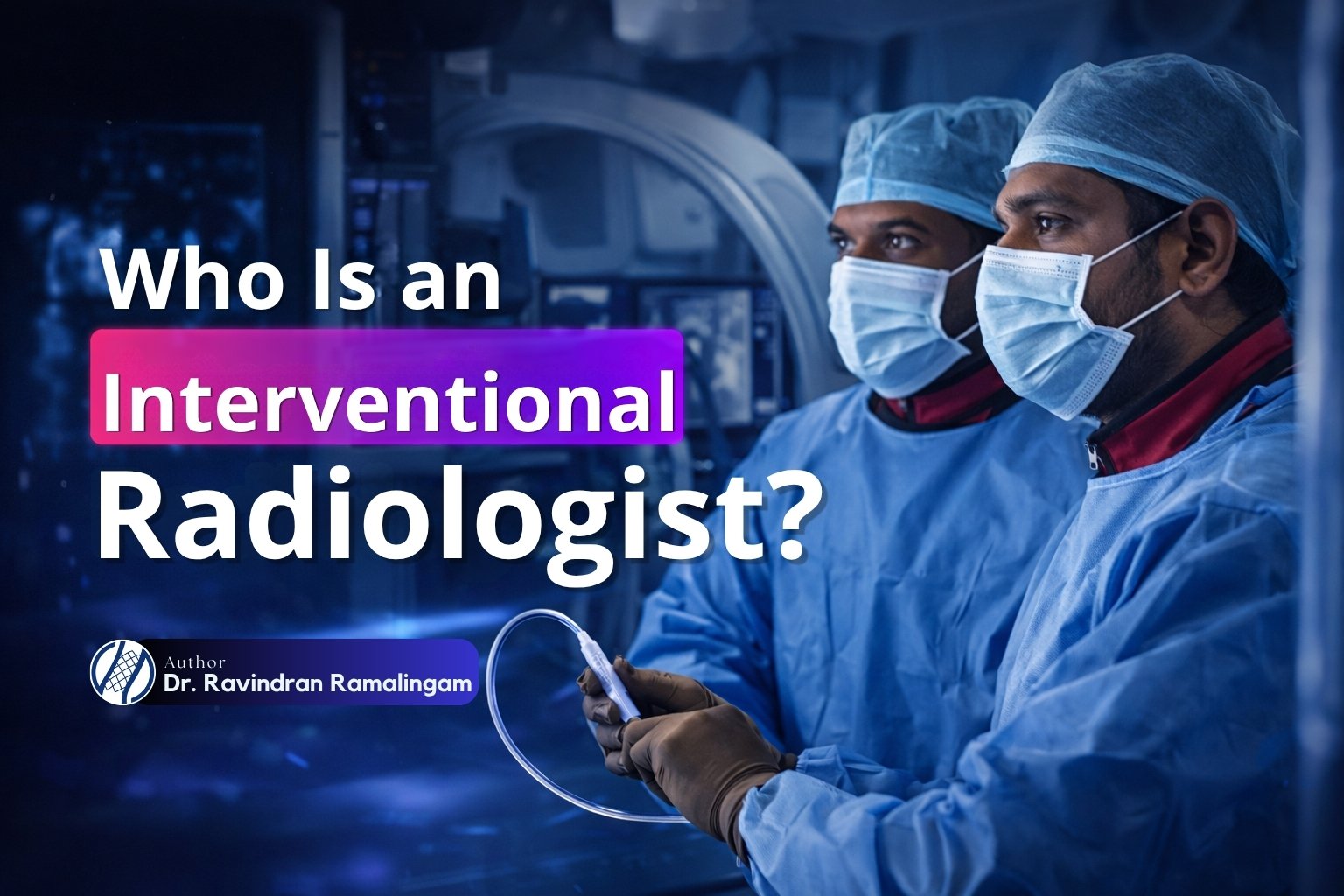
An Interventional Radiologist is a specialist doctor who treats many medical problems without big surgery. They use advanced imaging like ultrasound, CT scan, MRI, and X-ray to see inside your body and treat the problem using tiny needles, wires, and thin tubes (catheters).
In simple words, an Interventional Radiologist:
- Treats problems from inside the body
- Uses small cuts or needle holes, not big wounds
- Offers less pain, faster recovery, and safer treatment compared to many surgeries
What Does an Interventional Radiologist Do?
An Interventional Radiologist (often called an IR doctor) uses imaging machines like a live GPS to guide their instruments exactly to the problem area.
They can:
- Open blocked blood vessels
- Treat stroke and brain aneurysms
- Treat tumors without open surgery
- Stop internal bleeding
- Treat varicose veins
- Treat uterine fibroids
- Drain infections or fluid collections
- Treat kidney stones and bile duct blocks
- Create or fix dialysis access
- Treat certain cancers using ablation or targeted therapy
All this is done through tiny openings in the skin, not large cuts.
How Is an Interventional Radiologist Different from a Surgeon?
Both surgeons and interventional radiologists treat serious medical problems—but the method is different.
An Interventional Radiologist:
- Uses small needles or thin tubes, not big cuts
- Works using live imaging guidance
- Causes less pain and less bleeding
- Usually means shorter hospital stay
- Helps patients recover faster
In many cases, patients can go home the same day or the next day.
 If you’ve been told you need surgery, ask if a minimally invasive option is possible.
What Is “Image-Guided” Treatment?
“Image-guided” means the doctor uses:
- Ultrasound
- CT scan
- X-ray (fluoroscopy)
- MRI
to see exactly where the problem is and treat it with high accuracy.
This makes treatment:
- More precise
- Safer for nearby organs
- More effective
- Less risky
Think of it like Google Maps for the inside of your body—the doctor knows exactly where to go.
What Are the Benefits of Treatment by an Interventional Radiologist?
Patients choose Interventional Radiology because it offers:
🌟 No big surgery
🌟 Smaller wounds or no stitches
🌟 Less pain after the procedure
🌟 Faster recovery
🌟 Shorter hospital stay
🌟 Lower risk of complications
🌟 Quick return to normal life
For many conditions, this means modern treatment with minimum stress on the body.
What Problems Are Commonly Treated by Interventional Radiologists?
Interventional Radiologists treat a wide range of conditions, including:
- Stroke and brain aneurysms
- Blocked arteries and veins
- Varicose veins
- Tumors of liver, kidney, lung, uterus, and more
- Uterine fibroids
- Chronic pain conditions
- Kidney stones and bile duct blocks
- Abscess and infection drainage
- Dialysis access problems
- Certain cancers using ablation or targeted treatments
👉 If you have been advised surgery
Are Procedures Done by Interventional Radiologists Safe?
Yes. Interventional Radiology procedures are widely used all over the world and are proven to be safe and effective.
Because the doctor:
- Uses real-time imaging
- Works with high precision
- Avoids large cuts and major surgery
The risks are often lower than traditional surgery, and recovery is usually much faster.
Of course, every medical procedure has some risk—but your doctor will explain everything clearly and choose the safest option for you.
What Is Recovery Like After Interventional Radiology Procedures?
Recovery is usually quick and comfortable:
- Many patients walk the same day
- Pain is usually mild
- Hospital stay is short (or not needed at all)
- Most people return to normal activities faster than after surgery
Your doctor will give you simple after-care instructions based on your treatment.
When Should You See an Interventional Radiologist?
You should consider seeing an Interventional Radiologist if:
- You want to avoid major surgery
- You were told surgery is high risk for you
- You want faster recovery and less pain
- You want to know if a minimally invasive treatment is possible
- You have a condition like blocked vessels, tumor, fibroids, varicose veins, or chronic pain
👉 Not sure if you’re a candidate?
Why Choose an Interventional Radiologist?
Because it means:
- Smarter treatment, not bigger surgery
- Less pain, faster healing
- Modern technology with precise care
- Treatment that fits your life
👉 Big problems don’t always need big operations.
Frequently Asked Questions (FAQs): Who Is an Interventional Radiologist?
Who is an Interventional Radiologist?
An Interventional Radiologist is a specialist doctor who treats many medical problems using minimally invasive, image-guided procedures. They use ultrasound, CT scan, or X-ray to guide tiny instruments inside the body instead of doing open surgery.
What does an Interventional Radiologist do?
An Interventional Radiologist treats conditions like blocked blood vessels, stroke, tumors, fibroids, varicose veins, kidney stones, and infections using small needles or thin tubes guided by medical imaging.
How is an Interventional Radiologist different from a surgeon?
A surgeon usually treats problems with open surgery and large cuts, while an Interventional Radiologist treats many conditions using small needle holes and catheters, leading to less pain, faster recovery, and shorter hospital stay.
What is Interventional Radiology?
Interventional Radiology is a medical specialty that uses imaging guidance (ultrasound, CT, MRI, X-ray) to perform minimally invasive treatments without major surgery.
What problems can be treated by an Interventional Radiologist?
Interventional Radiologists can treat stroke, brain aneurysms, blocked arteries and veins, varicose veins, tumors, uterine fibroids, chronic pain, kidney stones, bile duct blockages, abscesses, and dialysis access problems, among many others.
Are procedures done by an Interventional Radiologist safe?
Yes. Image-guided, minimally invasive procedures are widely used and proven to be safe. Because the doctor works with real-time imaging, the treatment is precise and usually has lower risk than open surgery.
Do Interventional Radiologists perform surgery?
They do not perform traditional open surgery. Instead, they perform minimally invasive procedures using needles, wires, and catheters through very small skin openings.
Will I need anesthesia for an Interventional Radiology procedure?
Many procedures are done using local anesthesia and mild sedation. Some may need stronger anesthesia depending on the procedure and your condition. Your doctor will explain this before treatment.
How long does recovery take after an Interventional Radiology procedure?
Recovery is usually much faster than after surgery. Many patients go home the same day or the next day and return to normal activities within a short time.
Can Interventional Radiology replace surgery?
In many cases, yes. For several conditions, Interventional Radiology offers a safer, less invasive alternative to surgery. However, some conditions still need surgery. Your doctor will guide you to the best option.
Who should see an Interventional Radiologist?
You should consider seeing an Interventional Radiologist if you want to avoid major surgery, need treatment for blocked vessels, tumors, fibroids, varicose veins, chronic pain, or if surgery is considered high risk for you.
How does an Interventional Radiologist see inside the body?
They use imaging tools like ultrasound, CT scan, MRI, and X-ray to see inside the body in real time and guide treatment safely and accurately.
Are Interventional Radiology procedures painful?
Most procedures cause minimal pain. Any discomfort is usually mild and controlled with local anesthesia or pain medicines.
How do I know if my condition can be treated by an Interventional Radiologist?
The best way is to consult an Interventional Radiologist. They will review your reports and scans and tell you if a minimally invasive treatment is suitable for you.
Do I need a referral to see an Interventional Radiologist?
This depends on the hospital or clinic. Some patients come with a referral from another doctor, while others can book a direct consultation. You can contact the clinic to confirm.
Are Interventional Radiologists real doctors and specialists?
Yes. Interventional Radiologists are fully qualified doctors with special training in imaging and minimally invasive treatments. They undergo many years of medical and specialty training.
Is Interventional Radiology only for serious conditions?
No. Interventional Radiology treats both simple and complex problems, from draining infections and treating varicose veins to managing stroke and tumors.
Why should I choose treatment by an Interventional Radiologist?
Because it often means less pain, smaller wounds, faster recovery, lower risk, and shorter hospital stay compared to traditional surgery.
Is Interventional Radiology suitable for elderly or high-risk patients?
Yes. Many elderly or high-risk patients benefit from Interventional Radiology because the procedures are less stressful on the body than major surgery.
How can I book an appointment with an Interventional Radiologist?
You can contact the hospital or clinic directly to schedule a consultation. The doctor will review your condition and guide you to the best treatment option.
Book Your Consultation Today
If you or your loved one has been advised surgery—or is suffering from a condition that may be treated without open surgery—don’t wait.
- Talk to an Interventional Radiology expert today
- Find out if a minimally invasive treatment is right for you
- Get safer treatment with faster recovery
Comments are closed