

Chennai-based Endovascular & IR Specialist, Dr. Ravindran Ramalingam offers minimally invasive, scar-free treatments ensuring faster recovery and minimal pain.

Endovascular &
IR Specialist

Center Address
- Gleneagles Health City, Perumbakkam, Chennai, TN
- Maruti Scans, Velachery, Chennai, TN

Partial Splenic Embolization

A Minimally Invasive Treatment to Improve Blood Counts and Reduce Portal Hypertension

In some liver and blood disorders, the spleen becomes enlarged and starts destroying too many blood cells (platelets, white cells, or red cells). This can cause low platelets, low immunity, anemia, and bleeding problems.

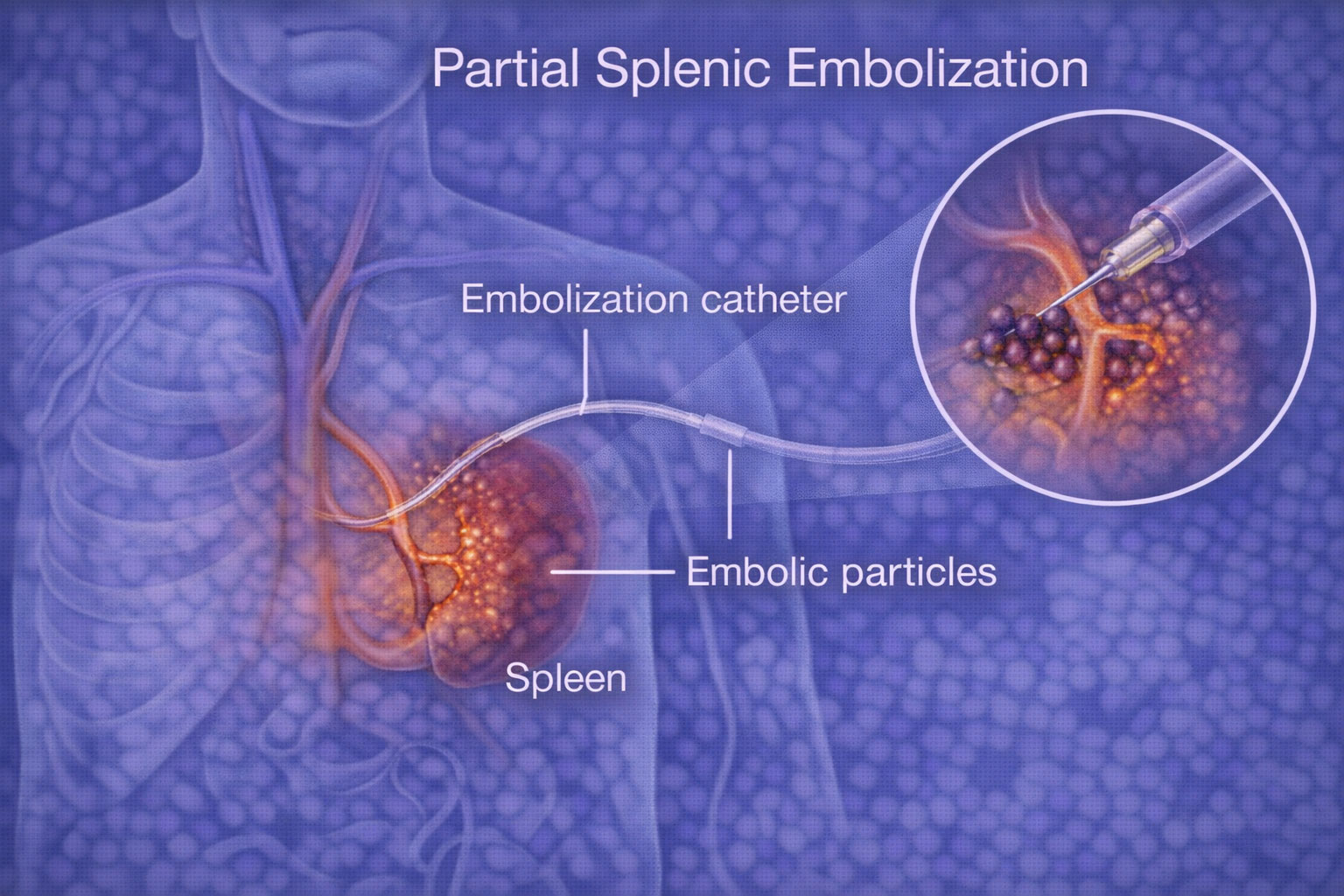
Partial Splenic Embolization (PSE) is a minimally invasive, image-guided procedure that blocks blood flow to part of the spleen to reduce its overactivity, improve blood counts, and control complications—often without removing the spleen by surgery.
👉Low platelets or enlarged spleen due to liver disease?

What Is Partial Splenic Embolization?

Partial Splenic Embolization is a procedure where a specialist:

  • Uses a thin tube (catheter) to reach the splenic artery, and
  • Blocks blood flow to part of the spleen using special embolic particles

This:

  • Reduces the size and overactivity of the spleen
  • Improves platelet, white cell, and red cell counts
  • Decreases complications of hypersplenism
  • Preserves part of the spleen so it can still fight infections
  • Minimally invasive

  • No open surgery

  • Spleen-preserving

  • Helps improve blood counts and treatment options

Why Is Partial Splenic Embolization Done?

PSE is done in patients with hypersplenism (overactive spleen), often due to:

  • Liver cirrhosis and portal hypertension
  • Low platelet count (thrombocytopenia)
  • Low white blood cells or anemia
  • To make patients eligible for chemotherapy, surgery, or antiviral treatment
  • Recurrent bleeding due to low platelets
  • Enlarged spleen causing discomfort or fullness

Main goals:

  • Increase platelet and blood cell counts
  • Reduce spleen size and overactivity
  • Lower risk of bleeding and infections
  • Enable other treatments to be given safely

How Is Partial Splenic Embolization Done?

The procedure is performed by an interventional radiologist in a cath lab using X-ray guidance.

Step-by-step:

  • You are given local anesthesia and sedation
  • A small tube (catheter) is inserted through an artery in the groin or wrist
  • The catheter is guided to the splenic artery
  • Embolic particles are injected to block blood flow to part of the spleen
  • X-ray images confirm partial reduction of spleen blood supply
  • The catheter is removed and a bandage is applied

What Are the Risks?

PSE is effective but commonly causes temporary symptoms due to partial spleen infarction. Possible risks with approximate incidence include:

  • Fever and left upper abdominal pain (post-embolization syndrome) – common (60–90%)
  • Nausea or vomiting – common (20–40%)
  • Pleural effusion (fluid near lungs) – uncommon (10–20%)
  • Infection or splenic abscess – uncommon (2–5%)
  • Blood clot in splenic or portal vein – uncommon (2–5%)
  • Significant bleeding – rare (<1–2%)
  • Severe infection or sepsis – rare (<1–2%)

What Are the Alternatives?

Your treatment options depend on:

  • Your blood counts and bleeding risk
  • The cause of the enlarged or overactive spleen (such as liver cirrhosis or blood disorders)
  • Your overall health and personal preferences

Your specialist will help you choose the safest and most effective option.

Alternative 1: No Active Treatment (Observation Only)

  • Avoids undergoing any procedure
  • Main drawback: low blood counts and bleeding risk are unlikely to improve and may worsen over time
  • Ongoing low platelets or low white/red cells can lead to higher risk of bleeding and infection

Alternative 2: Surgery (Splenectomy or Liver Transplant in Selected Cases)

  • Splenectomy (removal of the spleen) is more commonly used for genetic or blood-related disorders
  • In patients with liver cirrhosis, a liver transplant may be considered to address the root cause and improve blood counts
  • However, compared to partial splenic embolization (PSE), surgery:
    • Is more invasive
    • Carries a higher risk of complications
    • Requires a longer hospital stay and recovery period

Alternative 3: TIPS (Transjugular Intrahepatic Portosystemic Shunt)

  • Considered when hypersplenism is due to scarring of the liver (cirrhosis)
  • A minimally invasive procedure that creates a new pathway for blood to bypass the scarred liver
  • This reduces backed-up pressure in the portal vein
  • Lower pressure can cause the spleen to shrink over time and become less overactive, helping improve blood counts

Choosing the Right Treatment

For many patients with cirrhosis-related hypersplenism, partial splenic embolization offers a targeted, minimally invasive way to improve blood counts and reduce bleeding risk, with less risk and faster recovery than surgery. A personalized evaluation helps choose the best and safest treatment plan.

📌 Compared to surgery, PSE preserves part of the spleen and avoids major operation.

What Happens After Your Procedure?

After PSE:

  • Fever and pain are common for a few days and treated with medicines
  • You will stay in the hospital for monitoring and pain control
  • Blood counts usually start improving within days to weeks
  • Follow-up tests check platelet and white cell counts
  • You may need antibiotics and painkillers for a short time
  • Most patients can return to normal activities in 1–2 weeks
  • Long-term follow-up ensures counts remain stable

Frequently Asked Questions (FAQs) – Partial Splenic Embolization (PSE)

Partial splenic embolization is a minimally invasive procedure that blocks blood flow to part of the spleen to reduce its overactivity, helping increase platelet and blood cell counts and treat problems caused by an enlarged spleen.

PSE is done to:

  • Treat low platelet count (thrombocytopenia) due to an enlarged spleen
  • Improve low white blood cells or anemia
  • Help patients become fit for surgery, chemotherapy, or antiviral treatment
  • Reduce symptoms of hypersplenism in liver disease or blood disorders

No. PSE is a catheter-based, minimally invasive procedure, not open surgery.

Pain and fever after the procedure are common but temporary and are well controlled with medicines in the hospital.

The procedure usually takes 60 to 120 minutes, depending on the anatomy and treatment area.

Most patients stay in the hospital for 3 to 7 days for pain control and observation.

Platelet counts usually start increasing within a few days to weeks after the procedure.

Common side effects include fever and left-sided abdominal pain. Less common risks include infection, fluid near the lungs, blood clots in nearby veins, or rarely serious bleeding.

Yes. Only part of the spleen is treated, so the remaining spleen continues to fight infections.

In many patients, the benefits last for a long time, but some may need repeat treatment depending on the underlying disease.

PSE preserves part of the spleen and avoids major surgery, while splenectomy removes the spleen completely and carries a higher risk of long-term infections.

Alternatives include splenectomy, medicines, blood transfusions, or treating the underlying liver disease, depending on the condition.

Yes. When done by experienced specialists, PSE is safe and effective, though temporary fever and pain are common.

PSE is performed by a trained interventional radiologist using image guidance.

Yes. Partial splenic embolization is available in major hospitals with interventional radiology services across India.

Why Choose Partial Splenic Embolization?

  • Minimally invasive

  • Preserves part of the spleen

  • Improves platelet and blood counts

  • Avoids major surgery

  • Helps patients become fit for other treatments

  • Proven and effective procedure

Struggling With Low Platelets or Enlarged Spleen?

Low blood counts can delay treatment and increase bleeding risk. Partial splenic embolization can safely improve your counts and reduce spleen overactivity—without removing the spleen.

The right treatment can make other life-saving treatments possible.
Call Now Button