

Chennai-based Endovascular & IR Specialist, Dr. Ravindran Ramalingam offers minimally invasive, scar-free treatments ensuring faster recovery and minimal pain.

Endovascular &
IR Specialist

Center Address
- Gleneagles Health City, Perumbakkam, Chennai, TN
- Maruti Scans, Velachery, Chennai, TN

Lymphatic Embolization

A Minimally Invasive Treatment for Persistent Lymphatic Leaks and Chylous Effusions

The lymphatic system is a network of tiny vessels that carries lymph fluid throughout the body. Sometimes, due to surgery, trauma, cancer, or congenital problems, these vessels can leak, causing fluid to collect in the chest (chylothorax), abdomen (chylous ascites), groin, or surgical wounds.

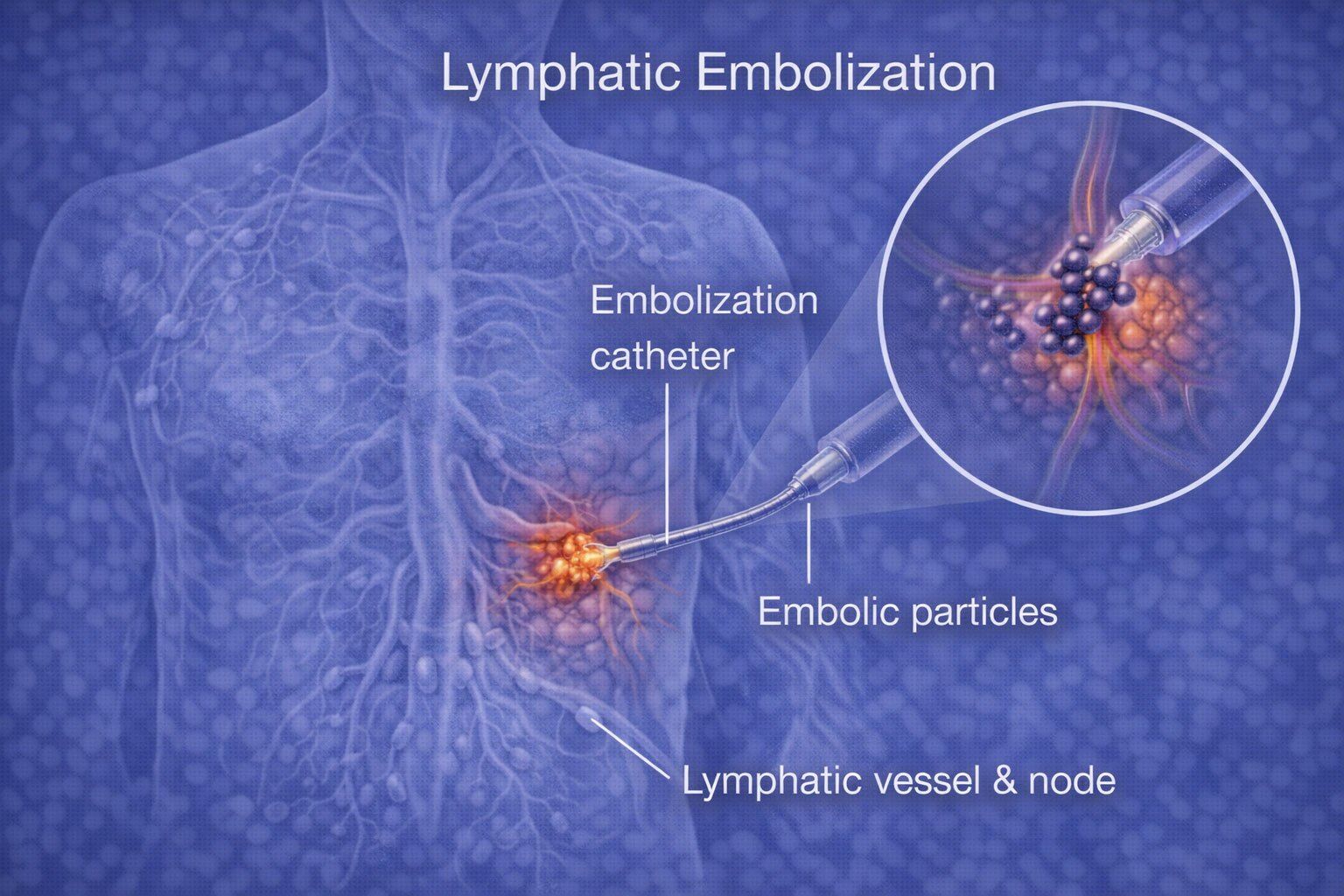
Lymphatic embolization is a minimally invasive, image-guided procedure that seals the leaking lymphatic vessels from inside—often stopping the leak without major surgery and helping patients recover faster.
👉Dealing with persistent lymphatic leak or chylous fluid?

What Is Lymphatic Embolization?

Lymphatic embolization is a procedure where a specialist:

  • Uses advanced imaging to find the exact site of lymph leak, and
  • Injects special medical glue or embolic material to seal the leaking lymphatic vessel

This:

  • Stops ongoing lymph fluid leakage
  • Reduces fluid collections in the chest or abdomen
  • Helps wounds and surgical sites heal

Avoids or reduces the need for open surgery

  • Minimally invasive

  • Image-guided and precise

  • No large cuts or stitches

  • Faster recovery than surgery

Why Is Lymphatic Embolization Done?

Lymphatic embolization is done when:

  • There is a persistent lymphatic leak after surgery or injury
  • You have chylothorax (milky fluid around the lungs)
  • You have chylous ascites (lymph fluid in the abdomen)
  • There is continuous drainage from wounds or drains
  • Conservative treatment (diet changes, medicines, drainage) has not worked
  • The leak is causing breathlessness, swelling, infection risk, or nutrition problems

Common causes include:

  • Chest, neck, or abdominal surgery
  • Trauma or injury
  • Cancer or radiation therapy
  • Congenital lymphatic problems

Main goals:

  • Stop the leak at its source
  • Reduce fluid buildup and symptoms
  • Shorten hospital stay
  • Avoid major surgery

How Is Lymphatic Embolization Done?

The procedure is performed by an interventional radiologist using special imaging techniques such as lymphangiography and X-ray guidance.

Step-by-step:

  • You lie comfortably; local anesthesia and sometimes mild sedation are given
  • The doctor first performs lymphangiography (imaging of lymph vessels) to find the leak
  • A very thin needle or catheter is guided to the leaking lymph vessel
  • Medical glue or embolic material is injected to seal the leak
  • Imaging confirms that the leak has stopped
  • A small bandage is applied; no stitches are usually needed

What Are the Risks?

Lymphatic embolization is generally very safe when done by experienced specialists. Possible risks with approximate incidence include:

  • Mild pain or discomfort at needle site – common (10–20%)
  • Low-grade fever or inflammation – uncommon (5–10%)
  • Skin or soft tissue infection – rare (<1–2%)
  • Allergic reaction to contrast dye – rare (<1%)
  • Non-target embolization (material going to nearby area) – very rare (<1%)
  • Bleeding or bruising at puncture site – uncommon (<3–5%)
  • Need for repeat procedure if leak persists – uncommon (5–15%)

What Are the Alternatives?

Your treatment options depend on:

  • The cause of the lymphatic leak
  • Your symptoms and overall health
  • How severe the fluid buildup is
  • Your personal preferences

Your specialist will help you choose the safest and most effective approach.

Alternative 1: No Active Treatment or Drainage Alone

  • Avoids undergoing any procedure
  • Fluid can be temporarily removed with paracentesis (abdomen) or thoracentesis (chest)
  • Limitation: without treating the cause, the fluid is very likely to come back
  • Repeated fluid buildup can lead to breathing problems, pain, and nutritional loss

Alternative 2: Dietary Treatment or IV Nutrition (TPN)

  • Includes:
    • Low-fat diet with special fats (MCT diet), or
    • Total parenteral nutrition (TPN) given through a vein
  • Avoids a procedure
  • Can reduce lymph flow and allow the leak to heal on its own
  • Limitation: works in only about 3 out of 10 patients
  • TPN also carries additional risks, such as infection or line-related complications

Alternative 3: Surgery (Thoracic Duct Ligation)

  • An open surgical procedure to tie off and block the thoracic duct
  • Often very effective, even when less invasive treatments fail
  • However, surgery:
    • Is more invasive
    • Has a higher risk of complications, seen in about 1 in 3 patients
    • Requires general anesthesia and longer recovery
    •  

Choosing the Right Treatment

Thoracic duct embolization offers a minimally invasive, targeted way to seal the lymphatic leak with lower risk and faster recovery compared to surgery, and with better success than diet or drainage alone. A personalized evaluation helps select the best and safest treatment plan.

📌 When conservative treatment fails, lymphatic embolization is often the best minimally invasive option before surgery.

What Happens After Your Procedure?

After lymphatic embolization:

  • You will be observed in the hospital for a short period
  • Drain output (if you have a drain) usually reduces over days
  • Breathlessness or swelling often improves gradually
  • You may continue dietary advice or medicines for a short time
  • Follow-up imaging or exams may be done to confirm the leak has stopped
  • Most patients can return to normal activities within a few days
  • If needed, a repeat session can be done safely

Frequently Asked Questions (FAQs) – Lymphatic Embolization

Lymphatic embolization is a minimally invasive, image-guided procedure used to seal leaking lymphatic vessels and stop abnormal lymph fluid leakage from the chest, abdomen, or surgical wounds.

It is done to treat persistent lymphatic leaks, such as:

  • Chylothorax (lymph fluid around the lungs)
  • Chylous ascites (lymph fluid in the abdomen)
  • Ongoing drainage after surgery or trauma

Lymph leaks related to cancer or radiation

No. It is a catheter-based, minimally invasive procedure, not open surgery.

It is done under local anesthesia and sometimes mild sedation, so most patients feel only mild discomfort.

The procedure usually takes 1 to 3 hours, depending on how complex the leak is.

Most patients stay in the hospital for 1 to 3 days for observation and to monitor fluid drainage.

In many patients, it significantly reduces or completely stops the lymphatic leak, especially when the leak site is clearly identified.

Drain output or fluid buildup usually starts decreasing within a few days after the procedure.

Possible risks include mild pain, fever, infection, bruising, allergic reaction to contrast dye, or rarely leakage into nearby areas. Serious complications are uncommon.

Alternatives include diet changes, medicines, repeated drainage, or surgical repair, depending on the severity and cause of the leak.

Some patients need their drain for a short time until the leak fully stops, after which it can be removed.

The procedure is performed by a trained interventional radiologist with expertise in lymphatic imaging and interventions.

Yes. When done by experienced specialists, it is safe and effective with low complication rates.

Yes. It is available in advanced interventional radiology centers in India.

In many cases, yes. It can stop the leak without the need for open surgery, reducing recovery time and complications.

Why Choose Lymphatic Embolization?

  • Minimally invasive

  • Targets the leak directly

  • Avoids major surgery in many cases

  • Faster recovery

  • Less pain and fewer complications

  • Proven, modern treatment option

Don’t Let Lymphatic Leaks Delay Your Recovery

Persistent lymphatic leaks can keep you in the hospital, weaken your body, and slow healing. Lymphatic embolization offers a precise, minimally invasive way to stop the leak and get you back on track.

Target the leak. Heal faster. Live better.
Call Now Button