

Chennai-based Endovascular & IR Specialist, Dr. Ravindran Ramalingam offers minimally invasive, scar-free treatments ensuring faster recovery and minimal pain.

Endovascular &
IR Specialist

Center Address
- Gleneagles Health City, Perumbakkam, Chennai, TN
- Maruti Scans, Velachery, Chennai, TN

Hemorrhoid Artery Embolization

A Minimally Invasive, Non-Surgical Treatment for Bleeding Piles

Hemorrhoids (also called piles) are swollen blood vessels around the anus that can cause bleeding, pain, itching, and discomfort.

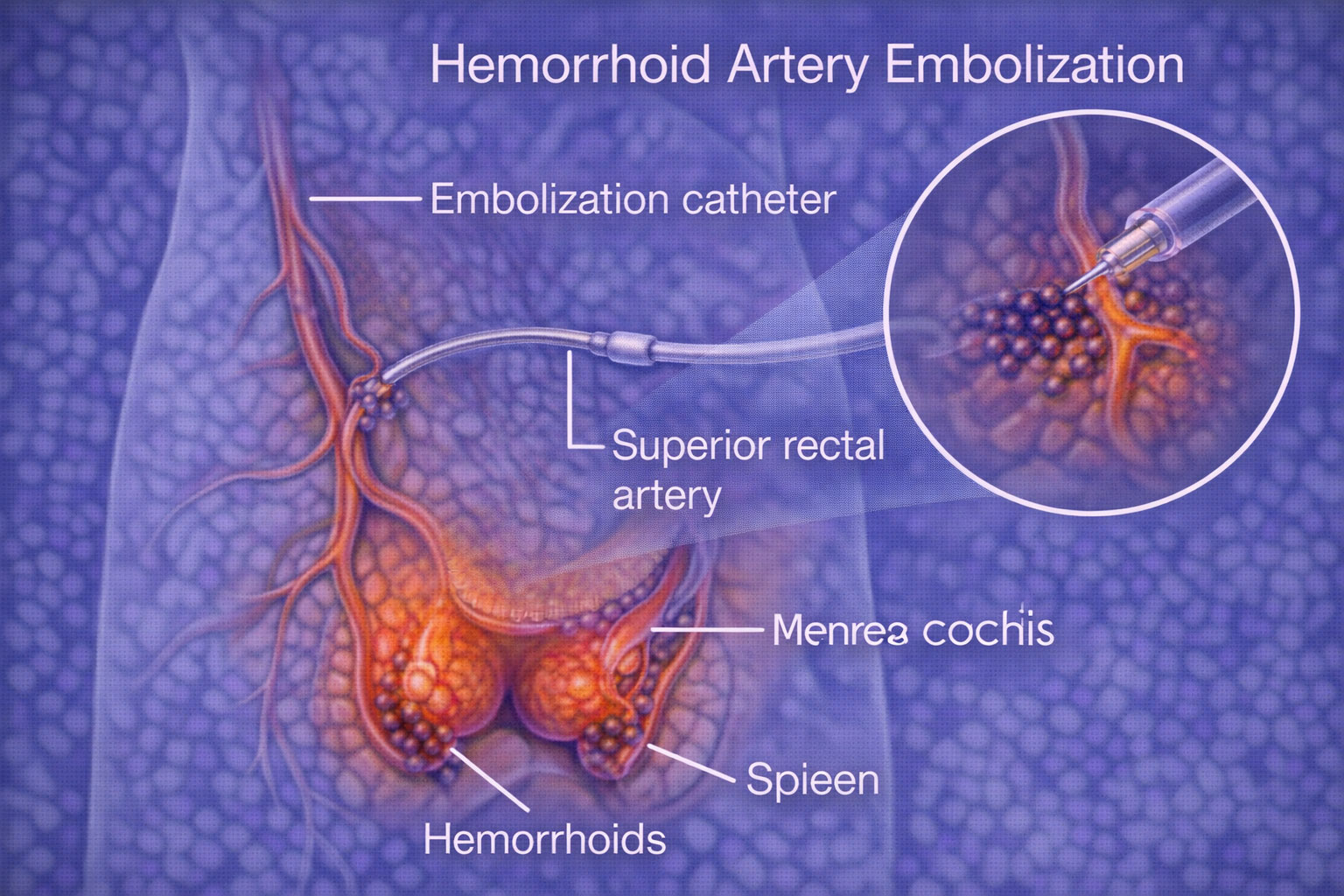
Hemorrhoid artery embolization is a modern, minimally invasive treatment that reduces blood flow to hemorrhoids from inside the blood vessels—without cutting or stitches—helping control bleeding and shrink hemorrhoids with faster recovery than surgery.
👉Troubled by bleeding piles but want to avoid surgery?

What Is Hemorrhoid Artery Embolization?

Hemorrhoid artery embolization (HAE) is a procedure in which a specialist:

  • Enters the blood vessels using a thin tube (catheter), and
  • Blocks the tiny arteries supplying blood to the hemorrhoids using microscopic particles or coils

This:

  • Reduces blood flow to hemorrhoids
  • Stops or greatly reduces bleeding
  • Shrinks the hemorrhoids over time
  • Avoids cutting, stitches, or removal of tissue
  • Non-surgical

  • No cuts or stitches

  • Performed under local anesthesia

  • Faster recovery and less pain than surgery

Why Is Hemorrhoid Artery Embolization Done?

HAE is usually recommended for patients who:

  • Have recurrent or heavy bleeding from hemorrhoids
  • Do not improve with medicines, creams, or rubber banding
  • Want to avoid surgery
  • Are high-risk for surgery due to other medical problems
  • Have anemia (low hemoglobin) due to chronic hemorrhoid bleeding

Main goals:

  • Stop bleeding
  • Shrink hemorrhoids
  • Improve quality of life
  • Avoid painful surgical procedures

How Is Hemorrhoid Artery Embolization Done?

The procedure is performed by an interventional radiologist in a cath lab using X-ray guidance.

Step-by-step:

  • You lie on the procedure table; local anesthesia (and sometimes mild sedation) is given
  • A small tube (catheter) is inserted through an artery in the wrist or groin
  • Using X-ray guidance, the doctor navigates to the arteries supplying the hemorrhoids
  • Tiny embolic particles or coils are released to reduce blood flow to the hemorrhoids
  • The catheter is removed, and a small bandage is applied
  • No cuts or stitches near the anus are needed

What Are the Risks?

Hemorrhoid artery embolization is generally safe in experienced centers. Possible risks with approximate incidence include:

  • Mild pain or discomfort in pelvis/rectal area – common (10–20%)
  • Bruising at wrist or groin puncture site – common (5–10%)
  • Temporary fever or inflammation – uncommon (3–5%)
  • Allergic reaction to contrast dye – rare (<1–2%)
  • Non-target embolization (affecting nearby tissue) – very rare (<1%)
  • Infection – very rare (<1%)
  • Persistent or recurrent symptoms needing repeat treatment – uncommon (5–15%)

What Are the Alternatives?

Your treatment choices for hemorrhoids (piles) depend on:

  • The grade and severity of your hemorrhoids
  • Whether you have bleeding, pain, or prolapse
  • Your overall health and other medical conditions
  • Whether previous treatments have worked or failed
  • Your personal preferences and risk factors

Your specialist will help you decide the safest and most effective option for long-term relief.

Alternative 1: No Active Procedure (Medical Treatment and Observation)

  • Mild hemorrhoids can often be managed with diet changes, fiber supplements, stool softeners, and medications
  • Symptoms can be monitored over time with regular follow-up
  • This approach avoids the risks of procedures or surgery

Limitation:

  • Medical treatment may not control ongoing bleeding or prolapse
  • Symptoms can come back or worsen, and some patients may eventually need a procedure

Alternative 2: Surgical Hemorrhoidectomy

  • An open surgical procedure where the hemorrhoids are removed
  • Can provide a definitive and long-term solution, especially for advanced (Grade III–IV) hemorrhoids

However, compared to minimally invasive treatments, surgery:

  • Is more invasive
  • Has a higher risk of complications such as pain, bleeding, infection, or anal stenosis
  • Requires a longer hospital stay and longer, more painful recovery period

Despite these drawbacks, surgical hemorrhoidectomy has a high success rate in suitable patients.

Choosing the Right Hemorrhoid Treatment

Many patients today benefit from minimally invasive treatments like Hemorrhoid Artery Embolization (HAE), which:

  • Targets the blood supply to bleeding hemorrhoids
  • Offers lower risk, no surgical cuts, and less pain
  • Allows faster recovery and early return to daily activities compared to surgery

A personalized evaluation helps determine the best way to control bleeding, relieve symptoms, and improve quality of life with the safest possible approach.

📌 Compared to surgery, embolization avoids wounds, stitches, and long recovery.

What Happens After Your Procedure?

After hemorrhoid artery embolization:

  • Most patients go home the same day or next day
  • Mild discomfort may last 1–3 days
  • You can usually return to normal activities within a few days
  • Bleeding often reduces quickly and continues to improve over weeks
  • Hemorrhoids shrink gradually over time
  • Follow-up visits check symptom improvement and hemoglobin levels
  • You may still be advised diet changes and fiber intake to prevent recurrence

Frequently Asked Questions (FAQs) – Hemorrhoid Artery Embolization (HAE)

Hemorrhoid artery embolization is a minimally invasive, non-surgical treatment that reduces blood flow to hemorrhoids from inside the blood vessels, helping stop bleeding and shrink piles without cuts or stitches.

HAE is suitable for patients who:

  • Have recurrent or heavy bleeding from hemorrhoids
  • Did not improve with medicines or banding
  • Want to avoid surgery
  • Have anemia due to hemorrhoid bleeding
  • Are high risk for surgery

No. It is a catheter-based, minimally invasive procedure, not open surgery.

It is done under local anesthesia. Most patients feel little to mild discomfort, much less than traditional surgery.

The procedure usually takes 60 to 90 minutes.

Most patients go home the same day or after overnight observation.

In many patients, bleeding reduces immediately or within a few days and continues to improve over the following weeks.

It significantly reduces bleeding and shrinks hemorrhoids. Many patients get long-lasting relief, but diet and lifestyle changes are important to prevent recurrence.

Possible risks include mild pelvic discomfort, bruising at the puncture site, temporary fever, or rarely infection or non-target embolization. Serious complications are very rare.

Yes. When done by experienced specialists, HAE is safe and widely used, with low complication rates.

Most patients return to normal daily activities within a few days.

HAE is non-surgical, has no cuts or stitches, causes less pain, and has faster recovery compared to traditional hemorrhoid surgery.

Recurrence is uncommon, but it can happen. High-fiber diet, good bowel habits, and follow-up reduce the chance of recurrence.

Yes. HAE is available in advanced interventional radiology centers in India.

The procedure is performed by a trained interventional radiologist using image guidance.

Why Choose Hemorrhoid Artery Embolization?

  • Non-surgical treatment

  • No cuts, no stitches

  • Less pain than surgery

  • Faster recovery

  • Effective for bleeding piles

  • Suitable for high-risk surgical patients

Tired of Bleeding Piles?

Chronic hemorrhoid bleeding can lead to anemia, weakness, and poor quality of life. Hemorrhoid artery embolization offers a modern, minimally invasive way to control bleeding and shrink piles—without surgery.

Don’t live with bleeding—safe, effective treatment is available.
Call Now Button