

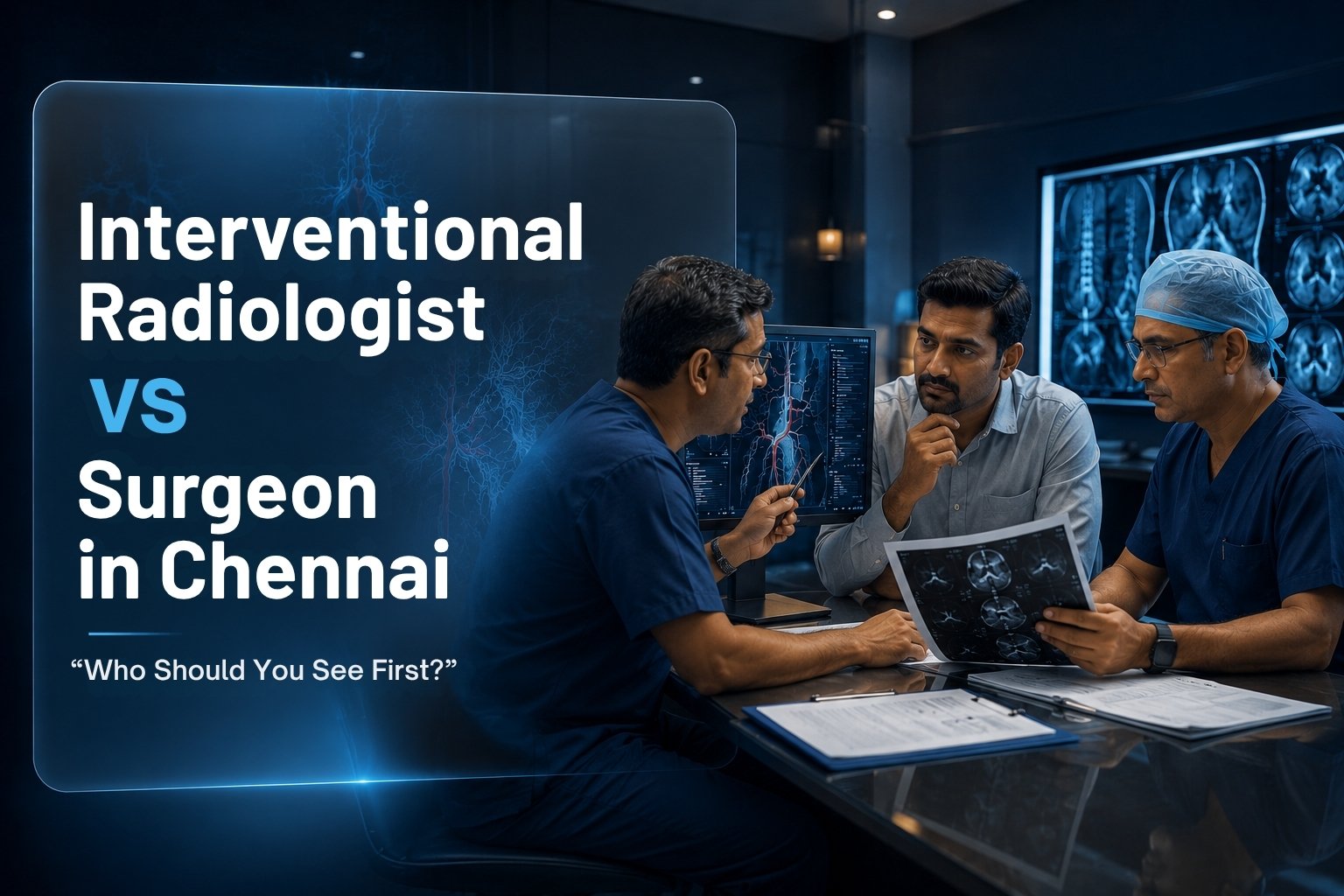
Here is how most people in Chennai end up on a surgery table. Their knee hurts. They go to a GP. The GP sends them to a surgeon. The surgeon recommends an operation. Nobody in that chain ever mentions that an interventional radiologist in Chennai could have treated the same problem through a needle puncture with two days of recovery instead of two months.
This is not a rare situation. It happens constantly. And it happens because most referral pathways in Chennai simply do not include IR specialists.
This guide explains what each specialist actually does, which conditions belong to which doctor, and what one question you should ask before agreeing to any surgical date.
What Does an Interventional Radiologist Do?
An interventional radiologist is a doctor who treats disease from inside the body using live X-ray or ultrasound guidance. They pass a thin catheter through a 2mm needle puncture in the wrist or groin, no surgical cut, no stitches, no theatre admission in most cases.
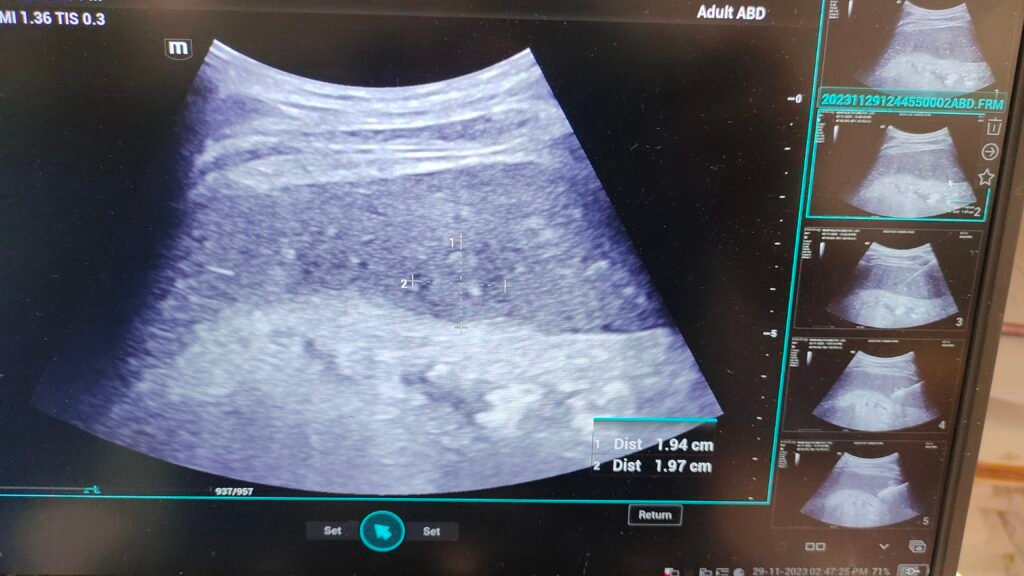
The list of conditions they treat is longer than most people expect:
- Varicose veins
- Uterine fibroids
- Piles (haemorrhoids Grade II and III)
- Varicocele
- Chronic knee pain from osteoarthritis
- Enlarged prostate
- Blocked fallopian tubes
- Liver tumours
- Chronic pelvic pain
Every single one of those through a 2mm hole in the skin.
People Also Ask: What does an interventional radiologist treat?
An interventional radiologist in Chennai treats varicose veins, fibroids, piles, varicocele, knee pain, enlarged prostate, liver tumours, and blocked fallopian tubes. All procedures use a catheter guided through a small needle puncture under local anaesthesia. Most patients go home the same day.
What Does a Surgeon Do and When Are They the Right Choice?
A surgeon is trained to cut, repair, and remove. That is a genuine skill set and there are conditions where nothing else works.
Surgery belongs first when:
- The haemorrhoid is Grade IV, permanently prolapsed and cannot be manually reduced
- Knee arthritis is Grade IV, complete cartilage loss; replacement is genuinely necessary
- Cancer needs tissue removal for staging or excision
- There is a surgical emergency: rupture, trauma, obstruction
- A previous IR procedure did not work
Outside of those situations, the question of whether to see an IR specialist first is worth asking. A surgeon will almost always recommend what they are trained to do. That is not criticism, it is just how specialities work.
Pro Tip: Before any elective surgery date, ask your doctor one direct question “Is there an interventional radiologist I should see about this first?” If the answer is unclear or dismissive, book a separate IR consultation. One appointment. That is all it takes to know whether surgery is genuinely the only path.
The Comparison That Actually Matters
Numbers make this clearer than words do.
| Interventional Radiologist | Surgeon | |
| How it enters the body | 2mm needle puncture | Surgical incision |
| Anaesthesia | Local in most cases | General or spinal |
| Hospital stay | Same day or overnight | 1 to 5 nights |
| Recovery | 1 to 3 days | 2 to 8 weeks |
| Scarring | None | Incision marks |
| Complication risk | Lower overall | Higher wound, anaesthesia |
| Best suited for | Moderate-stage conditions | Severe damage and emergencies |
What the Evidence Shows
The New England Journal of Medicine published a study in 2022 showing that 73% of patients referred for knee replacement improved enough with non-surgical image-guided treatment that surgery was no longer needed two years later. That is not a fringe result it is a major journal finding.
For fibroids specifically, Uterine Fibroid Embolization delivers 90% symptom improvement at 12 months. Compare that to 6 to 8 weeks of recovery after hysterectomy. The outcomes are similar. The recovery is not even close.
How Dr Ravindran Applies This Approach
Chennai-based Dr Ravindran Ramalingam — Endovascular & Interventional Radiologist works exactly this way. He reviews each patient’s imaging personally before the procedure. He treats the specific anatomy in front of him, not a standard protocol. That distinction matters because it is the difference between complete treatment in one session and partial treatment that requires a repeat visit.
Which Conditions Should Go to IR First?
This is the practical list. If your condition is on it, an IR specialist should be part of your conversation before surgery is scheduled.
| Condition | IR Procedure | Recovery |
| Varicose veins | Endovenous Laser Ablation | 24 to 48 hours |
| Uterine fibroids | Uterine Fibroid Embolization | 7 to 14 days |
| Piles Grade II–III | Hemorrhoid Artery Embolization | 2 to 3 days |
| Varicocele | Percutaneous embolization | 1 to 2 days |
| Knee pain moderate | Genicular Artery Embolization | 2 to 3 days |
| Enlarged prostate | Prostate Artery Embolization | 1 to 2 days |
None of these require general anaesthesia. None leave a surgical wound. All are available in Chennai right now.
Why These Procedures Preserve More Than Just Time
These procedures preserve the organ itself. UFE keeps the uterus intact. GAE keeps the knee joint intact. HAE treats the haemorrhoid without removing tissue. For patients who want to avoid permanent structural changes, this matters enormously.
When Should You See a Surgeon First?
Surgery remains the right first choice in specific situations. Do not delay a surgical assessment for these:
- Grade IV haemorrhoids permanently prolapsed, surgery is necessary
- Severe knee arthritis, Grade IV, complete cartilage loss, replacement is appropriate
- Large fibroids requiring tissue diagnosis, biopsy, or surgical excision are needed
- Acute surgical emergencies: appendicitis, bowel obstruction, trauma
- Cancer requiring staging and excision of tissue removal is non-negotiable
An honest IR specialist will tell you directly when surgery is the better path. That transparency is part of what separates a good specialist from a salesperson.
Why Most Chennai Patients Never Hear About IR
The referral system in most Chennai hospitals runs through surgeons. GPs refer to surgeons. Gynaecologists refer to surgical colleagues. The IR specialist sits outside that loop entirely.
This is not a conspiracy. It is simply how medical referral culture developed. Surgeons were there first. IR is newer. Most patients do not know to ask.
What This Costs Patients
The result is that thousands of people in Chennai have surgery every year for conditions that an IR specialist could have treated in 45 minutes with a recovery period measured in days rather than weeks.
The only way around this is to ask specifically. By name. By specialty. That one question changes the entire conversation.
About Dr Ravindran Ramalingam, Interventional Radiologist in Chennai
Dr Ravindran Ramalingam is an Endovascular and Interventional Radiologist at Gleneagles Health City, Perumbakkam, Chennai. He performs the full range of IR procedures for varicose veins, fibroids, piles, knee pain, prostate, and varicocele as day-care treatments.
Key Takeaways
- An IR specialist in Chennai treats 10+ conditions without surgery most patients are never told this
- Recovery after IR is 1 to 3 days versus 2 to 8 weeks after equivalent surgery
- 73% of knee replacement candidates avoided surgery with non-surgical image-guided treatment (NEJM, 2022)
- The referral system defaults to surgeons; you have to ask for IR by name
- One question before every surgery date: “Should I see an interventional radiologist first?”
Frequently Asked Questions
Check your condition and its stage. For moderate varicose veins, fibroids, piles, varicocele, knee pain, and prostate problems, an IR specialist is worth seeing first. For severe structural damage, emergencies, or cancer, a surgeon is the right starting point. When in doubt, one IR consultation gives you a clear answer without committing to anything.
Varicose veins, uterine fibroids, haemorrhoids, varicocele, knee pain, enlarged prostate, liver tumours, blocked fallopian tubes, and chronic pelvic pain. All through a 2mm needle puncture under local anaesthesia. Most patients go home the same day or the next morning
Because GPs and gynaecologists refer to surgeons by default. IR specialists are not part of the standard referral chain in most hospitals in Chennai. Patients only find out about IR when they specifically ask or seek a second opinion from another specialist.
Grade IV haemorrhoids, complete knee cartilage loss, cancers needing tissue removal, acute emergencies, and conditions where previous IR treatment has failed. In these cases, surgery is the right call and an honest IR specialist will tell you so directly.
Dr Ravindran Ramalingam at Gleneagles Health City, Perumbakkam, Chennai. He performs EVLA, UFE, HAE, GAE, and PAE as day-care procedures.
One Last Thing
For conditions like varicose veins, fibroids, piles, and knee pain, an interventional radiologist often offers a shorter path to the same result. You just have to know how to ask for one.
Seeing a surgeon first is the default in Chennai. But default is not the same as best.
Book a consultation with Dr Ravindran Ramalingam
Best Interventional Radiologist In Chennai: Non-Surgical Pin-Hole Treatment Specialist - Dr. Ravindran - Endovascular & Interventional Radiologist
15/09/2026[…] To understand this distinction in full clinical detail, read Interventional Radiologist vs Surgeon in Chennai: Who Should You See First? […]