

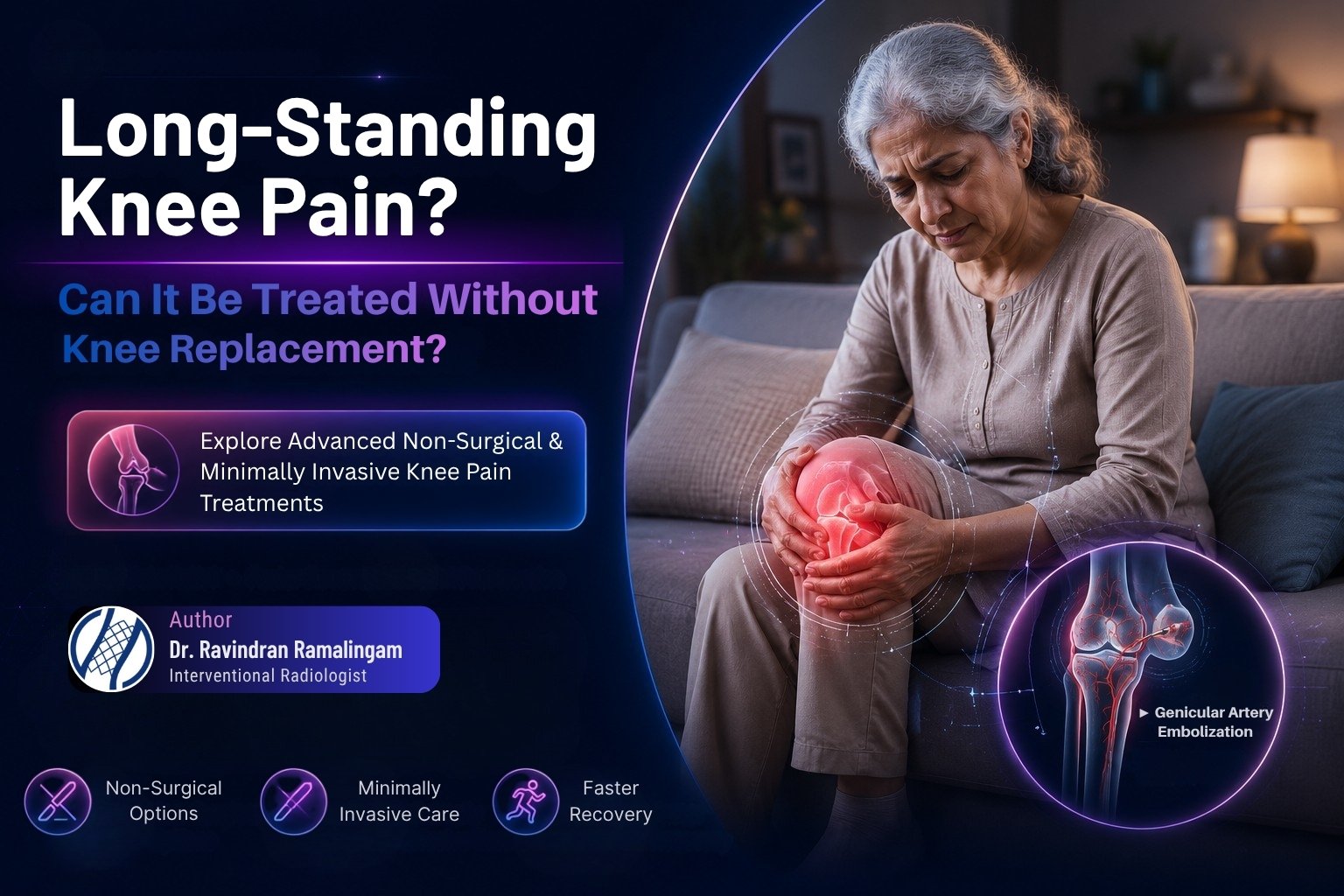
Knee pain that stays for months changes everything. Walking slows down. Climbing stairs becomes a daily struggle. Sitting for just 20 minutes leaves your knees stiff and sore. Many patients assume this means knee replacement. However, that is not always the case. Knee pain treatment without surgery in Chennai works well for many patients, especially when the problem is caught early.
Today, doctors have several strong non-surgical options. These range from physiotherapy and joint injections to a newer procedure called Genicular Artery Embolization. As a result, many patients avoid surgery entirely. This guide explains the causes, the diagnostic process, all available non-surgical options, and when replacement genuinely becomes necessary so that you can make a clear, confident decision.
What Is Chronic Knee Pain?
“Chronic knee pain is joint pain lasting more than three months most commonly caused by osteoarthritis or cartilage wear that limits walking and daily activity, and needs specialist evaluation to find the right treatment.”
| 15% Of adults over 40 have chronic knee pain that limits daily activity (Lancet, 2023) | 73% The number of knee replacement candidates improves enough with non-surgical treatment to avoid surgery (NEJM, 2022) | 70–80% pain improvement after Genicular Artery Embolization at 12 months (JVIR) | 45–60 min average procedure time for GAE same-day discharge, no general anaesthesia |
What Causes Long-Standing Knee Pain?
Most chronic knee pain builds up slowly. It rarely comes from one single injury. Instead, it develops over months or years because of wear, old damage, or alignment problems. Understanding the cause helps doctors choose the right treatment and helps you understand your options.
These are the most common causes:
- Osteoarthritis: The cartilage inside the knee wears down over time. This causes pain when you walk or stand, especially after rest.
- Meniscus degeneration: The cushioning inside the knee weakens or tears. As a result, you feel pain in certain movements.
- Old ligament injuries: Past knee injuries that were not fully treated can continue to cause instability and pain.
- Joint inflammation: The lining of the joint becomes inflamed. This leads to swelling, stiffness, and reduced movement.
- Alignment problems: When one side of the knee carries more weight than the other, it wears out faster.
If your pain has lasted more than three months, it needs proper evaluation, not just painkillers.
Signs You Should Not Ignore
Some symptoms tell you that the problem has moved beyond the early stage. If you notice any of the following, it is time to act:
- You cannot walk more than 500 to 1000 metres without stopping
- Stairs are becoming harder each week
- Your knee feels stiff after sitting for 20 to 30 minutes
- Swelling keeps coming back after activity
- You hear grinding or clicking when you move your knee
- Your knee cannot straighten or bend fully
Important
Painkillers do not treat knee damage. They only hide the pain. Meanwhile, the joint continues to deteriorate. The sooner you get an assessment, the more non-surgical options remain available to you.
People Also Ask: When should I see a doctor for knee pain?
See a specialist when pain has lasted more than three months, limits your walking distance, or stops responding to painkillers. Early assessment keeps your non-surgical treatment options open. Waiting until Grade IV arthritis develops narrows those options significantly.
Key Takeaway
Knee pain that has lasted more than three months is not normal. It needs a proper diagnosis, not continued self-management. Early assessment leads to better outcomes and more treatment choices.
How Doctors Diagnose Your Knee Pain
Diagnosing knee pain is straightforward. Most patients receive a clear answer in a single visit. The specialist uses three simple tools to understand what is happening inside your knee.
| Test | What It Shows | When It Is Used |
|---|---|---|
| X-ray (standing) | Joint space narrowing, arthritis grade, alignment | First step for all chronic knee pain |
| MRI scan | Cartilage quality, meniscus tears, ligament damage | When X-ray alone does not explain symptoms |
| Clinical examination | Range of movement, stability, tenderness | Every consultation |
Pro Tip
Always ask for a weight-bearing X-ray, not a lying-down one. A standing X-ray shows the real joint space under load. Many patients are told their arthritis is mild based on a supine scan. A standing scan often tells a very different story.
Key Takeaway
A weight-bearing X-ray and a clinical examination give the specialist everything needed to confirm your diagnosis and plan your treatment. Most patients leave the first appointment with a clear picture of what is happening and what comes next.
Do You Always Need Knee Replacement?
No. Knee replacement is considered when pain appears even at rest, daily activities become severely limited, and other treatments have stopped working. However, many patients fall between these extremes. Their pain is real and limiting, but their joint is not yet fully destroyed.
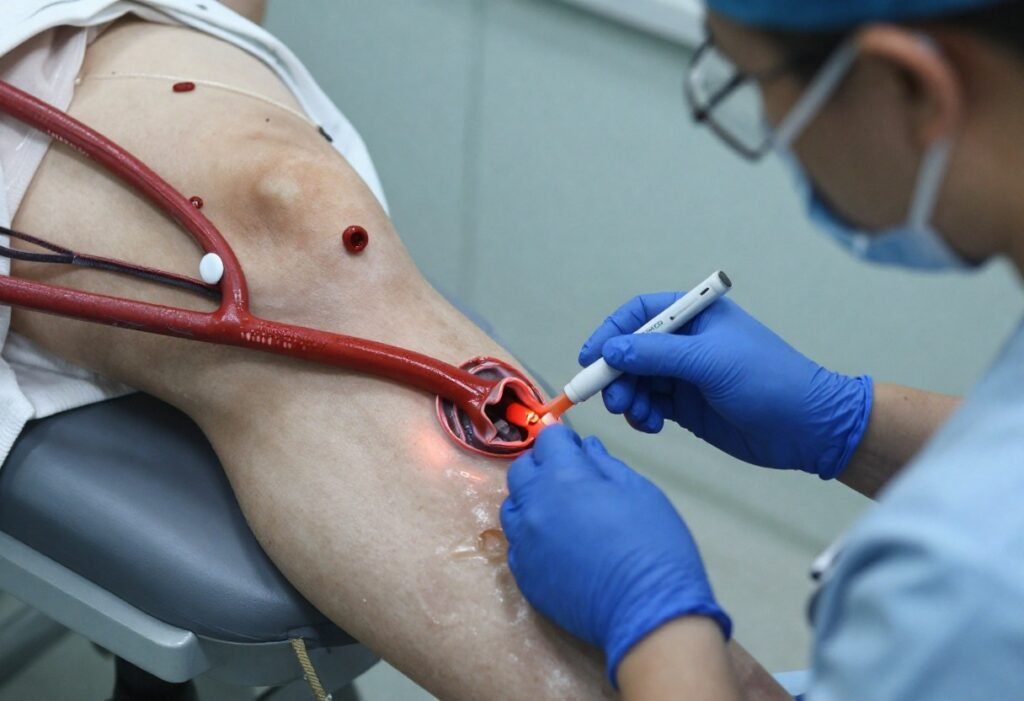
According to the New England Journal of Medicine (2022), 73% of patients who were referred for knee replacement improved enough with structured non-surgical care that they no longer needed surgery after two years. Furthermore, most orthopaedic guidelines now recommend a minimum of three to six months of non-surgical treatment before replacement is considered.
People Also Ask: What grade of arthritis needs a knee replacement?
Knee replacement is generally appropriate for Grade III–IV osteoarthritis where joint space is severely narrowed and daily function is significantly impaired after 3–6 months of non-surgical treatment. Grade I and II and many Grade III cases respond well to physiotherapy, injections, and Genicular Artery Embolization.
Key Takeaway
Surgery is not the automatic next step for every patient with knee pain. For most people with moderate arthritis, non-surgical treatment delivers real improvement and often removes the need for surgery entirely.
Non-Surgical Knee Pain Treatments That Work
Effective knee pain treatment without surgery follows a clear sequence. Each step builds on the one before it. Starting from the simplest measures and progressing only when needed gives the best results.
Step 1: Lifestyle Changes
Simple changes make a measurable difference. Specifically, losing 5 to 10% of your body weight reduces knee stress significantly. Even 4 to 5 kg of weight loss takes meaningful pressure off the joint with every step you take.
- Avoid deep squatting and sitting cross-legged
- Use footwear with good cushioning and arch support
- Break up long periods of sitting with short walks
Pro Tip
Every kilogram you lose reduces the load on your knee by approximately 4 kg per step. Consequently, even modest weight loss creates a significant reduction in daily knee stress — without any medical procedure.
Step 2: Physiotherapy
Physiotherapy plays a major role in knee pain management. A structured programme focuses on three things: strengthening the thigh muscles, improving flexibility, and restoring joint movement. Moreover, following a 6 to 8 week programme consistently produces clear improvement in most patients.
- Quadriceps and hamstring strengthening reduces joint instability
- Gentle flexibility exercises restore range of motion
- Low-impact activity such as swimming or cycling maintains fitness without adding knee load
Step 3: Medications and Injections
When lifestyle changes and physiotherapy are not enough, medications and injections provide additional relief. These work best as part of a broader plan not as a standalone long-term solution.
| Option | How It Helps | How Long It Lasts |
|---|---|---|
| Anti-inflammatory medication | Reduces joint inflammation and pain | 2–6 weeks of use |
| Steroid injections | Rapidly reduces swelling and pain | 6–12 weeks |
| Hyaluronic acid injections | Improves joint lubrication | 3–6 months |
| PRP injections | Growth factors reduce inflammation | 3–6 months |
Common Mistake
Using steroid injections more than three times per year. Repeated steroid injections actually accelerate cartilage breakdown over time. Therefore, if two injections in the same year have not given adequate relief, the treatment plan needs to change not continue.
Key Takeaway
Non-surgical treatments work best in combination. Physiotherapy alone outperforms medication alone. Injections work better when physiotherapy is already underway. Following the sequence, rather than repeating the same treatment, delivers the best outcomes.
Genicular Artery Embolization: A Newer Non-Surgical Option
Genicular Artery Embolization or GAE, is a newer treatment for chronic knee pain. It works for patients who have tried physiotherapy and injections but still have significant pain. Importantly, it does not involve any surgery or general anaesthesia.
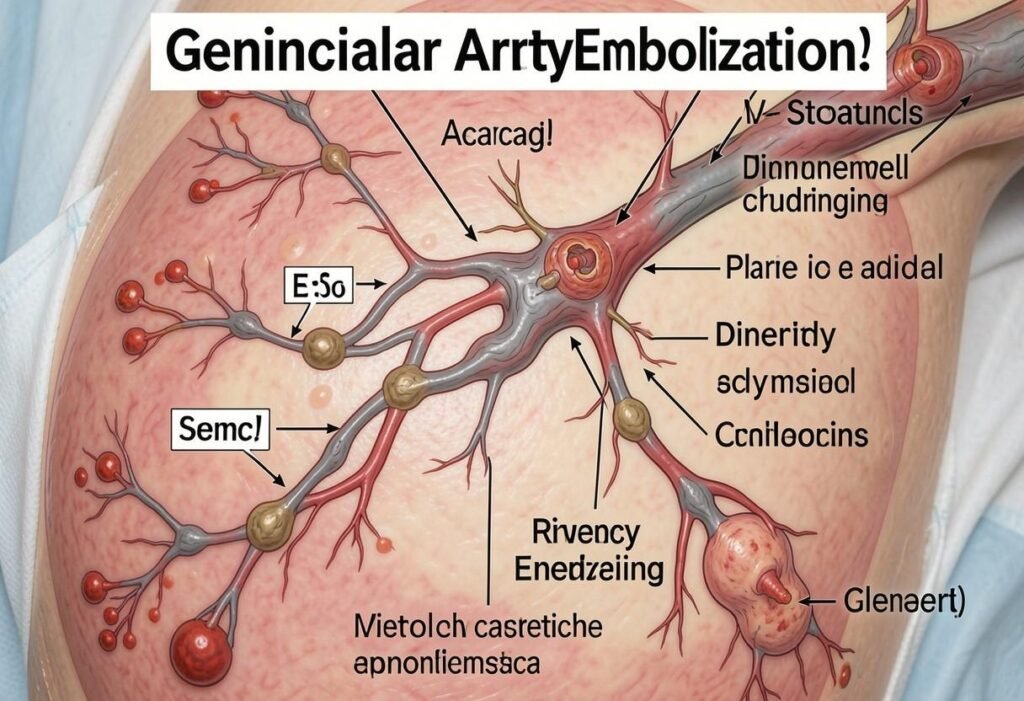
GAE targets the blood vessels that feed the inflammation inside the knee. By reducing blood flow to those specific vessels, the inflammation drops. As a result, pain reduces progressively over four to eight weeks. Research published in the Journal of Vascular and Interventional Radiology shows 70–80% pain improvement at 12 months.
Chennai-based Dr Ravindran Ramalingam — Endovascular & Interventional Radiologist, applies this image-guided approach in clinical practice. By reviewing each patient’s MRI before the procedure and targeting the specific vessels driving their inflammation, he shows how personalised vascular mapping leads to better outcomes than a one-size-fits-all protocol.
What Happens During the Procedure?
- Imaging review. First, the specialist reviews your MRI and X-rays to map which knee arteries need to be treated.
- Small needle access. Next, a 2mm needle puncture is made in the wrist or groin. There is no surgical cut and no stitches.
- Catheter navigation. Under live X-ray, a thin catheter is guided to the genicular arteries supplying the inflamed knee tissue.
- Microsphere injection. Tiny particles are injected to reduce blood flow to the inflamed vessels without affecting normal knee tissue.
- DischargeThe procedure takes 45–60 minutes. Most patients go home the same day. Light activity resumes within 48 hours.
| Feature | GAE | Steroid Injection | Knee Replacement |
|---|---|---|---|
| Anaesthesia | Local only | Local only | General or spinal |
| Hospital stay | Same day | Outpatient | 3–5 nights |
| Recovery time | 2–3 days | Same day | 6–12 weeks |
| Relief duration | 12+ months | 6–12 weeks | Long-term |
| Joint preserved | ✅ Yes | ✅ Yes | ❌ Replaced |
| Success rate | 70–80% at 12m | 60–70% at 8w | 90%+ long-term |
Pro Tip Before Agreeing to Surgery
If your surgeon has recommended knee replacement and you have moderate arthritis, ask one direct question: “Am I a candidate for Genicular Artery Embolization?” If the answer is unclear, book a single consultation with an Interventional Radiologist. One appointment could save you a six-week surgical recovery.
Key Takeaway
GAE fills the gap between injections and surgery. It delivers 12+ months of meaningful relief without touching the joint. It is not suitable for severe Grade IV arthritis, but for Grade II and III patients, it is now a first-line discussion before any surgical referral.
Who Can Benefit from This Treatment?
GAE works best for a specific group of patients. If you match this profile, a specialist assessment will confirm whether it is right for you.
- Knee pain lasting more than 3 to 6 months
- Moderate arthritis, Grade II or III on X-ray
- Physiotherapy and injections have not helped enough
- You want to delay or avoid knee replacement
- No severe joint deformity that requires surgical correction
People Also Ask: Can GAE prevent knee replacement entirely?
For Grade II–III osteoarthritis, GAE can delay or eliminate the need for replacement. At 12-month follow-up, 70–80% of patients report significant pain reduction. However, GAE does not reverse cartilage loss. In Grade IV disease with complete cartilage loss, knee replacement is still the appropriate treatment.
When Surgery Becomes Necessary
Surgery is the right choice in certain situations. These include severe joint damage on imaging, visible knee deformity, pain that wakes you at night, or complete failure of non-surgical treatments over an adequate period. In these cases, knee replacement delivers outcomes that no other treatment can match.
The goal is straightforward: choose surgery only when it is truly needed, not as a first step.
Key Takeaway
Surgery is not the inevitable destination for every knee pain patient. However, when it is genuinely necessary, it should not be delayed. The key is proper staging, knowing exactly where you are on the osteoarthritis scale before committing to any treatment path.
Knee Pain Specialist in Chennai — Dr. Ravindran Ramalingam
Dr. Ravindran Ramalingam is an Endovascular and Interventional Radiologist at Gleneagles Health City, Perumbakkam, Chennai. He provides minimally invasive, image-guided knee pain treatment without surgery for patients with moderate knee osteoarthritis.
His focus is simple: reduce pain, improve movement, and help patients avoid or delay knee replacement whenever possible.
Frequently Asked Questions
How long does knee pain treatment without surgery take to show results?
Physiotherapy shows improvement within 6 to 8 weeks when followed consistently. Joint injections work within 1 to 2 weeks and last 6 to 12 weeks. GAE reduces pain progressively over 4 to 8 weeks, with maximum benefit at 3 to 6 months. Most patients who commit to non-surgical treatment see clear improvement within three months.
What is Genicular Artery Embolization and how is it different from injections?
Joint injections deliver medication into the knee to reduce inflammation temporarily, typically for 6 to 12 weeks. GAE blocks the abnormal blood vessels that drive chronic knee inflammation through a catheter. As a result, GAE lasts much longer, over 12 months in most cases, and works for patients who have stopped responding to repeated injections.
Why does knee pain come back after steroid injections stop working?
Steroid injections suppress inflammation temporarily. However, they do not remove the abnormal blood vessels that continuously produce that inflammation. When the steroid wears off, the same process starts again. GAE targets those vessels directly. Consequently, the relief it provides lasts significantly longer than any injection.
When should I see a knee specialist in Chennai?
Book a specialist assessment when knee pain has lasted more than 3 months, limits your walking distance below 1 km, causes stiffness after 20 minutes of rest, or when painkillers are no longer managing your symptoms. The earlier you come in, the more non-surgical options remain available.
Which non-surgical knee treatment works best for osteoarthritis?
For Grade I–II arthritis, structured physiotherapy combined with weight management delivers the best long-term results. For Grade II–III arthritis where physiotherapy and injections have not helped enough, GAE currently offers the most durable pain relief with 70 to 80% improvement at 12 months and no surgery required.
Key Takeaways Full Summary
- Knee pain lasting more than 3 months needs a proper assessment, not more painkillers
- 73% of knee replacement candidates improve sufficiently with non-surgical treatment (NEJM, 2022)
- The non-surgical sequence is: lifestyle changes → physiotherapy → injections → GAE
- GAE delivers 70–80% pain relief at 12 months as a same-day procedure with 2–3 days recovery
- Never use steroid injections more than 3 times per year they accelerate cartilage damage
- Ask specifically about GAE before accepting a knee replacement recommendation
Conclusion: You Have More Options Than You Think
Knee replacement is not the only answer to long-standing knee pain. For many patients, especially those with moderate arthritis, knee pain treatment without surgery delivers real, lasting results. The key is getting the right diagnosis at the right stage.
A simple weight-bearing X-ray and a specialist consultation give you a clear picture of your knee. From there, you and your doctor can choose the treatment that fits your specific situation whether that is physiotherapy, injections, GAE, or planned surgery.
Do not wait until walking becomes difficult. Early treatment gives you more choices and better outcomes. A single appointment can change your direction entirely.
Ready to Explore Knee Pain Treatment Without Surgery?
Book a consultation with Dr Ravindran Ramalingam, Gleneagles Health City, Chennai
📞 +91 8190 907 908 | Learn About GAE ↗
Medical Disclaimer: This article is for educational purposes only. It is not medical advice. All treatment decisions should be made with a qualified medical specialist after proper clinical assessment and imaging.
Comments are closed