

Chennai-based Endovascular & IR Specialist, Dr. Ravindran Ramalingam offers minimally invasive, scar-free treatments ensuring faster recovery and minimal pain.

Endovascular &
IR Specialist

Center Address
- Gleneagles Health City, Perumbakkam, Chennai, TN
- Maruti Scans, Velachery, Chennai, TN

Abscess Drainage

Image-Guided Abscess Drainage

A Safe, Minimally Invasive Way to Treat Pus Collections Without Surgery

An abscess is a pocket of pus caused by infection. It can happen in the liver, abdomen, pelvis, chest, kidney, or soft tissues and may cause fever, pain, swelling, and weakness.

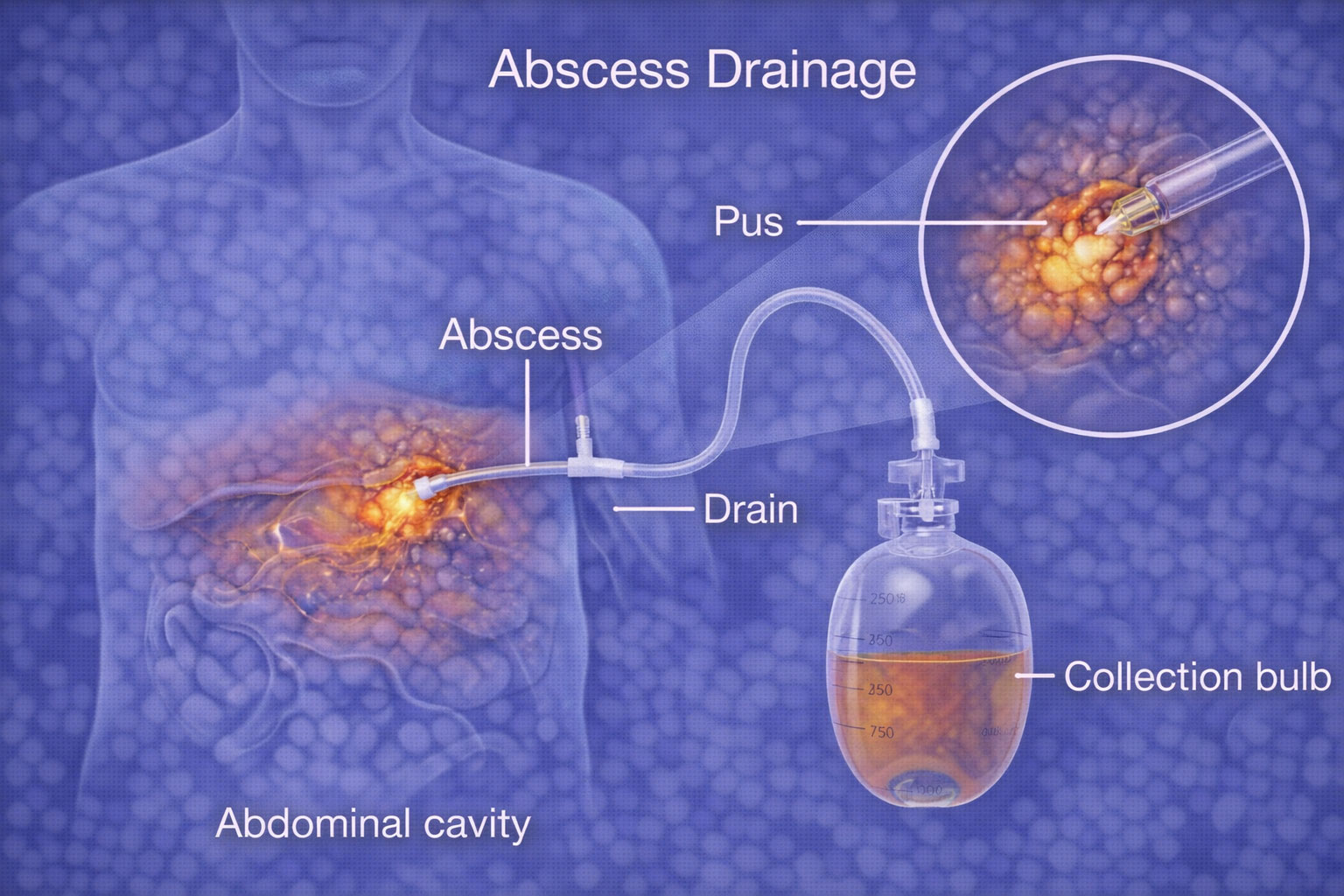
Image-guided abscess drainage is a minimally invasive procedure where doctors use ultrasound or CT scan to safely place a small tube into the abscess and drain the pus—often avoiding open surgery and helping you recover faster.
👉Have fever, pain, or a scan showing an abscess?

What Is Image-Guided Abscess Drainage?

Image-guided abscess drainage is a procedure in which a specialist:

  • Uses ultrasound or CT scan to find the abscess exactly, and
  • Places a thin needle or small tube (catheter) through the skin into the abscess to drain the infected fluid

This:

  • Removes pus and infection
  • Relieves pain and fever
  • Helps antibiotics work better
  • Avoids or reduces the need for surgery
  • Minimally invasive

  • No big cuts or stitches

  • Faster recovery than surgery

  • Can be done under local anesthesia

Why Is Abscess Drainage Done?

Abscess drainage is done when:

  • There is a collection of pus seen on ultrasound or CT scan
  • The patient has fever, pain, or signs of infection
  • Antibiotics alone are not enough to cure the infection
  • The abscess is large, deep, or causing pressure on nearby organs
  • The infection is not improving or is getting worse

Common places for abscesses include:

  • Liver
  • Abdomen or pelvis (after surgery, appendicitis, bowel infection)
  • Kidney
  • Chest (lung/pleural space)
  • Soft tissues

Main goals:

  • Control the infection quickly
  • Prevent spread of infection (sepsis)
  • Reduce pain and fever
  • Avoid major surgery

How Is Image-Guided Abscess Drainage Done?

The procedure is done by an interventional radiologist using ultrasound or CT guidance.

Step-by-step:

  • You lie in a comfortable position; local anesthesia (and sometimes mild sedation) is given
  • The doctor uses ultrasound or CT to locate the abscess precisely
  • A small needle is inserted through the skin into the abscess
  • A thin tube (catheter) may be placed to continuously drain the pus
  • The pus is sent for lab testing to choose the right antibiotics
  • The tube is secured to the skin and connected to a drainage bag (if needed)

What Are the Risks?

Image-guided abscess drainage is generally very safe. Possible risks with approximate incidence include:

  • Pain at the puncture site – common (10–20%)
  • Mild bleeding – uncommon (3–5%)
  • Infection at skin entry site – uncommon (3–5%)
  • Injury to nearby organs – rare (<1–2%)
  • Incomplete drainage or need for repeat procedure – uncommon (5–15%)
  • Allergic reaction to contrast (if CT is used) – rare (<1%)
  • Severe bleeding or sepsis – very rare (<1%)

What Are the Alternatives?

Your treatment options depend on:

  • The size and location of the abscess
  • How severe the infection is
  • Your overall health and medical condition

Your doctor will help you choose the safest and most effective approach.

Alternative 1: Antibiotics Alone (No Drainage)

  • Treats the infection with germ-fighting medicines
  • Avoids placing a drain or performing a procedure
  • In some cases, the abscess may shrink or heal with antibiotics alone
  • Limitation: many abscesses do not fully clear without drainage
  • If the infection continues, it can:
    • Make you more seriously ill
    • Spread to other parts of the body
    • Become life-threatening

Alternative 2: Surgical Drainage (Open Surgery)

  • Involves opening the abscess to remove pus and clean the infected area
  • The surgeon may leave a larger surgical drain in place
  • Advantage: can clear the infection in one operation
  • However, surgery:
    • Requires a larger cut (incision)
    • Needs stitches and longer recovery time
    • Has higher risks compared to minimally invasive drainage
    • May not be safe for very sick or high-risk patients

Choosing the Right Abscess Treatment

Image-guided percutaneous abscess drainage offers a minimally invasive, effective way to control infection with less pain, fewer complications, and faster recovery than open surgery—often combined with antibiotics for the best results.

📌 For most deep or large abscesses, image-guided drainage is safer and less painful than surgery.

What Happens After Your Procedure?

After drainage:

  • Fever and pain usually start improving within 24–72 hours
  • You will continue antibiotics as advised
  • If a tube is left in place, nurses will teach you how to care for it
  • The drainage amount is checked daily
  • The tube is removed once the abscess has collapsed and drainage stops
  • Follow-up scans may be done to confirm healing
  • Most patients return to normal activities in a few days

Frequently Asked Questions (FAQs) – Image-Guided Abscess Drainage

Image-guided abscess drainage is a minimally invasive procedure where doctors use ultrasound or CT scan to safely place a needle or small tube into an abscess to drain pus and treat infection.

You may need drainage if:

  • You have fever, pain, or signs of infection
  • A scan shows a collection of pus
  • Antibiotics alone are not enough
  • The abscess is large, deep, or not improving

No. It is a minimally invasive, needle-and-tube procedure, not open surgery.

It is done under local anesthesia, so you may feel pressure or mild discomfort, but usually no severe pain.

The procedure usually takes 20 to 60 minutes, depending on the size and location of the abscess.

Many patients stay in the hospital for 1 to 3 days, especially if the infection was severe.

Most patients feel less pain and fever within 24 to 72 hours after the abscess is drained.

Some patients need a small tube (catheter) for a few days or longer, depending on the size of the abscess.

Yes. Many patients go home with the tube and return for follow-up and removal.

Possible risks include pain at the site, minor bleeding, skin infection, injury to nearby organs, or the need for repeat drainage. Serious complications are rare.

Alternatives include antibiotics alone (for small abscesses) or surgical drainage, depending on the size and location of the abscess.

Yes. When done by experienced specialists, it is safe, effective, and widely used to treat infections.

Image-guided drainage is less invasive, causes less pain, leaves no big scar, and has faster recovery compared to surgery.

The procedure is performed by a trained interventional radiologist using imaging guidance.

Yes. It is available in major hospitals with interventional radiology services across India.

Why Choose Image-Guided Abscess Drainage?

  • Minimally invasive

  • No big cuts or stitches

  • Faster recovery than surgery

  • Less pain and fewer complications

  • Precise, image-guided treatment

  • Proven and widely used technique

Don’t Ignore an Abscess

An untreated abscess can spread infection and become life-threatening. Image-guided abscess drainage can quickly control the infection and help you recover—often without surgery.

Early treatment means faster healing and fewer complications.
Call Now Button