

Chennai-based Endovascular & IR Specialist, Dr. Ravindran Ramalingam offers minimally invasive, scar-free treatments ensuring faster recovery and minimal pain.

Endovascular &
IR Specialist

Center Address
- Gleneagles Health City, Perumbakkam, Chennai, TN
- Maruti Scans, Velachery, Chennai, TN

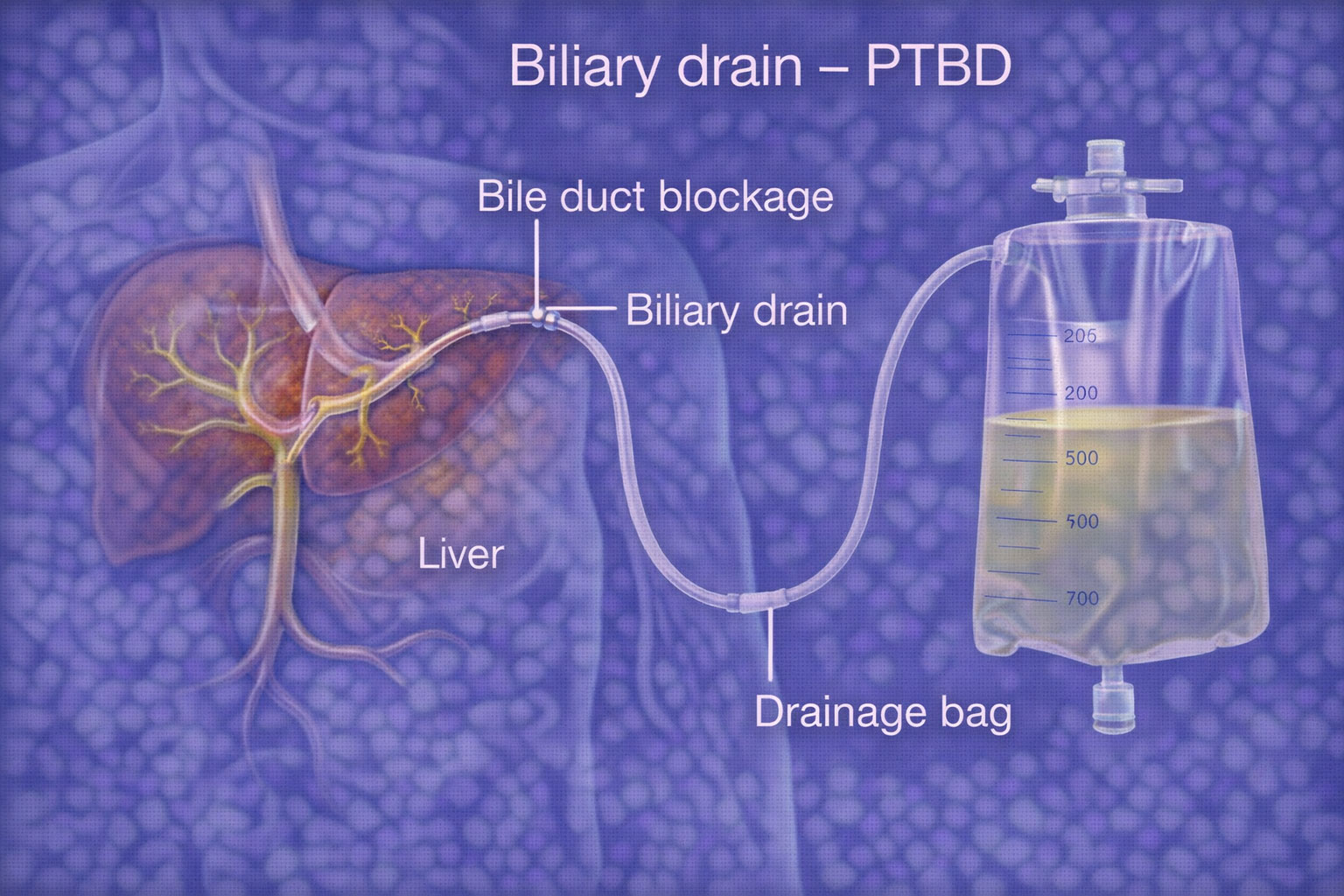
Biliary drain – PTBD

Percutaneous Transhepatic Biliary Drainage & Stenting (PTBD)

A Minimally Invasive Way to Relieve Bile Duct Blockage and Jaundice

When the bile ducts get blocked, bile cannot flow from the liver to the intestine. This can cause jaundice (yellow eyes/skin), itching, infection, pain, and liver damage.

Percutaneous Transhepatic Biliary Drainage & Stenting (PTBD) is a minimally invasive, image-guided procedure that drains bile and/or places a stent to open the blocked bile duct, giving quick relief from jaundice and infection—often without major surgery.
👉Yellow eyes, itching, fever, or bile duct blockage on scan?

What Is Percutaneous Transhepatic Biliary Drainage & Stenting (PTBD)?

PTBD is a procedure where a specialist:

  • Passes a thin tube through the skin and liver into the bile ducts, and
  • Drains the blocked bile outside the body and/or
  • Places a stent (small tube) to keep the bile duct open from inside

This:

  • Relieves jaundice and itching
  • Controls infection (cholangitis)
  • Improves liver function
  • Allows further treatment like surgery or chemotherapy
  • Can be temporary or long-term, depending on the cause
  • Minimally invasive

  • Done under local anesthesia

  • Fast relief from symptoms

  • Life-saving in severe infections

Why Is Percutaneous Transhepatic Biliary Drainage & Stenting Done?

PTBD is done when bile flow is blocked due to:

  • Bile duct stones
  • Cancer of pancreas, bile duct, gallbladder, or liver
  • Strictures (narrowing) after surgery or inflammation
  • Failed or not-possible endoscopy (ERCP)
  • Severe jaundice with infection (cholangitis)
  • Before surgery or chemotherapy to improve liver function

Main goals:

  • Relieve jaundice and itching
  • Treat or prevent serious infection
  • Protect the liver from damage
  • Improve patient’s condition for further treatment

How Is Percutaneous Transhepatic Biliary Drainage & Stenting Done?

The procedure is performed by an interventional radiologist using ultrasound and X-ray (fluoroscopy) guidance.

Step-by-step:

  • You lie on the procedure table; local anesthesia (and sometimes mild sedation) is given
  • Using ultrasound, the doctor inserts a thin needle through the skin into the liver bile ducts
  • Contrast dye is injected to see the blockage on X-ray
  • A thin wire and catheter are guided across the blockage
  • A drainage tube is placed to drain bile outside, or
  • A metal/plastic stent is placed to open the bile duct internally
  • The tube (if placed) is fixed to the skin and connected to a bag

What Are the Risks?

PTBD is generally safe when done by experienced specialists. Possible risks with approximate incidence include:

  • Pain at the puncture site – common (20–30%)
  • Mild bleeding – uncommon (5–10%)
  • Bile leak around the tube – uncommon (5–8%)
  • Infection or fever after procedure – uncommon (5–10%)
  • Significant bleeding needing treatment – rare (<2%)
  • Injury to nearby organs – rare (<1%)
  • Tube blockage or displacement – uncommon (5–10%)

What Are the Alternatives?

Your treatment options depend on:

  • Whether you have a bile duct blockage, infection (cholangitis), or both
  • The cause and level of obstruction
  • Your overall health and urgency of treatment

Your doctor will help you choose the safest and most effective approach.

Alternative 1: No Drain or Stent (Medicines Alone)

  • Uses antibiotics to treat infection
  • Avoids placing a bile duct drain or stent
  • In some patients, infection may improve with medicines alone
  • Limitations:
    • The infection may not fully clear and can become life-threatening
    • If symptoms are due to a blocked bile duct, the blockage can worsen, leading to increasing jaundice, pain, or infection

Alternative 2: ERCP (Endoscopic Bile Duct Treatment)

  • A procedure where a thin camera (endoscope) is passed through the mouth into the stomach and intestine
  • Doctors can locate and open certain bile duct blockages from inside the digestive tract
  • Often the first-line treatment for many bile duct problems
  • Limitation:
    • Not all blockages can be treated with ERCP
    • If ERCP is not successful or not possible, a bile duct drain or stent placed through the skin may be required

Choosing the Right Biliary Drainage Method

For many patients, minimally invasive, image-guided biliary drainage or stenting offers a safe and effective way to relieve bile duct blockage and control infection when ERCP is not suitable or has failed.

📌 When ERCP is not possible or fails, PTBD is often the best and fastest solution.

What Happens After Your Procedure?

After PTBD:

  • Jaundice, itching, and fever usually start improving within a few days
  • You’ll receive antibiotics and pain medicines if needed
  • If you have an external drain, nurses will teach you how to care for it
  • Follow-up scans or X-rays may be done to check bile flow and stent position
  • The external tube may be removed later if an internal stent is working well
  • You can usually return to normal activities in a few days, as advised by your doctor

Frequently Asked Questions (FAQs) – Percutaneous Transhepatic Biliary Drainage & Stenting (PTBD)

PTBD (Percutaneous Transhepatic Biliary Drainage) is a minimally invasive procedure that drains blocked bile and/or places a stent to open a blocked bile duct, helping relieve jaundice, itching, and infection.

PTBD is done to:

  • Relieve jaundice and severe itching
  • Treat or prevent bile duct infection (cholangitis)
  • Improve liver function
  • Allow patients to safely undergo surgery, chemotherapy, or other treatments
  • Treat bile duct blockage when ERCP is not possible or has failed

Common causes include:

  • Bile duct stones
  • Cancer of pancreas, bile duct, gallbladder, or liver
  • Scarring or narrowing after surgery or inflammation
  • Tumor pressing on the bile duct

No. PTBD is a needle-and-catheter, minimally invasive procedure, not open surgery.

It is done under local anesthesia, so you may feel pressure or mild discomfort, but usually no severe pain.

The procedure usually takes 30 to 90 minutes, depending on the type and location of the blockage.

Most patients stay in the hospital for 1 to 3 days, especially if they had infection or severe jaundice.

Many patients notice improvement in jaundice and itching within a few days as bile starts draining properly.

Some patients will have an external drainage tube at first. In many cases, this can later be removed after placing an internal stent.

Possible risks include pain at the puncture site, mild bleeding, infection, bile leak, tube blockage or displacement. Serious complications are uncommon.

Yes. Many patients go home with the tube and come back for follow-up visits and tube or stent management.

You will be taught how to keep the area clean, empty the drainage bag, and watch for signs of infection or blockage.

Alternatives include ERCP (endoscopic drainage/stenting), surgery, or medical treatment, depending on the cause of the blockage.

Yes. When done by experienced specialists, PTBD is a safe and commonly performed procedure, especially in patients with severe jaundice or infection.

Yes. PTBD is available in major hospitals with interventional radiology services across India.

Why Choose PTBD?

  • Minimally invasive

  • Quick relief from jaundice and infection

  • Done under local anesthesia

  • Life-saving in severe bile duct infection

  • Helps prepare for surgery or cancer treatment

  • Proven and widely used procedure

Don’t Ignore Jaundice or Bile Duct Blockage

Blocked bile ducts can damage the liver and cause serious infection. PTBD can quickly relieve the blockage, control infection, and improve your condition—often without major surgery.

Early treatment means safer recovery and better outcomes.
Call Now Button