

Chennai-based Endovascular & IR Specialist, Dr. Ravindran Ramalingam offers minimally invasive, scar-free treatments ensuring faster recovery and minimal pain.

Endovascular &
IR Specialist

Center Address
- Gleneagles Health City, Perumbakkam, Chennai, TN
- Maruti Scans, Velachery, Chennai, TN

Brain AVM Embolization

A Minimally Invasive Way to Treat Abnormal Brain Blood Vessels and Reduce Bleeding Risk 

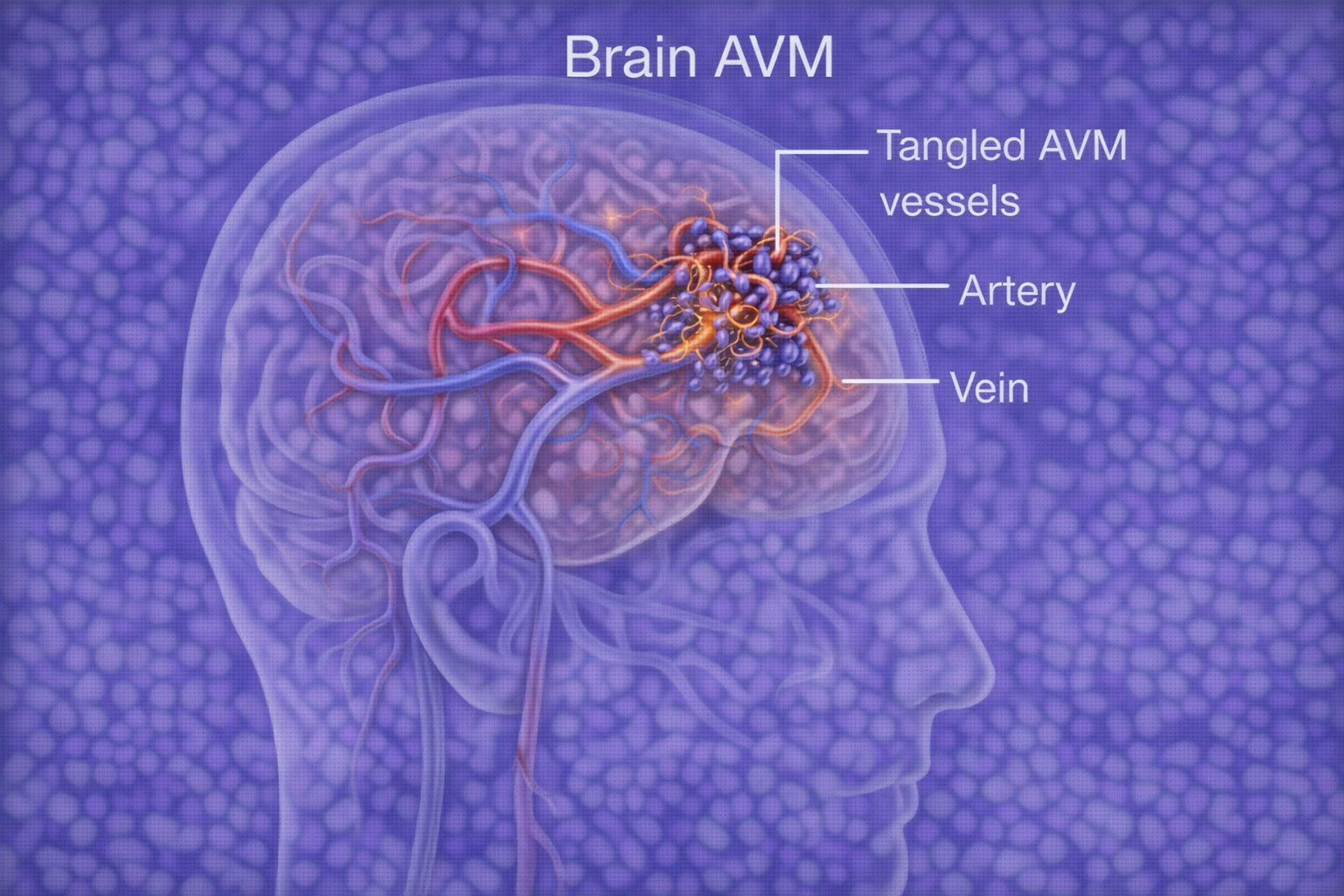
Brain AVM (Arteriovenous Malformation) is an abnormal tangle of blood vessels in the brain that can bleed suddenly and cause stroke, seizures, or brain damage. 

Brain AVM embolization is a modern, minimally invasive treatment that blocks the abnormal blood vessels from inside, helping to reduce the risk of bleeding and often make surgery or radiation safer and more effective. 
👉 Diagnosed with a brain AVM or had a brain bleed/seizure? 

What Is Brain AVM Embolization?

Brain AVM embolization is a procedure where a specialist: 

  • Reaches the AVM from inside the blood vessels using a thin tube (catheter), and 
  • Injects special glue, liquid agents, or tiny particles to block the abnormal vessels 

This: 

  • Reduces blood flow to the AVM 
  • Lowers the risk of bleeding 
  • Can shrink the AVM 
  • Is often used before surgery or radiosurgery to make treatment safer 
  • Minimally invasive
  • No open brain surgery
  • Image-guided and precise
  • Can be part of a combined treatment plan

What Is a Brain AVM?

Brain AVM (Arteriovenous Malformation) is a tangle of abnormal blood vessels where arteries connect directly to veins without normal capillaries. 

Why this is dangerous: 

  • Blood flows too fast and under high pressure 
  • The vessels are weak and can rupture 
  • This can cause brain bleeding (hemorrhage), stroke, seizures, or headaches 

Common symptoms: 

  • Seizures 
  • Severe headache 
  • Weakness, vision, or speech problems 
  • Some AVMs are found by chance on CT or MRI scans 

How Is Brain AVM Embolization Done?

The procedure is performed by a neuro-interventional radiologist in a cath lab using X-ray guidance. 

Step-by-step: 

  • You are given general anesthesia (you will be asleep) 
  • A thin tube (catheter) is inserted through an artery in the groin or wrist 
  • The catheter is guided carefully to the blood vessels of the brain 
  • The doctor reaches the abnormal AVM vessels 
  • Special embolic material (glue, liquid agent, or particles) is injected to block the abnormal flow 
  • Blood flow is checked, and the catheter is removed 
  • A small dressing is applied at the entry site 

What Are the Risks?

Brain AVM embolization is widely performed and generally safe in experienced centers. Possible risks with approximate incidence include: 

  • Groin/wrist bruising or bleeding – common (5–10%) 
  • Headache or nausea after procedure – common (10–20%) 
  • Temporary weakness or speech/vision changes – uncommon (5–10%) 
  • Stroke or brain injury – uncommon (3–7%, varies with AVM complexity) 
  • Bleeding in the brain – uncommon (2–5%) 
  • Infection – rare (<1%) 
  • Need for further treatment sessions – common in large/complex AVMs (20–50% may need staged treatment) 
brain avm embolization chennai

What Are the Alternatives?

Treatment options for a Brain Arteriovenous Malformation (AVM) depend on: 

  • The size and location of the AVM 
  • Whether it has bled (ruptured) or not 
  • Your overall health and symptoms 
  • Your personal preferences and risk factors 

Your specialist will help you choose the safest and most effective treatment for your condition. 

Alternative 1: Observation (Conservative Management) 

  • Some small, low-risk, unruptured AVMs may not need immediate treatment 
  • These can be monitored regularly with MRI, CT, or angiography scans 
  • This avoids the risks of surgery or procedures 

Limitation: 

  • The AVM is still present and carries a risk of brain bleeding, so long-term follow-up is essential 


Alternative 2: Microsurgical Removal (Open Surgery) 

  • brain surgery to completely remove the AVM 
  • Can provide a permanent cure in selected patients 

However, compared to minimally invasive treatments, surgery: 

  • Is more invasive 
  • Has higher risks such as stroke, bleeding, infection, or neurological deficits 
  • Needs a longer hospital stay and recovery 


Alternative 3: Stereotactic Radiosurgery (Gamma Knife / CyberKnife) 

  • non-invasive radiation treatment that gradually closes the AVM over 1–3 years 
  • Useful for small or deep AVMs that are difficult to operate on 

Limitation: 

  • The AVM is not immediately cured, and bleeding risk remains until it fully closes 

Choosing the Right Brain AVM Treatment 

Many patients benefit from minimally invasive endovascular treatments like Brain AVM embolization, which often offer lower risk, less pain, and faster recovery than open surgery. A personalized evaluation helps choose the best way to prevent brain hemorrhage and protect brain function. 

📌 Often, embolization is used as part of a combined treatment plan to get the best and safest result. 

What Happens After Your Procedure?

After brain AVM embolization: 

  • You will be monitored in ICU or special care for 1–2 days 
  • Headache or tiredness may occur for a few days 
  • Most patients stay in hospital for 2–5 days 
  • You may need medicines to prevent seizures or control pain 
  • Follow-up scans are done to check AVM reduction 
  • You may need additional sessions, surgery, or radiosurgery depending on results 
  • Gradual return to normal activities is usually advised over 1–2 weeks 

Frequently Asked Questions (FAQs) – Brain AVM Embolization

Brain AVM embolization is a minimally invasive treatment that blocks abnormal blood vessels inside the brain using special materials to reduce the risk of bleeding and treat an arteriovenous malformation (AVM). 

A brain AVM (arteriovenous malformation) is a tangle of abnormal blood vessels where arteries connect directly to veins, which can rupture and cause brain bleeding, seizures, or stroke. 

It is done to: 

  • Reduce the risk of brain bleeding 
  • Shrink or partially close the AVM 
  • Make surgery or radiosurgery safer 
  • Sometimes completely cure small AVMs 

No. It is a catheter-based, minimally invasive procedure, not open brain surgery. 

No. The procedure is done under general anesthesia, so you won’t feel pain during it. 

It usually takes 1 to 4 hours, depending on the size and complexity of the AVM. 

Most patients stay in the hospital for 2 to 5 days, depending on recovery and AVM complexity. 

Some small AVMs can be completely cured with embolization alone. In many cases, embolization is part of a combined treatment plan with surgery or radiosurgery. 

Possible risks include headache, temporary weakness, stroke, brain bleeding, infection, or need for more treatment. Serious complications are uncommon in experienced centers. 

Many patients, especially with large or complex AVMs, need more than one embolization session or additional treatments like surgery or radiosurgery. 

Success depends on the size, location, and type of AVM. It is very effective in reducing bleeding risk and helping other treatments work better. 

Most patients can return to light activities within 1–2 weeks, depending on recovery and doctor’s advice. 

Yes. Regular MRI or angiography scans are important to check that the AVM is closed or shrinking and not coming back. 

Yes. When done by experienced neuro-intervention specialists, it is a safe and widely used treatment with good outcomes. 

Yes. It is available in advanced neuro-intervention and stroke centers across India. 

Why Choose Angioembolization for Visceral Artery Aneurysm?

  • Minimally invasive
  • No open brain surgery
  • Reduces risk of brain bleeding
  • Helps make surgery or radiation safer
  • Modern, precise, image-guided treatment
  • Shorter recovery than open surgery

Don’t Ignore a Brain AVM

A brain AVM can bleed without warning and cause serious or life-threatening problems. Early, expert treatment can protect the brain and prevent future bleeding.

If you or your loved one has been diagnosed with a brain AVM or has symptoms like seizures or sudden severe headache:
Call Now Button