

Chennai-based Endovascular & IR Specialist, Dr. Ravindran Ramalingam offers minimally invasive, scar-free treatments ensuring faster recovery and minimal pain.

Endovascular &
IR Specialist

Center Address
- Gleneagles Health City, Perumbakkam, Chennai, TN
- Maruti Scans, Velachery, Chennai, TN

Kidney Biopsy

A Simple Test to Find the Exact Cause of Kidney Problems

When blood tests, urine tests, or scans show something wrong with the kidneys, doctors sometimes need a tiny piece of kidney tissue to understand the real cause.

A kidney biopsy is a safe, commonly performed procedure where a small sample of kidney tissue is taken with a thin needle and examined under a microscope to diagnose kidney diseases, inflammation, infection, scarring, or transplant problems.
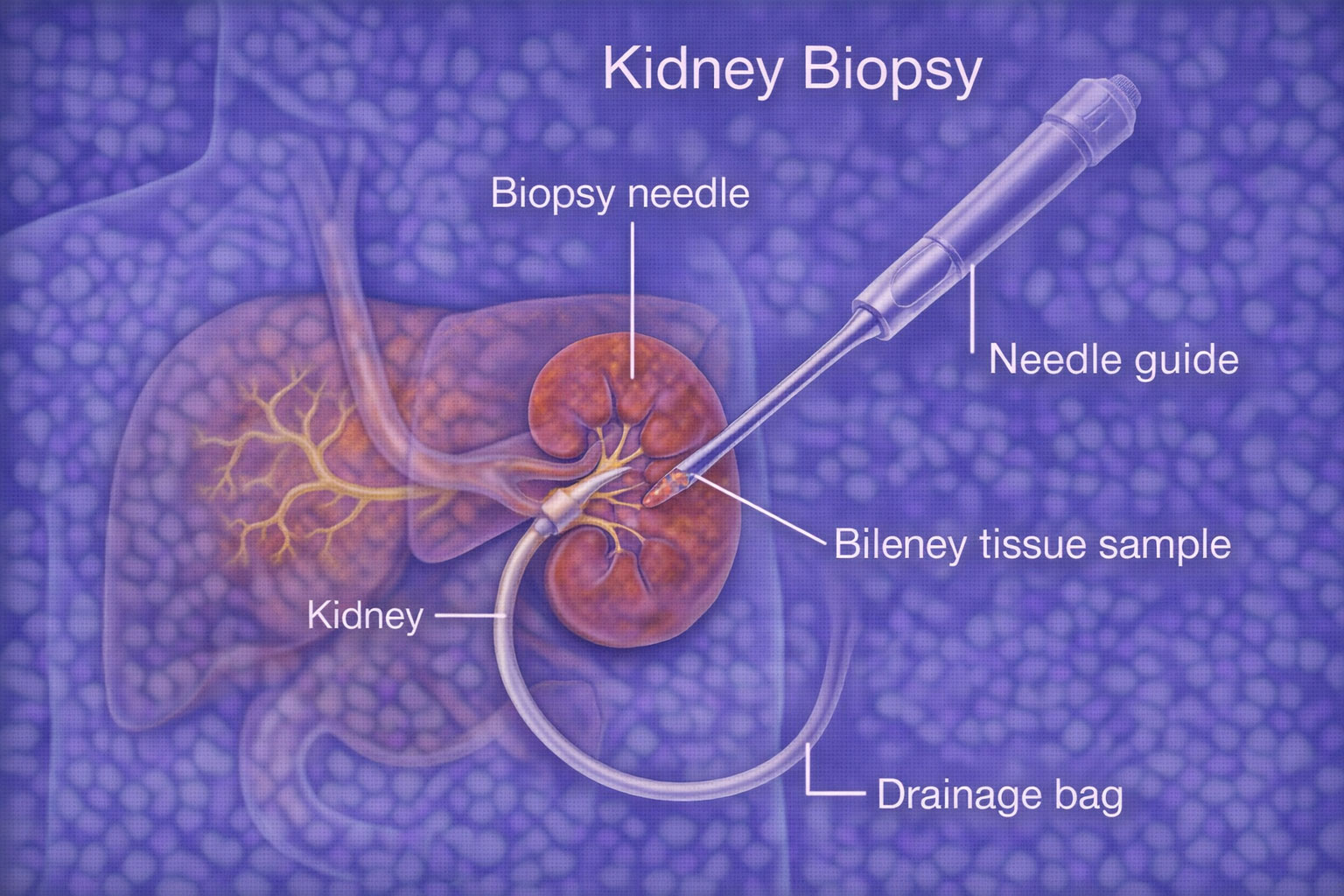
👉Abnormal kidney tests or unexplained kidney disease?

What Is a Kidney Biopsy?

A kidney biopsy is a medical test in which a doctor removes a very small piece of kidney tissue using a thin needle. The sample is studied in the lab to find:

  • Type of kidney disease
  • Amount of inflammation or scarring
  • Cause of protein or blood in urine
  • Reason for kidney failure or worsening kidney function
  • Problems after kidney transplant

Types of kidney biopsy:

  • Ultrasound- or CT-guided needle biopsy (most common)
  • Transjugular biopsy (through a neck vein, in special high-risk cases)
  • Surgical biopsy (rare)
  • Accurate diagnosis

  • Minimally invasive

  • Usually a day-care procedure

  • Guides the right treatment

Why Is Kidney Biopsy Done?

A kidney biopsy is done when:

  • There is unexplained kidney failure or rising creatinine
  • You have protein or blood in urine without a clear cause
  • Doctors suspect glomerulonephritis or other kidney inflammation
  • To check how severe kidney disease is
  • To decide the best treatment (steroids, immunosuppressants, etc.)
  • To check a transplanted kidney if it’s not working well

Main goals:

  • Get a clear and exact diagnosis
  • Know how serious the kidney disease is
  • Choose the right treatment
  • Avoid wrong or unnecessary medicines

How Is Kidney Biopsy Done?

Most kidney biopsies are done by an interventional radiologist or nephrologist using ultrasound or CT guidance.

Step-by-step:

  • You lie on your stomach or side (for native kidney biopsy)
  • The skin is cleaned and local anesthesia is given
  • Ultrasound or CT is used to locate the kidney safely
  • A thin biopsy needle is inserted for a few seconds
  • 1–2 tiny tissue samples are taken
  • The needle is removed and a small dressing is applied
  • You are asked to lie flat and rest for a few hours for observation

What Are the Risks?

Kidney biopsy is generally safe when done by experienced specialists. Possible risks with approximate incidence include:

  • Mild pain at biopsy site – common (20–30%)
  • Blood in urine for 1–2 days – common (10–20%)
  • Small bruise or minor bleeding around kidney – uncommon (5–10%)
  • Significant bleeding needing treatment or transfusion – rare (<1–2%)
  • Infection – very rare (<1%)
  • Need for procedure to stop bleeding – very rare (<1%)
kidney biopsy chennai

What Are the Alternatives?

Your evaluation and treatment options depend on:

  • Your symptoms and overall health
  • The size, location, and appearance of the kidney lesion or abnormal area
  • How likely it is to be a serious condition such as cancer, infection, or kidney disease

Your nephrologist or treating doctor will help you choose the most appropriate approach.

Alternative 1: No Biopsy

  • Avoids undergoing a kidney biopsy procedure
  • However, without a biopsy, doctors may not be able to confirm the exact diagnosis
  • This can lead to delay, uncertainty, or incorrect treatment if the condition needs specific medical care

Alternative 2: Watchful Waiting (Monitoring)

  • Regular follow-up with ultrasound, CT scan, MRI, or blood and urine tests
  • Used to see whether the kidney lesion or abnormality changes in size or behavior over time
  • Avoids immediate invasive testing
  • Main drawback: if the condition is serious (such as kidney cancer or active kidney disease), treatment may be delayed

Alternative 3: Surgical Biopsy or Surgical Removal

  • Involves surgery to remove part or all of the kidney lesion for diagnosis
  • Considered a more invasive option
  • Carries higher risks such as pain, bleeding, infection, and anesthesia-related complications
  • Requires a longer hospital stay and recovery period
  • Surgeons usually prefer a needle (image-guided) kidney biopsy first to confirm the diagnosis before planning major surgery

Making the Right Choice

An image-guided kidney biopsy is a safe, accurate, and minimally invasive way to diagnose kidney diseases and kidney tumors. It helps doctors start the right treatment early while avoiding unnecessary surgery or delays in care.

📌 However, in many kidney diseases, only a biopsy can give a definite and accurate diagnosis.

What Happens After Your Procedure?

After a kidney biopsy:

  • You will be observed for 6–24 hours
  • Your blood pressure, pulse, and urine will be checked
  • Mild pain or soreness may last 1–2 days
  • You should avoid heavy work, exercise, or lifting for 3–5 days
  • Most patients go home the same day or next day
  • The biopsy report usually comes in 3–7 days
  • Your doctor will explain the result and start or adjust treatment

Frequently Asked Questions (FAQs) – Kidney Biopsy

A kidney biopsy is a medical test in which a small piece of kidney tissue is taken using a thin needle and examined under a microscope to find the exact cause of kidney disease.

Doctors recommend a kidney biopsy to:

  • Find the cause of protein or blood in urine
  • Diagnose kidney inflammation (glomerulonephritis)
  • Check unexplained kidney failure or rising creatinine
  • Know how severe the kidney disease is
  • Decide the best treatment plan
  • Check a transplanted kidney if it is not working well

It is done under local anesthesia, so you may feel pressure or brief discomfort, but usually no severe pain.

No. It is a minimally invasive, needle-based procedure, not open surgery.

The procedure usually takes 20 to 30 minutes.

Many patients go home the same day or after overnight observation, depending on their condition.

Most reports are ready in 3 to 7 days, depending on special tests needed.

Kidney biopsy is very safe when done by experienced doctors. Serious complications are rare.

Possible risks include mild pain, blood in urine, small bleeding around the kidney, or rarely significant bleeding. Most problems are temporary.

A small amount of blood in urine for 1–2 days is common and usually goes away on its own.

Alternatives include blood tests, urine tests, ultrasound, CT, MRI, and special kidney tests, but often only a biopsy gives a definite diagnosis.

Most people can return to light activities in 1–2 days, but should avoid heavy work for 3–5 days.

Your doctor will explain the report and start the right treatment as early as possible.

Permanent damage is very rare. The amount of tissue taken is very small and does not affect kidney function.

Yes. Kidney biopsy is widely available in hospitals and nephrology centers across India.

Why Choose an Image-Guided Liver Biopsy?

  • Accurate diagnosis
  • Minimally invasive
  • No big surgery
  • Quick recovery
  • Safe and commonly performed
  • Helps choose the right treatment

Worried About Your Kidney Tests or Kidney Function?

A kidney biopsy can give clear answers and help your doctor start the right treatment at the right time.

Early and accurate diagnosis can protect your kidneys and your future health.
Call Now Button