

Chennai-based Endovascular & IR Specialist, Dr. Ravindran Ramalingam offers minimally invasive, scar-free treatments ensuring faster recovery and minimal pain.

Endovascular &
IR Specialist

Center Address
- Gleneagles Health City, Perumbakkam, Chennai, TN
- Maruti Scans, Velachery, Chennai, TN

Liver Biopsy

A Simple Test to Find the Exact Cause of Liver Disease

When blood tests or scans show a problem in the liver, doctors sometimes need a small piece of liver tissue to know exactly what’s going on.

A liver biopsy is a safe, commonly done procedure where a tiny sample of liver tissue is taken and examined under a microscope to diagnose fatty liver, hepatitis, fibrosis, cirrhosis, infections, or cancer.
👉Abnormal liver tests or a liver spot on scan?

What Is a Liver Biopsy?

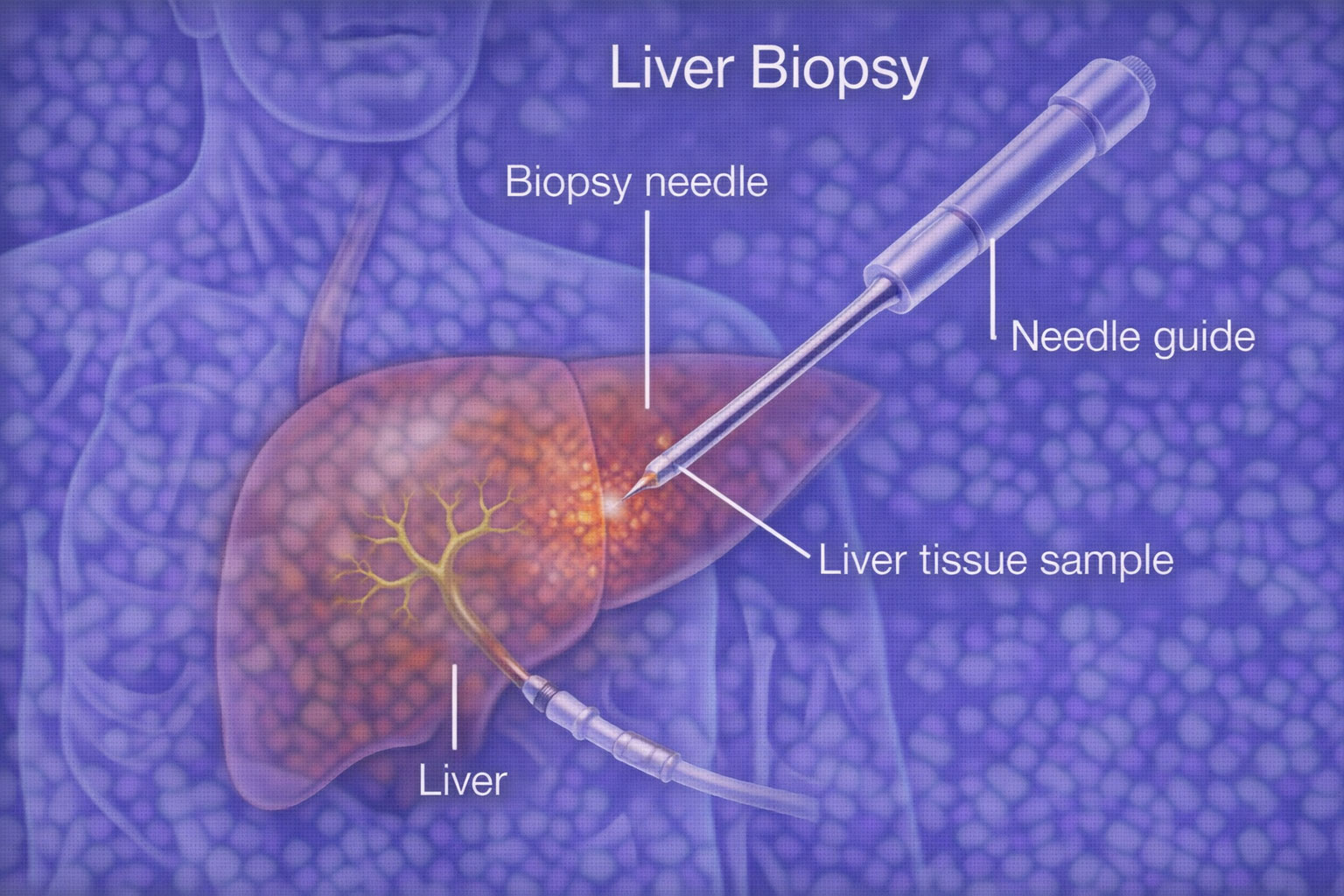
A liver biopsy is a medical procedure in which a doctor takes a small sample of liver tissue using a thin needle. The sample is sent to the lab to check:

  • Inflammation or infection (like hepatitis, TB, etc.)
  • Fatty liver disease
  • Fibrosis or cirrhosis (scarring of the liver)
  • Liver tumors or cancer
  • Cause of abnormal liver function tests

Types of liver biopsy:

  • Ultrasound- or CT-guided needle biopsy (most common)
  • Transjugular liver biopsy (through a neck vein, in special cases)
  • Surgical biopsy (rare, during surgery)
  • Accurate diagnosis
  • Minimally invasive
  • Usually a day-care procedure
  • Guides the right treatment

Why Is Liver Biopsy Done?

A liver biopsy is done when:

  • Blood tests show unexplained liver problems
  • Scans show a liver mass or abnormal area
  • Doctors need to confirm fatty liver, hepatitis, or cirrhosis
  • To check the stage of liver disease
  • To find the cause of chronic liver disease
  • To decide the best treatment plan

Main goals:

  • Get a clear and correct diagnosis
  • Know how severe the liver disease is
  • Start the right treatment early
  • Avoid wrong or unnecessary treatments

How Is Liver Biopsy Done?

Most liver biopsies are done using ultrasound or CT guidance by an interventional radiologist.

Step-by-step:

  • You lie comfortably on the bed
  • The skin is cleaned and local anesthesia is given
  • Ultrasound or CT is used to locate the exact area in the liver
  • A thin biopsy needle is inserted for a few seconds
  • A tiny piece of liver tissue is taken
  • The needle is removed, and a small dressing is applied
  • You are observed for a few hours afterward

What Are the Risks?

Liver biopsy is generally safe when done by experienced specialists. Possible risks with approximate incidence include:

  • Mild pain at biopsy site or right shoulder – common (20–30%)
  • Small bruise or minor bleeding – uncommon (5–10%)
  • Significant internal bleeding – rare (<1–2%)
  • Infection – very rare (<1%)
  • Injury to nearby organs – very rare (<1%)
  • Drop in blood pressure or dizziness – uncommon (<2–3%)
liver biopsy chennai

What Are the Alternatives?

Your treatment and testing options depend on:

  • Your symptoms and overall health
  • The size, location, and appearance of the liver lesion or abnormal area
  • How likely it is to be a serious condition such as cancer, infection, or chronic liver disease

Your doctor will help you choose the most appropriate approach.

Alternative 1: No Biopsy

  • Avoids undergoing a liver biopsy procedure
  • However, without a biopsy, doctors may not be able to confirm the exact cause of the liver problem
  • This can lead to delay, uncertainty, or incorrect treatment if the condition needs specific medical care

Alternative 2: Watchful Waiting (Monitoring)

  • Regular follow-up with ultrasound, CT scan, MRI, or blood tests
  • Used to check whether the liver lesion or abnormality changes in size or behavior over time
  • Avoids immediate invasive testing
  • Main drawback: if the condition is serious (such as cancer or active liver disease), treatment may be delayed

Alternative 3: Surgical Biopsy or Surgical Removal

  • Involves surgery to remove part or all of the liver lesion for diagnosis
  • Considered a more invasive option
  • Carries higher risks such as pain, bleeding, infection, and anesthesia-related complications
  • Requires a longer hospital stay and recovery period
  • Surgeons usually prefer a needle (image-guided) liver biopsy first to confirm the diagnosis before planning major surgery

Making the Right Choice

An image-guided liver biopsy is a safe, accurate, and minimally invasive way to diagnose liver diseases and liver tumors. It helps doctors start the right treatment early while avoiding unnecessary surgery or delays in care.

📌 However, only a biopsy can give a definite tissue diagnosis in many cases.

What Happens After Your Procedure?

After a liver biopsy:

  • You will be observed for 4–6 hours
  • Mild pain or discomfort may last a day or two
  • Avoid heavy work or exercise for 24–48 hours
  • You can usually go home the same day
  • The biopsy report usually comes in 3–7 days
  • Your doctor will explain the result and plan further treatment

Frequently Asked Questions (FAQs) – Liver Biopsy

A liver biopsy is a medical test in which a small piece of liver tissue is taken using a thin needle and examined under a microscope to find the exact cause of liver disease.

Doctors recommend a liver biopsy to:

  • Find the cause of abnormal liver tests
  • Diagnose fatty liver, hepatitis, fibrosis, or cirrhosis
  • Check a liver mass or tumor
  • Stage (measure severity of) liver disease
  • Decide the best treatment plan

It is done under local anesthesia, so you may feel pressure or mild discomfort, but usually no severe pain.

No. It is a minimally invasive, needle-based procedure, not open surgery.

The procedure usually takes 15 to 30 minutes.

Most patients go home the same day after a few hours of observation.

Most reports are ready in 3 to 7 days, depending on the tests needed.

Liver biopsy is very safe when done by experienced doctors. Serious complications are rare.

Possible risks include pain, small bleeding, bruising, infection, or rarely significant internal bleeding. Most problems are mild and temporary.

Both are image-guided methods to make the biopsy more accurate and safer. The choice depends on the location of the liver lesion.

Alternatives include blood tests, FibroScan, ultrasound, CT, or MRI, but in many cases, only a biopsy can give a definite diagnosis.

Your doctor will usually ask you to fast for a few hours before the procedure.

Most people can return to normal activities the next day, but should avoid heavy work for 24–48 hours.

Sometimes, more tests or a repeat biopsy may be needed to get a clear diagnosis.

Yes. Liver biopsy is widely available in hospitals and diagnostic centers across India.

Why Choose an Image-Guided Liver Biopsy?

  • Accurate diagnosis
  • Minimally invasive
  • No big surgery
  • Quick recovery
  • Safe and commonly performed
  • Guides the right treatment

Worried About Your Liver Tests or Scan?

A liver biopsy can give clear answers and help your doctor start the right treatment at the right time.

Early diagnosis means better care and better outcomes.
Call Now Button