

Chennai-based Endovascular & IR Specialist, Dr. Ravindran Ramalingam offers minimally invasive, scar-free treatments ensuring faster recovery and minimal pain.

Endovascular &
IR Specialist

Center Address
- Gleneagles Health City, Perumbakkam, Chennai, TN
- Maruti Scans, Velachery, Chennai, TN

Mechanical Thrombectomy for Stroke

A Life-Saving Emergency Treatment to Restore Blood Flow to the Brain 

A stroke is a medical emergency. When a large blood clot blocks an artery in the brain, every minute matters. 

Mechanical thrombectomy is a minimally invasive, advanced procedure that can physically remove the clot, restore blood flow, and significantly reduce disability or save life—even when medicines alone are not enough. 
👉 Sudden weakness, speech difficulty, or facial droop? 

What Is Stroke Mechanical Thrombectomy?

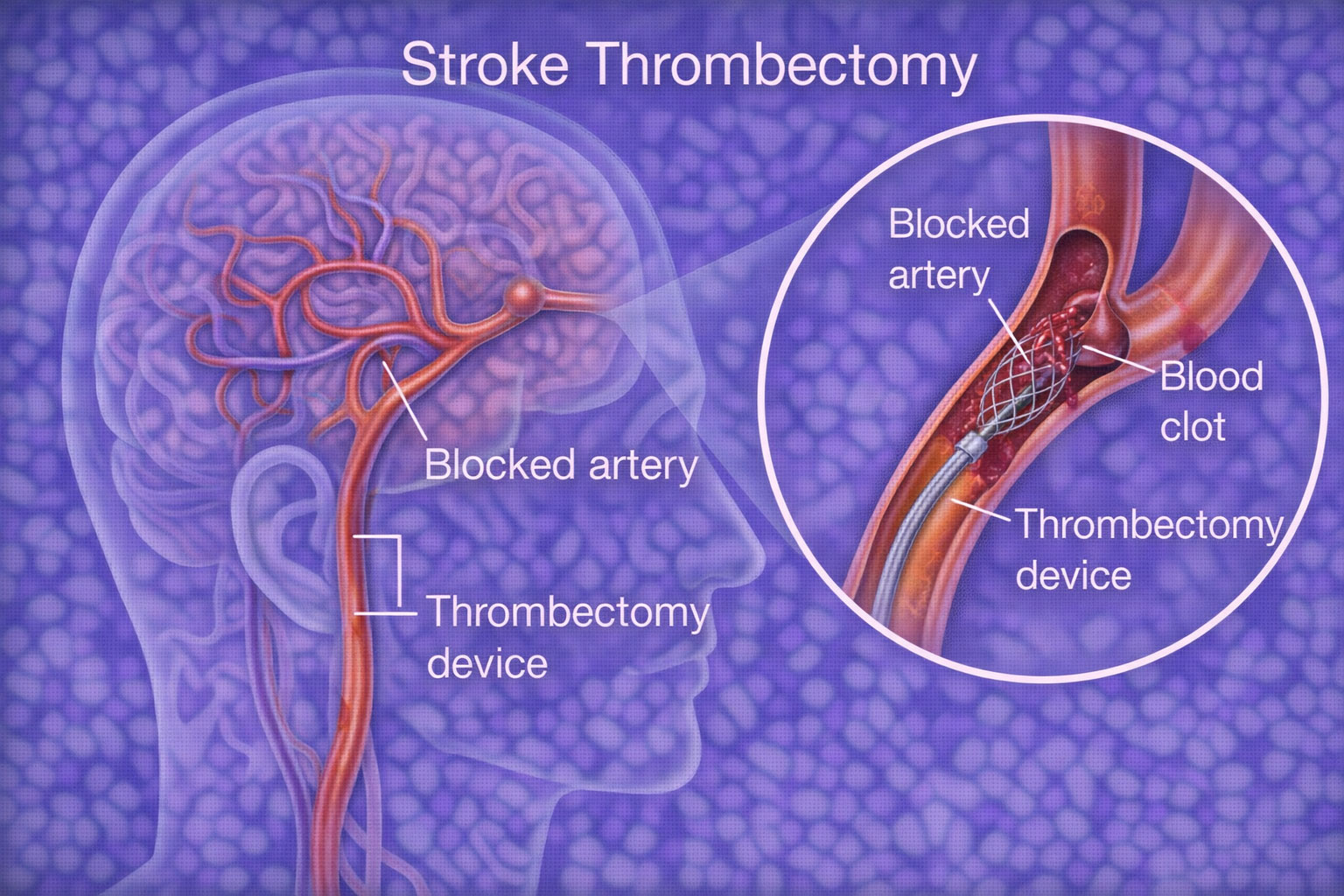
  • Mechanical thrombectomy is an emergency, image-guided procedure used to remove a large blood clot from a brain artery in patients with acute ischemic stroke. 

    This treatment: 

    • Reopens blocked brain arteries 
    • Restores blood supply 
    • Limits brain damage 
    • Improves chances of recovery 
  •  Performed through blood vessels (no brain surgery)
  •  Proven to reduce long-term disability
  • Can be life-saving 

Why Is Mechanical Thrombectomy for Stroke Done?

Mechanical thrombectomy is done for patients who have: 

  • Acute ischemic stroke caused by a large artery blockage in the brain 
  • Severe symptoms like paralysis, speech loss, or decreased consciousness 
  • Poor or no response to clot-busting injection (thrombolysis), or 
  • Arrive within the treatment time window (often up to 6–24 hours in selected cases) 

Main goals: 

  • Open the blocked brain artery quickly 
  • Reduce brain damage 
  • Improve chances of survival 
  • Reduce long-term disability 
  • Help patients return to independent life 

How Is Stroke Mechanical Thrombectomy Done?

Mechanical thrombectomy is performed by a trained neuro-interventional radiologist in a specialized stroke center. 

Step-by-step process: 

  • Patient is taken to the angiography suite urgently 
  • Local anesthesia or general anesthesia is given 
  • A thin tube (catheter) is inserted through an artery in the groin or wrist 
  • The catheter is guided to the blocked brain artery using live X-ray 
  • A special device (stent retriever / aspiration catheter) removes the clot 
  • Blood flow is restored immediately 
  • Catheter is removed and pressure applied 

What Are the Risks?

Mechanical thrombectomy is a proven and safe procedure when done by experienced teams. 
However, as with any emergency procedure, risks may occur. 

Possible risks with approximate incidence include: 

  • Bleeding in the brain – uncommon (5–7%) 
  • Blood vessel injury – rare (<3%) 
  • New stroke in another vessel – rare (<2%) 
  • Contrast dye reaction – rare (<1%) 
  • Infection or access-site bleeding – rare (<1%) 
  • Failure to retrieve clot – uncommon (10–15%) 

What Are the Alternatives?

Treatment choices depend on: 

  • Your overall health and severity of the stroke 
  • The size and location of the clot 
  • How serious your symptoms are 
  • Your personal preferences 

Each option has different benefits and risks. 

Alternative 1: No Active Treatment (Supportive Care Only) 

  • Avoids the risks and discomfort of medications or procedures 
  • However, this option carries a much higher risk of poor recovery 
  • Increased chance of permanent disability 
  • Higher risk of death compared to active stroke treatment 

This option is usually considered only when treatment risks are too high. <br>

Alternative 2: Clot-Busting Medicine (tPA) Alone 

  • Uses tPA (tissue plasminogen activator) to dissolve the clot 
  • Avoids an invasive procedure 
  • Risk of serious bleeding is similar to undergoing a procedure 
  • Generally less effective than clot removal procedures for large clots 

Expected outcomes: 

  • Death within 3 months occurs in about 2 in 10 patients versus 1 in 10 patients in mechanical thrombectomy. 
  • Recovery to independent living occurs in about 3 in 10 patients versus 5 in 10 patients in mechanical thrombectomy. 

Making the Right Stroke Treatment Decision 

Mechanical thrombectomy offers a better chance of survival and independence compared to medication alone in selected patients. Rapid assessment by a specialist stroke team is essential to choose the safest and most effective treatment. 

📌 For large vessel blockagesmechanical thrombectomy is superior to medicines alone. 

What Happens After Your Procedure?

Post-procedure care is crucial for recovery. 

After thrombectomy: 

  • Patient is monitored in ICU or stroke unit 
  • Brain scan is repeated to assess results 
  • Blood pressure and neurological status are closely watched 
  • Rehabilitation (physiotherapy, speech therapy) begins early 
  • Recovery varies based on stroke severity and timing 

Many patients experience: 

  • Improved movement 
  • Better speech 
  • Reduced long-term disability 

Frequently Asked Questions (FAQs) – Stroke Mechanical Thrombectomy

Mechanical thrombectomy is an emergency, minimally invasive procedure used to remove a blood clot from a brain artery in patients with ischemic stroke. It restores blood flow and helps prevent permanent brain damage. 

Mechanical thrombectomy is used for ischemic stroke caused by a large artery blockage in the brain. It is not used for bleeding (hemorrhagic) strokes. 

As early as possible. Best results occur when done within 6 hours of symptom onset, but selected patients may benefit up to 24 hours after stroke symptoms begin. 

Eligibility depends on: 

  • Sudden stroke symptoms 
  • Brain imaging showing a large vessel blockage 
  • Amount of salvageable brain tissue 
  • Time since symptom onset 

A stroke team decides eligibility after urgent scans. 


Yes. When performed by experienced neuro-interventional specialists, it is safe and evidence-based. Serious complications are uncommon, and benefits often outweigh risks. 

For large vessel strokes, mechanical thrombectomy is more effective than clot-busting medicines alone. In many cases, both treatments are used together. 

No. Mechanical thrombectomy is performed under local anesthesia with sedation or general anesthesia, so patients do not feel pain during the procedure. 

Yes. Age is not a limitation. Many elderly patients benefit significantly if they meet imaging and clinical criteria. 

Patients treated with thrombectomy have a much higher chance of regaining independence and reduced disability compared to patients who do not receive this treatment. Outcome depends on how early treatment is given. 

Without timely treatment, brain tissue continues to get damaged, leading to permanent disability or death. This is why early hospital arrival is critical. 

The procedure usually takes 30–90 minutes, depending on clot location and complexity. 

Yes. Most patients are monitored in a stroke unit or ICU for at least 24 hours to closely watch neurological status and blood pressure. 

No treatment can guarantee full recovery, but mechanical thrombectomy significantly improves survival and functional outcomes compared to no intervention. 

Yes. Mechanical thrombectomy is available in advanced stroke centers across India with trained neuro-intervention teams. 

Seek emergency care immediately if you notice: 

  • Face drooping 
  • Arm weakness 
  • Speech difficulty 
  • Sudden vision loss or imbalance 

Time is brain — every minute counts. 

Why Choose Mechanical Thrombectomy?

  • Proven life-saving stroke treatment 
  • Minimally invasive (no brain surgery)
  • Restores blood flow rapidly
  • Reduces long-term disability
  • Effective even when clot-busting drugs fail 

Act FAST — Stroke Cannot Wait

If you or someone around you shows signs of stroke:
Face drooping | Arm weakness | Speech difficulty | Time to act. Do not wait.

Do not wait.
  • Rush to the nearest stroke-ready hospital immediately
  • Ask if Mechanical Thrombectomy is possible
  • Early treatment can save brain function, independence, and life
Call Now Button