Chennai-based Endovascular & IR Specialist, Dr. Ravindran Ramalingam offers minimally invasive, scar-free treatments ensuring faster recovery and minimal pain.

Endovascular &
IR Specialist

Center Address
- Gleneagles Health City, Perumbakkam, Chennai, TN
- Maruti Scans, Velachery, Chennai, TN

Pulmonary AVM Embolization

A Safe, Minimally Invasive Treatment to Prevent Stroke and Bleeding from Lung AVMs 

Pulmonary AVM (Arteriovenous Malformation) is an abnormal connection between an artery and a vein in the lungs. This allows blood to bypass the normal filtering system of the lungs, which can lead to breathlessness, low oxygen levels, stroke, brain abscess, or bleeding. 

Pulmonary AVM embolization is a minimally invasive, image-guided procedure that blocks this abnormal connection from inside the blood vessel—often without surgery—and protects you from serious complications. 

👉 Unexplained breathlessness, low oxygen, or diagnosed with pulmonary AVM? 

What Is Pulmonary AVM Embolization?

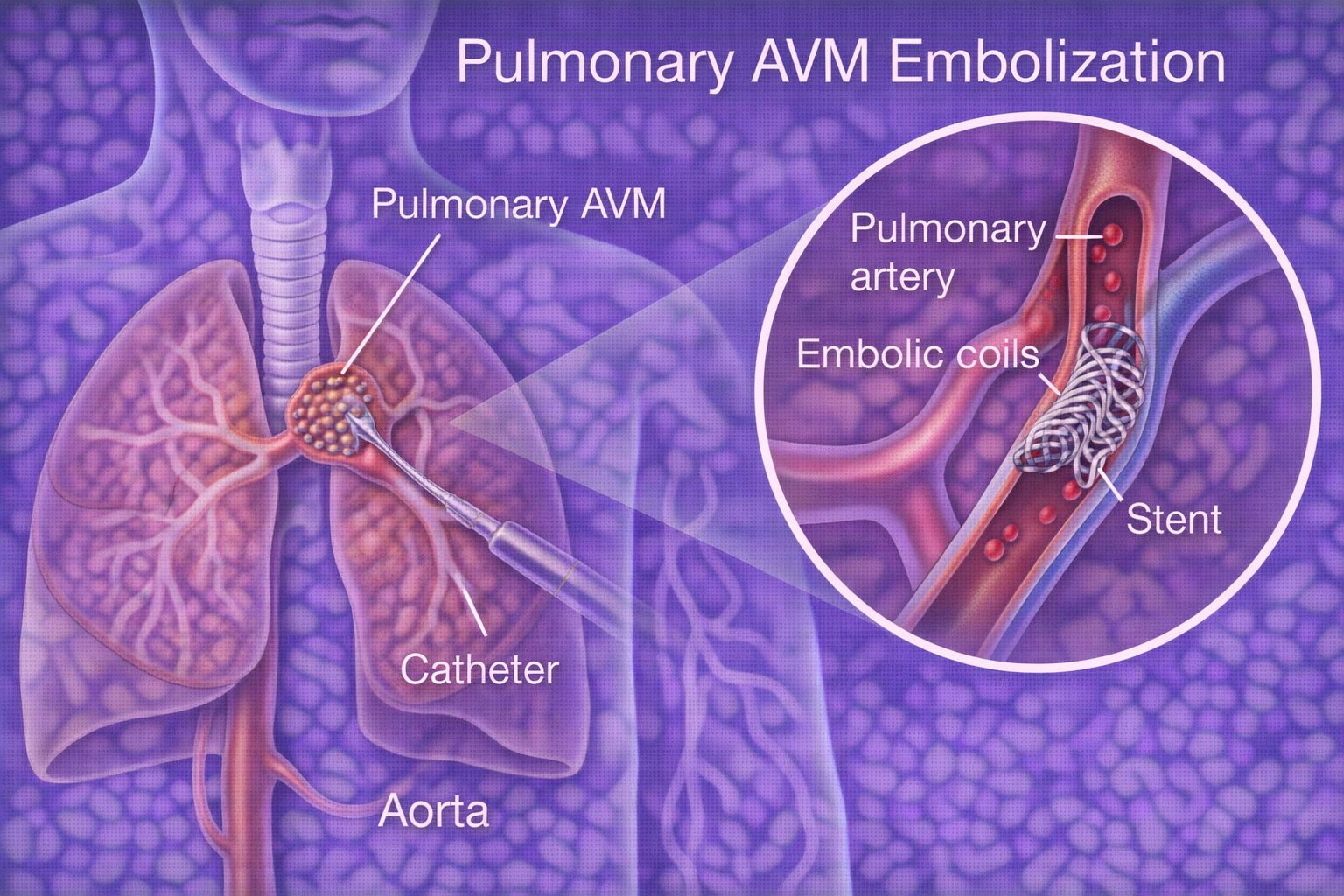
Pulmonary AVM embolization is a procedure where a doctor uses a thin tube (catheter) to reach the abnormal lung vessel and blocks it using special devices like coils or plugs. 

This treatment: 

  • Closes the abnormal artery–vein connection 
  • Improves oxygen levels in the blood 
  • Reduces the risk of stroke and brain infection 
  • Prevents bleeding from the lung 
  • Avoids open chest surgery in most patients 
  • No big cuts
  • Small puncture in the groin or arm
  • Fast recovery 
  • Proven, life-protecting treatment 

What Is a Pulmonary AVM?

Pulmonary AVM (Arteriovenous Malformation) is an abnormal shortcut between a lung artery and vein. Because of this: 

  • Blood does not get enough oxygen 
  • Small clots or germs can pass directly to the brain 
  • This increases the risk of: 
  • Stroke 
  • Brain abscess 
  • Breathlessness and fatigue 
  • Bluish lips or fingers 
  • Coughing up blood (in some cases) 

Many pulmonary AVMs are present from birth and are often associated with a condition called Hereditary Hemorrhagic Telangiectasia (HHT), but they can also occur alone. 

How Is Pulmonary AVM Embolization Done?

The procedure is performed by an interventional radiologist in a cath lab under X-ray guidance. 

Step-by-step: 

  • You lie comfortably on the table; local anesthesia (and sometimes light sedation) is given 
  • A small puncture is made in the groin or arm vein 
  • A thin catheter is guided into the blood vessels of the lungs 
  • Contrast dye is injected to see the AVM clearly 
  • Coils or vascular plugs are placed to block the abnormal connection 
  • Blood flow is checked to confirm the AVM is closed 
  • The catheter is removed and a small dressing is applied 

What Are the Risks?

Pulmonary AVM embolization is generally very safe in experienced centers. Possible risks with approximate incidence include: 

  • Chest discomfort or mild pain for 1–2 days – common (10–20%) 
  • Low-grade fever – common (5–10%) 
  • Bruising at puncture site – common (10–20%) 
  • Temporary shortness of breath – uncommon (5–10%) 
  • Migration or movement of coil/device – rare (<1–2%) 
  • Allergic reaction to contrast dye – rare (<2%) 
  • Serious complications (like stroke or major bleeding) – very rare (<1%) 

What Are the Alternatives?

Your treatment choices depend on: 

  • The size, number, and location of the pulmonary AVMs 
  • Your symptoms and oxygen levels 
  • Overall health and personal preferences 

Your doctor will help you choose the safest and most effective option. 

Alternative 1: No Active Treatment (Observation Only) 
  • Avoids undergoing any procedure 
  • May be considered for very small or low-risk PAVMs 
  • Major risk: the abnormal blood vessel connection remains untreated, increasing the risk of: 
  • Serious bleeding in the lungs 
  • Stroke or brain abscess (infection) due to clots or bacteria passing through the lungs 
  • Low oxygen levels and breathlessness 
  • These complications can be sudden and life-threatening 
  Alternative 2: Lung Surgery 
  • Involves surgical removal or disconnection of the abnormal blood vessels 
  • Can be effective in selected cases 
  • However, compared to pulmonary AVM embolization, surgery: 
  • Is more invasive 
  • Carries higher risks of complications 
  • Requires a longer hospital stay and recovery time 
  • May involve loss of healthy lung tissue 

📌 Embolization is now the preferred first-line treatment for most pulmonary AVMs because it is safe, effective, and minimally invasive. 

What Happens After Your Procedure?

After embolization: 

  • You’ll be observed in the hospital for a few hours or overnight 
  • Mild chest discomfort or fever may occur and usually settles quickly 
  • Most patients return to normal activities within 1–3 days 
  • Oxygen levels often improve over days to weeks 
  • Follow-up scans are done to confirm the AVM remains closed 
  • Some patients may need treatment of more than one AVM over time 

Frequently Asked Questions (FAQs) – Pulmonary AVM Embolization

Pulmonary AVM embolization is a minimally invasive, catheter-based procedure used to close abnormal blood vessel connections in the lungs and prevent complications like stroke, brain infection, and lung bleeding. 

A pulmonary AVM (arteriovenous malformation) is an abnormal connection between an artery and a vein in the lung, which allows blood to bypass normal oxygenation and filtering in the lungs. 

Pulmonary AVMs increase the risk of: 

  • Stroke 
  • Brain abscess (infection) 
  • Low oxygen levels and breathlessness 
  • Coughing up blood 
    Treating them reduces these serious risks. 

No. It is a minimally invasive, image-guided procedure, not open chest surgery. 

It is done under local anesthesia and sometimes light sedation, so most patients feel minimal discomfort. 

The procedure usually takes 1 to 2 hours, depending on the number and size of AVMs treated. 

It is highly effective in closing AVMs and significantly reducing the risk of stroke, brain abscess, and lung bleeding. 

Most patients go home the same day or after one night of observation. 

The treated AVM usually stays closed, but new AVMs can develop in some patients (especially those with HHT), so regular follow-up is important. 

Possible side effects include mild chest pain, fever, bruising at the puncture site, or rarely movement of the device or allergic reaction to contrast dye. Serious complications are very rare. 

In many patients, oxygen levels improve over days to weeks after the AVM is closed. 

Yes. This procedure is safely performed in both children and adults, depending on the condition. 

Embolization is less invasive, has faster recoveryless pain, and avoids removing lung tissue, unlike surgery. 

Yes. It is available in advanced interventional radiology and tertiary care centers across India. 

You will need regular follow-up scans (CT or other imaging) to make sure the AVM stays closed and to check for any new AVMs. 

Why Choose Pulmonary AVM Embolization?

  • Minimally invasive
  • No chest surgery
  • Protects against stroke and brain infectio
  • Improves oxygen levels
  • Fast recovery
  • Proven, life-saving treatment

Don’t Ignore a Pulmonary AVM

A pulmonary AVM may not always cause strong symptoms—but it can silently increase your risk of stroke, brain infection, and serious bleeding.

Pulmonary AVM embolization offers a safe, modern, and effective way to close the problem vessel and protect your health—without surgery.
Call Now Button