

Chennai-based Endovascular & IR Specialist, Dr. Ravindran Ramalingam offers minimally invasive, scar-free treatments ensuring faster recovery and minimal pain.

Endovascular &
IR Specialist

Center Address
- Gleneagles Health City, Perumbakkam, Chennai, TN
- Maruti Scans, Velachery, Chennai, TN

Retrograde Transvenous Obliteration (RTO)

A Minimally Invasive Treatment to Control Dangerous Stomach Variceal Bleeding in Liver Disease

People with liver cirrhosis can develop abnormally enlarged veins (varices) in the stomach due to high pressure in the portal vein (portal hypertension). These veins can bleed heavily and suddenly, which can be life-threatening.

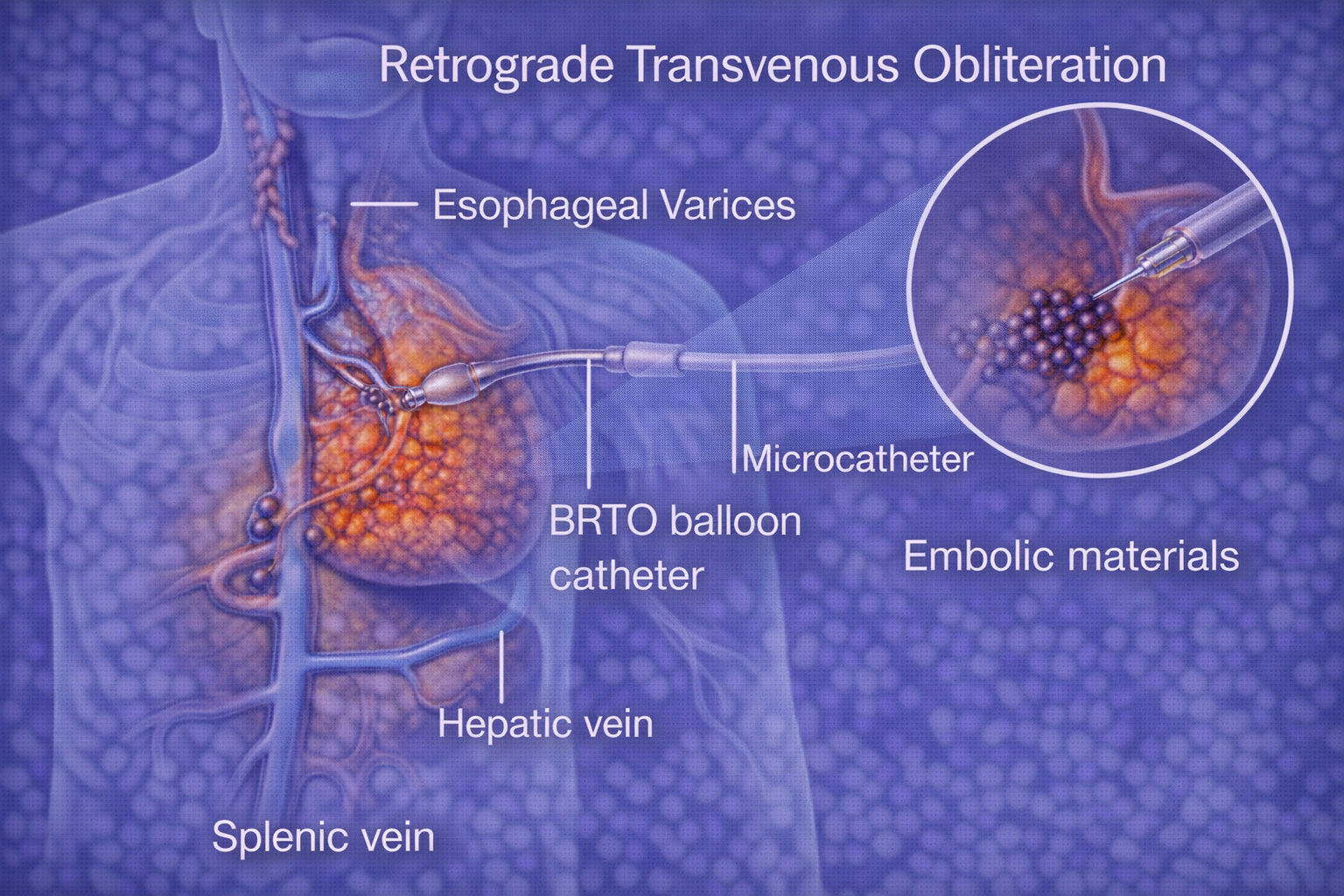
Retrograde Transvenous Obliteration (RTO) is a minimally invasive, image-guided procedure that blocks these abnormal veins from the vein side, helping to stop bleeding and prevent future bleeding—often without open surgery.
👉Bleeding from stomach varices or high-risk varices on scan?

What Is Retrograde Transvenous Obliteration (RTO)?

Retrograde Transvenous Obliteration is a procedure in which a specialist:

  • Reaches the abnormal veins (varices) through the veins, and
  • Closes (obliterates) them using a special sclerosing agent, coils, or plugs

This:

  • Stops blood flow into the dangerous varices
  • Prevents future bleeding
  • Shrinks or closes the abnormal veins
  • Is especially useful for gastric (stomach) varices with a large drainage vein (like a splenorenal shunt)

Common types include:

  • BRTO (Balloon-Occluded Retrograde Transvenous Obliteration)
  • PARTO / CARTO (using plugs or coils instead of balloons)
  • Minimally invasive

  • No open surgery

  • Very effective for gastric varices

  • Life-saving in bleeding patients

Why Is Retrograde Transvenous Obliteration Done?

RTO is usually done in patients with portal hypertension due to liver cirrhosis, especially when:

  • There is active or recurrent bleeding from gastric (stomach) varices
  • There are large gastric varices at high risk of bleeding
  • Endoscopic treatment has failed or is not suitable
  • The patient has a large shunt vein (like splenorenal shunt) that makes RTO possible
  • TIPS is not suitable or risky in that patient

Main goals:

  • Stop life-threatening bleeding
  • Prevent future bleeding
  • Reduce the size of varices
  • Stabilize the patient and improve survival

How Is Retrograde Transvenous Obliteration Done?

The procedure is performed by an interventional radiologist in a cath lab using X-ray guidance.

Step-by-step:

  • You are given local anesthesia and sedation (sometimes general anesthesia)
  • A small tube (catheter) is inserted through a vein in the neck or groin
  • The catheter is guided to the abnormal draining vein of the gastric varices
  • A balloon, plug, or coils are used to block the vein temporarily or permanently
  • A special liquid medicine (sclerosant) or embolic material is injected to close the varices
  • X-ray images confirm that the varices are completely blocked
  • The catheter is removed, and a small dressing is applied

What Are the Risks?

RTO is a well-established and effective procedure, but like any intervention, it has risks. Possible risks with approximate incidence include:

  • Fever or mild pain after procedure – common (10–20%)
  • Worsening of esophageal varices over time – uncommon (10–20%, needs follow-up)
  • Fluid buildup (ascites) increase – uncommon (10–20%)
  • Nausea or abdominal discomfort – common (10–20%)
  • Allergic reaction to contrast or sclerosant – rare (<1–2%)
  • Kidney strain from contrast dye – uncommon (<5%, higher in kidney disease)
  • Serious complications (bleeding, infection, clot migration) – rare (<1–2%)

What Are the Alternatives?

Your treatment options depend on:

  • The severity and location of the varices
  • Your risk of bleeding and liver function
  • Your overall health and medical conditions

Your specialist will help you choose the safest and most effective approach.

Alternative 1: No Active Treatment (Observation Only)

  • Avoids undergoing any procedure
  • Major risk: gastric varices can cause sudden, severe internal bleeding
  • Bleeding from varices is one of the leading causes of death in patients with liver cirrhosis
  • This option leaves the bleeding risk untreated

Alternative 2: Medicines

  • Medicines can help control other symptoms of liver disease and portal hypertension
  • However, they are less effective at preventing bleeding from stomach (gastric) varices
  • Usually used as supportive treatment, not a definitive solution for gastric varices

Alternative 3: TIPS (Transjugular Intrahepatic Portosystemic Shunt)

  • A minimally invasive procedure that creates a channel between two veins in the liver
  • Reduces high pressure in the portal vein, which helps lower bleeding risk
  • When used alone, it prevents bleeding from gastric varices in about 1 out of 2 patients
  • In many cases, TIPS is combined with RTO to improve bleeding control

Alternative 4: Endoscopic Treatment

  • A thin camera (endoscope) is passed through the mouth into the stomach
  • Doctors inject special material into the varices to make them clot and shrink
  • Less invasive than radiology procedures
  • Limitation: this approach is less effective at preventing future bleeding compared to RTO or TIPS

Choosing the Right Treatment

For patients with high-risk gastric varices, RTO (with or without TIPS) offers a more reliable and durable way to prevent life-threatening bleeding compared to medicines or endoscopy alone. A personalized, multidisciplinary evaluation helps choose the safest and most effective treatment plan.

📌 RTO is especially useful for gastric varices where endoscopy or TIPS is not ideal.

What Happens After Your Procedure?

After RTO:

  • You will be monitored in the hospital for a few days
  • Fever or mild pain may occur for 1–2 days
  • Follow-up scans or endoscopy may be done to confirm varices are closed
  • You may need medicines to control portal hypertension
  • Regular follow-up is important to check for new or worsening esophageal varices
  • Most patients can return to normal activities gradually within 1–2 weeks

Frequently Asked Questions (FAQs) – Retrograde Transvenous Obliteration (RTO)

RTO is a minimally invasive, catheter-based procedure used to close abnormal stomach veins (gastric varices) from the vein side to stop or prevent dangerous bleeding in patients with liver disease and portal hypertension.

They are types of RTO techniques:

  • BRTO: Uses a balloon to block the vein temporarily
  • PARTO: Uses a vascular plug
  • CARTO: Uses coils
    All aim to block the abnormal veins and stop bleeding.

RTO is done to:

  • Stop active bleeding from gastric (stomach) varices
  • Prevent future bleeding
  • Treat patients when endoscopy fails or is not suitable
  • Offer an option when TIPS is risky or not possible

No. RTO is a minimally invasive, image-guided procedure, not open surgery.

It is done under sedation or anesthesia, so most patients do not feel pain during the procedure.

The procedure usually takes 1 to 3 hours, depending on the complexity. 

Most patients stay in the hospital for 2 to 4 days for monitoring and recovery.

RTO has a very high success rate in controlling and preventing gastric variceal bleeding in suitable patients.

Possible risks include fever, abdominal discomfort, worsening of esophageal varices, increased ascites, allergic reaction to contrast or sclerosant, and rarely serious complications. Most side effects are temporary and manageable.

Yes. Because blood flow patterns change, esophageal varices can worsen over time, so regular endoscopy follow-up is important.

Yes. Most patients continue medicines for portal hypertension and liver disease.

They are used for different situations. RTO is especially good for gastric varices, while TIPS is better for widespread portal hypertension problems. Your doctor will choose the best option.

Recurrence of treated gastric varices is uncommon, but new varices elsewhere can develop, so follow-up is essential.

RTO is performed by a trained interventional radiologist using image guidance.

Yes. RTO (BRTO / PARTO / CARTO) is available in advanced liver and interventional radiology centers across India.

Why Choose Retrograde Transvenous Obliteration?

  • Minimally invasive

  • Very effective for gastric varices

  • Life-saving in bleeding patients

  • No open surgery

  • Shorter recovery time

  • Proven treatment for portal hypertension complications

Don’t Ignore Stomach Variceal Bleeding

Bleeding from gastric varices can be sudden and life-threatening. Retrograde Transvenous Obliteration can stop the bleeding and prevent it from coming back, often when other treatments are not suitable.

The right treatment at the right time can save lives.
Call Now Button