

Chennai-based Endovascular & IR Specialist, Dr. Ravindran Ramalingam offers minimally invasive, scar-free treatments ensuring faster recovery and minimal pain.

Endovascular &
IR Specialist

Center Address
- Gleneagles Health City, Perumbakkam, Chennai, TN
- Maruti Scans, Velachery, Chennai, TN

Radioembolization (TARE)

Transarterial Radioembolization (TARE / Y-90)

A Targeted, Minimally Invasive Radiation Treatment for Liver Tumors

When cancer affects the liver—either primary liver cancer (Hepatocellular Carcinoma) or tumors that have spread to the liver—not everyone can have surgery.

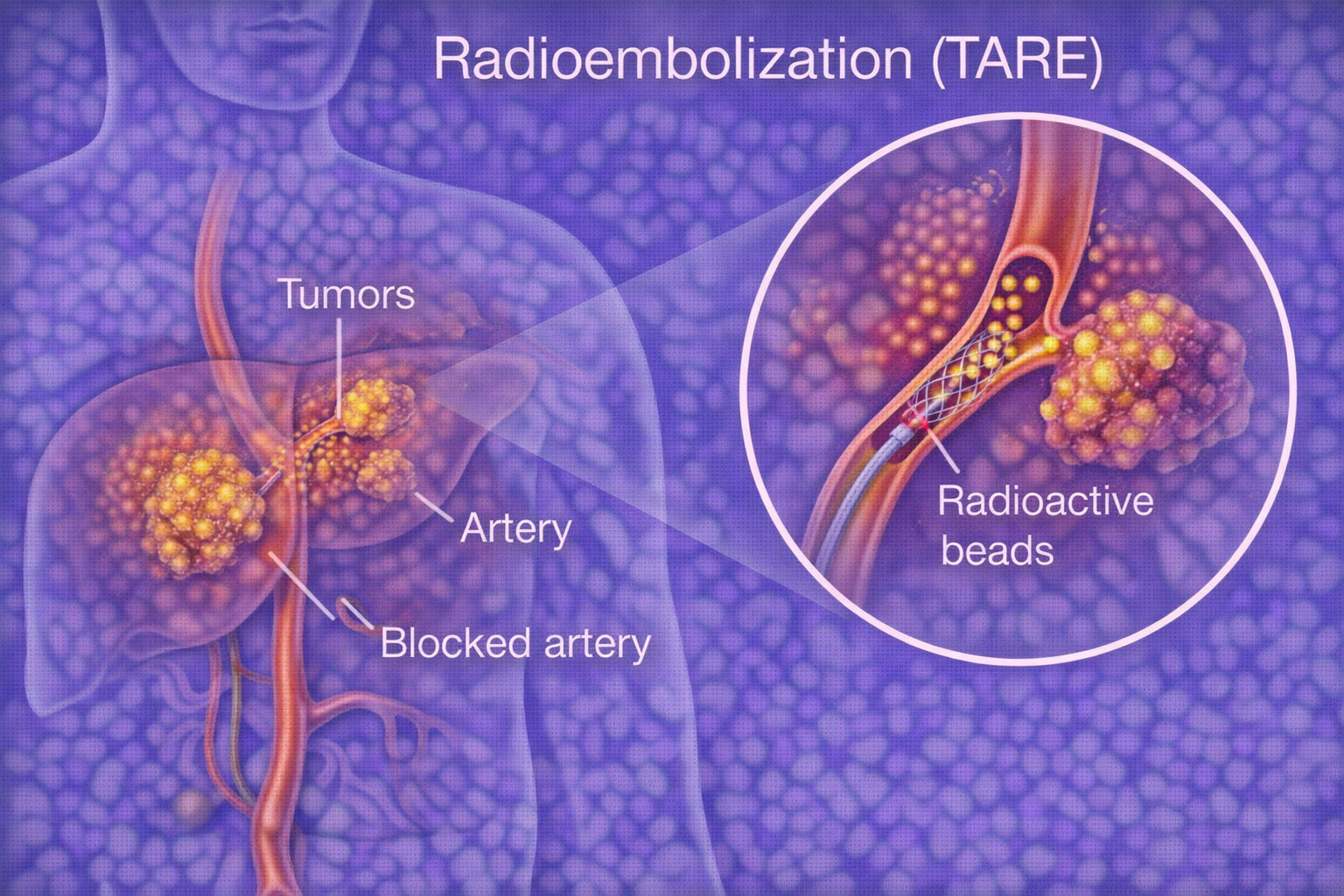
Transarterial Radioembolization (TARE), also called Y-90 radioembolization, is a minimally invasive, image-guided treatment that delivers tiny radioactive beads directly to the tumor through its blood supply. This allows high-dose radiation to hit the tumor while sparing most of the healthy liver.
👉Have a liver tumor and looking for a non-surgical, targeted treatment?

What Is Transarterial Radioembolization?

Transarterial Radioembolization (TARE) is a treatment where:

  • Very small radioactive beads (Y-90 microspheres) are delivered
  • Through a thin tube (catheter)
  • Directly into the artery feeding the liver tumor

These beads:

  • Get trapped inside the tumor’s blood vessels
  • Release radiation locally to destroy cancer cells
  • Minimize radiation exposure to the rest of the body
  • Do not block the artery completely (unlike TACE)

TARE is commonly used for:

  • Primary liver cancer (HCC)
  • Liver metastases from colon, neuroendocrine, or other cancers (in selected cases)
  • Highly targeted radiation
  • Minimally invasive
  • No big surgery
  • Usually fewer side effects than whole-body radiation
  • Can shrink or control tumors

Why Is Transarterial Radioembolization Done?

TARE is done when:

  • Liver tumors cannot be removed by surgery
  • The cancer is mainly in the liver
  • Other treatments like surgery or ablation are not suitable
  • The goal is to shrink the tumor, slow growth, or control symptoms
  • As a bridge to surgery or liver transplant in selected patients

Main goals:

  • Control or shrink liver tumors
  • Slow cancer progression
  • Improve quality of life
  • In some cases, downstage the tumor to make surgery possible

How Is Transarterial Radioembolization Done?

TARE is performed by an interventional radiologist in a cath lab using X-ray guidance. It usually happens in two steps.

Step 1: Planning Angiogram (Mapping)

  • A small tube (catheter) is inserted through the groin or arm artery
  • The doctor maps the blood vessels of the liver
  • Small vessels going to the stomach or intestine may be blocked to protect them
  • A test dose is given to check for safe blood flow patterns

Step 2: Treatment (Y-90 Delivery)

  • After a few days, the catheter is again guided to the liver tumor artery
  • Y-90 radioactive microspheres are injected
  • These beads lodge in the tumor and deliver radiation over days to weeks
  • The catheter is removed and a small dressing is applied

What Are the Risks?

TARE is widely used and generally safe in experienced centers. Possible risks with approximate incidence include:

  • Fatigue, mild fever, or flu-like symptoms – common (20–40%)
  • Abdominal discomfort or nausea – common (15–30%)
  • Temporary rise in liver enzymes – common (20–40%)
  • Stomach or duodenal irritation/ulcer – uncommon (<3–5%)
  • Infection – rare (<1–2%)
  • Radiation injury to liver (radiation hepatitis) – rare (<1–3%, depends on liver condition)
  • Non-target radiation to other organs – rare (<1–2%)

What Are the Alternatives?

Your treatment plan depends on:

  • Your overall health and liver function
  • The size, number, and location of the liver tumors
  • Whether the cancer has spread
  • Your personal preferences and treatment goals

In many cases, a combination of treatments may give the best results.

Alternative 1: No Active Treatment (Supportive Care)

  • Avoids procedures and cancer medicines
  • May be considered in very advanced disease or when treatment risks are too high
  • Main drawback: the cancer is likely to continue to grow and spread

Alternative 2: TACE (Transarterial Chemoembolization)

  • A minimally invasive, image-guided treatment
  • Tiny beads are delivered into the tumor’s blood supply
  • These beads release chemotherapy directly into the tumor
  • Similar to TARE, but uses chemotherapy instead of radiation
  • Helps slow tumor growth while limiting damage to healthy liver tissue

Alternative 3: Tumor Ablation

  • Another minimally invasive, image-guided procedure
  • A thin probe is placed through the skin into the tumor
  • Uses heat or cold to destroy cancer cells
  • Best suited for small or limited number of liver tumors

Alternative 4: Surgery or Liver Transplant

  • Surgery may involve removing part of the liver that contains the tumor
  • In selected patients, liver transplantation may be an option
  • Can offer a potential cure in suitable cases
  • However, surgery:
    • Is major and invasive
    • Requires longer recovery
    • Not suitable for all patients due to liver function or tumor spread

Alternative 5: External Beam Radiation Therapy

  • Uses high-energy radiation beams directed at the tumor from outside the body
  • Given in multiple treatment sessions
  • Can help shrink tumors or relieve symptoms
  • Not always the first choice for primary liver cancer

Alternative 6: Cancer Medicines and Immunotherapy

  • Includes targeted therapy, chemotherapy, and immunotherapy
  • Helps:
    • Slow tumor growth
    • Shrink tumors
    • Support the immune system in fighting cancer
  • Commonly used for advanced or spread liver cancer
  • May cause side effects and usually requires ongoing treatment

Choosing the Right Liver Cancer Treatment

Modern liver cancer care uses a multidisciplinary approach, combining minimally invasive procedures, surgery, radiation, and medicines to achieve the best possible outcome. A personalized evaluation helps select the most effective and safest treatment plan.

📌 TARE is often chosen when strong local tumor control is needed and surgery is not an option.

What Happens After Your Procedure?

After TARE:

  • Most patients go home the same day or next day
  • You may feel tired, mildly feverish, or have abdominal discomfort for a few days
  • These symptoms usually improve with simple medicines
  • You can usually return to normal activities in 5–7 days
  • Blood tests and scans are done to monitor liver function and tumor response
  • Tumor shrinkage or control is usually seen over weeks to months

Frequently Asked Questions (FAQs) – Transarterial Radioembolization (TARE / Y-90)

TACE is a minimally invasive cancer treatment that delivers chemotherapy directly into the blood vessels feeding a liver tumor and then blocks those vessels to cut off the tumor’s blood supply.

TARE is mainly used for:

  • Primary liver cancer (hepatocellular carcinoma)
  • Cancers that have spread to the liver (liver metastases) in selected patients

No. TARE is a catheter-based, minimally invasive procedure, not open surgery.

You usually won’t feel pain during the procedure. Some patients feel mild fatigue, fever, or abdominal discomfort for a few days afterward.

The treatment session usually takes 60 to 120 minutes. There is also a planning (mapping) procedure done before the actual treatment.

Most patients go home the same day or after one night of observation.

TARE can shrink or control tumors and slow disease progression. In some patients, it helps make surgery or liver transplant possible.

TARE is very effective in controlling liver tumors in many patients and is widely used around the world.

Common side effects include tiredness, mild fever, nausea, or abdominal discomfort. Less common risks include stomach irritation, liver irritation, infection, or non-target radiation. Serious complications are rare.

TACE uses chemotherapy and blocks the artery to the tumor. TARE uses targeted radiation (Y-90 beads) and usually does not completely block the artery.

Yes. TARE can be repeated in selected patients if needed.

Most patients return to normal daily activities within 5 to 7 days, depending on how they feel.

TARE is commonly used in patients with liver disease, but careful testing of liver function is done first to make sure it is safe.

Some patients may still need other treatments like chemotherapy, targeted therapy, immunotherapy, or surgery, depending on their cancer.

Yes. TARE (Y-90 radioembolization) is available in advanced cancer and interventional radiology centers across India.

Why Choose Transarterial Radioembolization (TARE)?

  • Highly targeted radiation treatment
  • Minimally invasive
  • No big surgery
  • Fewer whole-body side effects
  • Effective control of liver tumors
  • Short hospital stay
  • Proven, modern liver cancer therapy

Looking for Advanced, Targeted Treatment for Liver Tumors?

If you or your loved one has liver cancer or liver-dominant tumors not suitable for surgery, Transarterial Radioembolization (TARE / Y-90) may be a powerful and effective option.

Get expert advice and find out if TARE is right for you.
Call Now Button