

Chennai-based Endovascular & IR Specialist, Dr. Ravindran Ramalingam offers minimally invasive, scar-free treatments ensuring faster recovery and minimal pain.

Endovascular &
IR Specialist

Center Address
- Gleneagles Health City, Perumbakkam, Chennai, TN
- Maruti Scans, Velachery, Chennai, TN

Transjugular Intrahepatic Portosystemic Shunt (TIPS)

A Minimally Invasive Treatment to Control Portal Hypertension, Variceal Bleeding, and Ascites

People with advanced liver disease (cirrhosis) can develop high pressure in the portal vein (called portal hypertension). This can lead to dangerous bleeding from food pipe veins (varices), fluid in the abdomen (ascites), and severe complications.

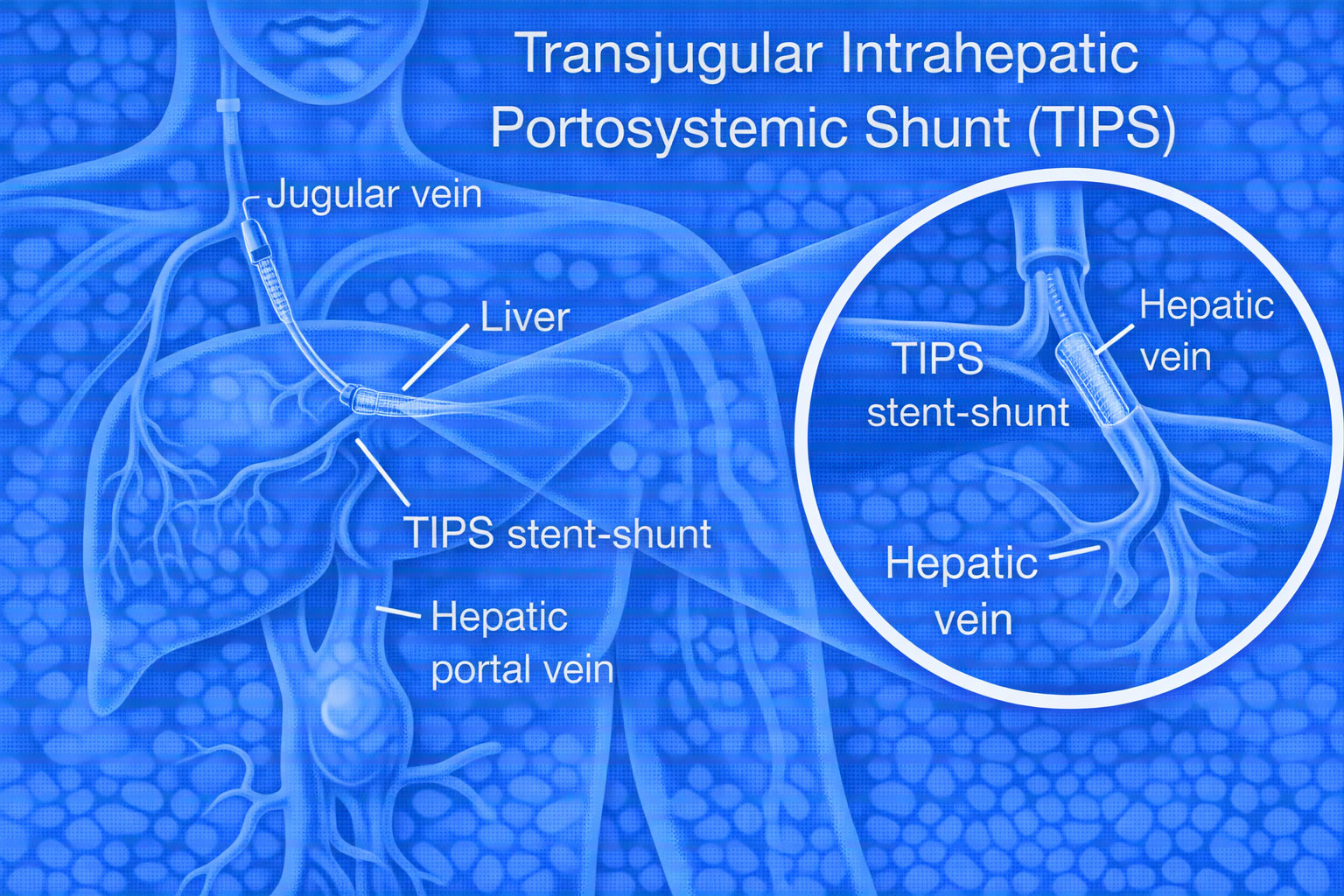
Transjugular Intrahepatic Portosystemic Shunt (TIPS) is a minimally invasive, image-guided procedure that creates a new pathway for blood flow inside the liver to reduce pressure, stop bleeding, and control fluid buildup—often without open surgery.
👉Bleeding from varices or uncontrolled ascites due to liver disease?

What Is Transjugular Intrahepatic Portosystemic Shunt (TIPS)?

TIPS is a procedure where a specialist:

  • Creates a small tunnel inside the liver between two veins, and
  • Places a special metal stent (tube) to keep this tunnel open

This new pathway:

  • Diverts blood around the scarred liver
  • Lowers high pressure in the portal vein
  • Reduces or stops variceal bleeding
  • Helps control ascites and fluid buildup
  • Minimally invasive

  • No open surgery

  • Life-saving in severe bleeding

  • Improves symptoms of portal hypertension

Why Is Transjugular Intrahepatic Portosystemic Shunt (TIPS) Done?

TIPS is usually done in patients with portal hypertension due to liver cirrhosis or other liver diseases, especially when:

  • There is recurrent or uncontrolled bleeding from esophageal or gastric varices
  • There is ascites (abdominal fluid) that does not improve with medicines
  • There is hepatic hydrothorax (fluid around the lungs due to liver disease)
  • Bleeding or fluid problems do not respond to medicines or endoscopy
  • As a bridge to liver transplantation in suitable patients

Main goals:

  • Stop life-threatening bleeding
  • Reduce portal vein pressure
  • Control ascites and fluid leaks
  • Improve quality of life
  • Stabilize the patient for further treatment

How Is Transjugular Intrahepatic Portosystemic Shunt (TIPS) Done?

The procedure is performed by an interventional radiologist in a cath lab using X-ray and ultrasound guidance.

Step-by-step:

  • You are given local anesthesia and sedation (sometimes general anesthesia)
  • A small tube (catheter) is inserted through a vein in the neck (jugular vein)
  • The catheter is guided into the veins of the liver
  • A small channel is created inside the liver between the portal vein and hepatic vein
  • A special stent is placed to keep this channel open
  • Blood flow and pressure are checked
  • The catheter is removed, and a small dressing is applied

What Are the Risks?

TIPS is a well-established procedure but is usually done in sick liver patients, so risks must be understood. Possible risks with approximate incidence include:

  • Hepatic encephalopathy (confusion, sleepiness) – common (25–35%)
  • Bleeding inside the liver or abdomen – uncommon (5–10%)
  • Infection – uncommon (5–10%)
  • Heart strain or heart failure worsening – uncommon (5–10%, in susceptible patients)
  • Shunt narrowing or blockage over time – uncommon (10–20%, needs follow-up and sometimes re-intervention)
  • Liver failure worsening – uncommon but serious (<5–10%, depends on liver condition)
  • Procedure-related death – rare (<1–3%, varies with patient severity)
What is FNAC? Thyroid FNAC Chennai uses ultrasound-guided needle test to diagnose nodules accurately and detect abnormalities early.

What Are the Alternatives?

The best option depends on whether TIPS is being considered for severe variceal bleeding or severe ascites (fluid buildup), as well as your overall health and liver condition.

For Severe Varices or High Risk of Bleeding

Alternative 1: No Procedure

  • Avoids undergoing any procedure and its risks
  • Major drawback: symptoms can worsen suddenly and bleeding can become life-threatening
  • Does not reduce the underlying pressure causing the varices

Alternative 2: Medicines to Reduce Bleeding Risk

  • Medicines can help lower the chance of future bleeding
  • They do not stop active bleeding
  • Less invasive than procedures
  • Limitation: the risk of bleeding again is higher with medicines alone compared to TIPS

Alternative 3: Endoscopic Treatment

  • A camera (endoscope) is passed through the mouth to see the varices
  • Doctors can:
    • Inject medicine into the varices, or
    • Place rubber bands around them to control bleeding
  • Less invasive than TIPS
  • Limitation: the chance of re-bleeding remains higher compared to TIPS, especially in severe disease

For Severe Ascites (Fluid Accumulation in the Abdomen)

Alternative 1: No Procedure

  • Avoids procedural risks
  • Main drawback: fluid will continue to collect, causing discomfort, breathing difficulty, and infection risk

Alternative 2: Paracentesis (Fluid Drainage)

  • A small tube is inserted into the abdomen to drain the fluid
  • Provides temporary relief of symptoms
  • Limitation: the fluid usually builds up again, so the procedure must be repeated frequently

Choosing the Right Treatment

For selected patients with recurrent variceal bleeding or refractory ascites, TIPS offers a more durable solution by reducing portal pressure, helping prevent repeat bleeding and reduce fluid buildup. A personalized evaluation ensures the safest and most effective treatment plan.

📌 TIPS is usually chosen when medicines and endoscopy are not enough.

What Happens After Your Procedure?

After TIPS:

  • You will be monitored in the hospital for a few days
  • Blood tests and scans will check liver function and shunt flow
  • You may need medicines to prevent encephalopathy
  • Ascites and bleeding usually improve over days to weeks
  • Regular Doppler ultrasound scans are needed to check shunt patency
  • Some patients may need shunt revision if it narrows
  • Diet, medicines, and follow-up are very important for long-term success

Frequently Asked Questions (FAQs) – Transjugular Intrahepatic Portosystemic Shunt (TIPS)

TIPS (Transjugular Intrahepatic Portosystemic Shunt) is a minimally invasive procedure that creates a new pathway for blood flow inside the liver to reduce high pressure in the portal vein and treat complications of liver cirrhosis.

TIPS is done to:

  • Stop or prevent bleeding from esophageal or gastric varices
  • Control ascites (fluid in the abdomen) that does not respond to medicines
  • Treat complications of portal hypertension
  • Act as a bridge to liver transplantation in some patients

No. TIPS is a catheter-based, minimally invasive procedure, not open surgery.

It is done under sedation or anesthesia, so most patients do not feel pain during the procedure.

The procedure usually takes 1 to 3 hours, depending on the difficulty.

Most patients stay in the hospital for 2 to 5 days for monitoring and recovery.

TIPS is very effective in controlling variceal bleeding and reducing ascites in most suitable patients.

Possible risks include hepatic encephalopathy (confusion), bleeding, infection, shunt narrowing, heart strain, or worsening liver function. Serious complications are uncommon.

It is a condition where toxins affect the brain, causing confusion, sleepiness, or behavior changes. It is common after TIPS but is usually controlled with medicines and diet.

No. TIPS treats the complications of liver disease but does not cure cirrhosis. Liver transplant may still be needed in some patients.

With modern stents and proper follow-up, many TIPS shunts work well for years, but regular ultrasound checks are needed.

Yes. Regular Doppler ultrasound scans and blood tests are important to make sure the shunt is working properly.

TIPS may not be suitable for patients with severe heart failure, severe liver failure, or uncontrolled infection. Your doctor will assess your fitness.

Alternatives include medicines, endoscopic treatment for varices, repeated fluid drainage, surgery, or liver transplant, depending on your condition.

Yes. TIPS is available in advanced liver and interventional radiology centers across India.

Why Choose TIPS?

  • Minimally invasive

  • Life-saving for variceal bleeding

  • Effective for refractory ascites

  • No open surgery

  • Shorter recovery than surgery

  • Proven treatment for portal hypertension complications

Struggling With Liver Disease Complications?

Repeated bleeding, uncontrolled ascites, or severe portal hypertension can be life-threatening. TIPS can reduce pressure, stop bleeding, and improve your quality of life—often when other treatments have failed.

The right treatment at the right time can save lives.
Call Now Button