

Chennai-based Endovascular & IR Specialist, Dr. Ravindran Ramalingam offers minimally invasive, scar-free treatments ensuring faster recovery and minimal pain.

Endovascular &
IR Specialist

Center Address
- Gleneagles Health City, Perumbakkam, Chennai, TN
- Maruti Scans, Velachery, Chennai, TN

Transjugular Liver Biopsy

A Safer Way to Get a Liver Tissue Sample in High-Risk Patients

Sometimes doctors need a small sample of liver tissue to find out why the liver is not working properly, to stage liver disease, or to plan the right treatment. In patients who have low platelets, bleeding risk, fluid in the abdomen (ascites), or advanced liver disease, a regular liver biopsy through the skin may be unsafe.

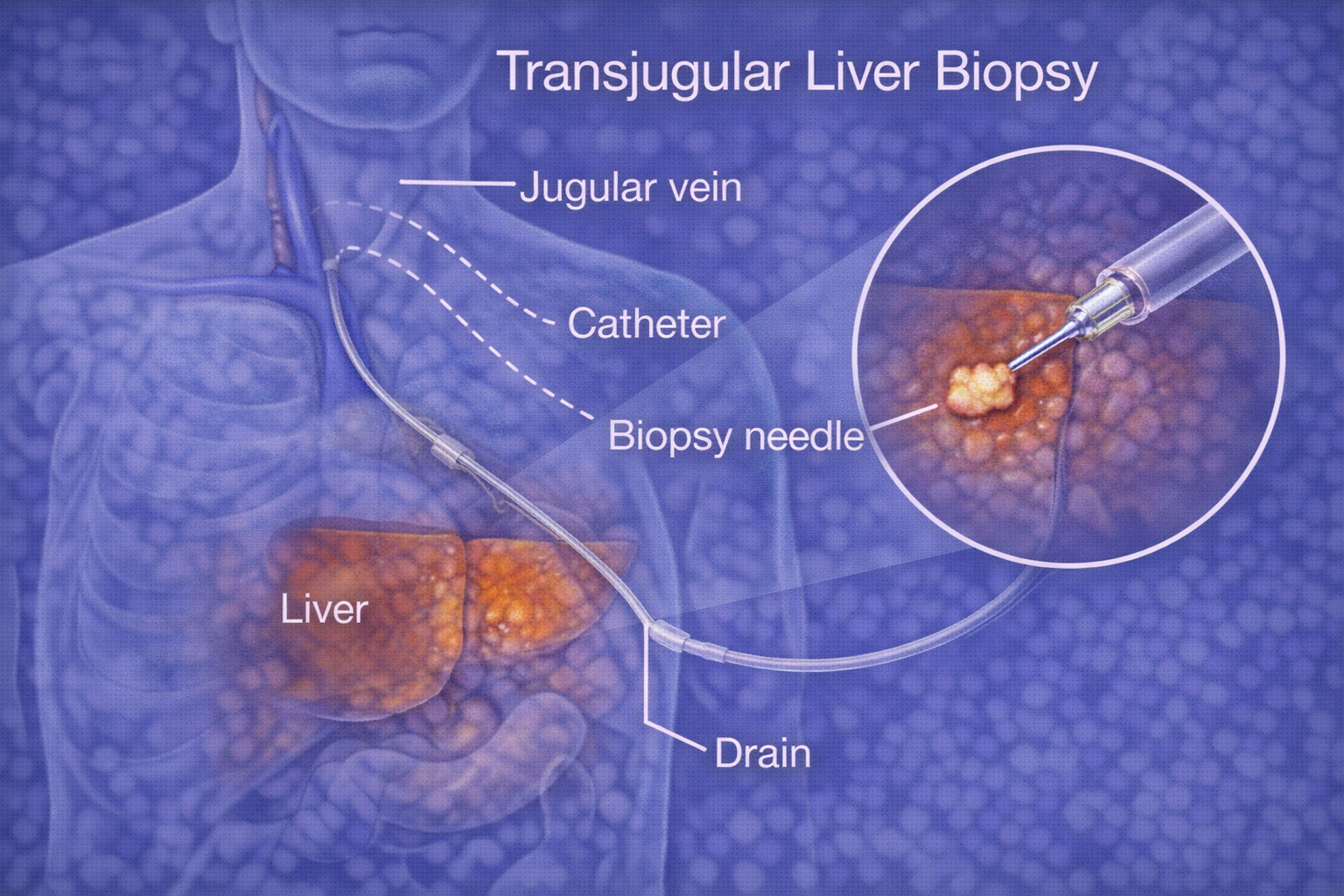
Transjugular Liver Biopsy (TJLB) is a minimally invasive, image-guided procedure that takes the biopsy from inside the blood vessels, making it safer for high-risk patients.
👉Have liver disease with bleeding risk or ascites?

What Is Transjugular Liver Biopsy?

Transjugular Liver Biopsy is a procedure in which:

  • A thin tube (catheter) is passed through a vein in the neck (jugular vein),
  • Guided into the veins of the liver, and
  • A small piece of liver tissue is taken from inside the vein using a special needle.

Because the biopsy is taken inside the blood vessel, any bleeding goes back into the vein, making this method safer than a skin (percutaneous) liver biopsy in high-risk patients.

  • Minimally invasive

  • No needle passes through the liver capsule from outside

  • Safer in patients with bleeding risk or ascites

  • Performed under imaging guidance

Why Is Transjugular Liver Biopsy Done?

TJLB is usually done when a regular liver biopsy is risky, such as in patients with:

  • Low platelet count or bleeding disorders
  • Severe ascites (fluid in the abdomen)
  • Advanced liver disease or cirrhosis
  • Severe obesity or difficult anatomy
  • Need for liver biopsy plus pressure measurements (portal hypertension assessment)

Doctors use TJLB to:

  • Diagnose liver diseases (hepatitis, cirrhosis, fatty liver, etc.)
  • Assess severity of liver damage
  • Guide treatment decisions
  • Evaluate unexplained abnormal liver tests

How Is Transjugular Liver Biopsy Done?

The procedure is performed by an interventional radiologist in a cath lab using X-ray guidance.

Step-by-step:

  • You lie on the table; local anesthesia and mild sedation are given
  • A small tube (catheter) is inserted into a vein in the neck
  • The catheter is guided into the hepatic vein inside the liver
  • A special biopsy needle takes 1–3 small tissue samples
  • Pressure measurements in liver veins may also be taken (if needed)
  • The catheter is removed and a small bandage is applied

What Are the Risks?

Transjugular liver biopsy is generally very safe, especially compared to regular liver biopsy in high-risk patients. Possible risks with approximate incidence include:

  • Neck pain or bruising at puncture site – common (5–10%)
  • Temporary irregular heartbeat during catheter passage – uncommon (2–5%)
  • Mild bleeding inside the vein – uncommon (<2–3%)
  • Infection – rare (<1%)
  • Capsule perforation or significant bleeding – very rare (<1%)
  • Allergic reaction to contrast dye – rare (<1%)

What Are the Alternatives?

Your options depend on:

  • Your symptoms and overall health
  • Your bleeding risk and clotting status
  • Why your doctor needs a liver tissue sample

Your clinician will help you choose the safest and most appropriate approach

Alternative 1: No Biopsy

  • Avoids undergoing any biopsy procedure
  • Main drawback: without a liver biopsy, your doctor may not be able to identify the exact liver problem
  • This can lead to delayed, incomplete, or incorrect treatment

Alternative 2: Percutaneous (Through-the-Skin) Liver Biopsy

  • The biopsy needle is passed directly through the skin of the right upper abdomen into the liver
  • The skin is numbed with local anesthesia before the procedure
  • This is a commonly used method to obtain liver tissue
  • Limitation: compared to the transjugular approach, this method has a slightly higher risk of bleeding, especially in patients with clotting problems or fluid in the abdomen

Making the Right Choice

A transjugular liver biopsy allows doctors to obtain liver tissue safely from inside the blood vessels, making it a preferred option for patients with higher bleeding risk. It helps ensure an accurate diagnosis while reducing the chance of complications.

📌 When bleeding risk is high, transjugular biopsy is usually the safest option.

What Happens After Your Procedure?

After TJLB:

  • You will be observed for a few hours (or overnight)
  • Your blood pressure and pulse will be monitored
  • Mild neck discomfort usually settles in a day
  • You can usually eat and walk the same day
  • The biopsy sample is sent to the lab for detailed analysis
  • Results are usually available in a few days
  • Most patients can return to normal activities within 24 hours

Frequently Asked Questions (FAQs) – Transjugular Liver Biopsy (TJLB)

A transjugular liver biopsy is a minimally invasive procedure where a small sample of liver tissue is taken through a vein in the neck, making it safer for patients who have a high risk of bleeding or ascites.

TJLB is done when a regular liver biopsy is risky, especially in patients with:

  • Low platelet count or bleeding disorders
  • Severe ascites (fluid in the abdomen)
  • Advanced liver disease or cirrhosis
  • Need for liver biopsy with pressure measurements

No. It is a catheter-based, minimally invasive procedure, not open surgery.

It is done under local anesthesia and mild sedation, so most patients feel only mild discomfort.

The procedure usually takes 30 to 60 minutes.

Many patients go home the same day or stay overnight for observation, depending on their condition.

TJLB is very safe, especially in high-risk patients. Serious complications are rare.

Possible risks include neck bruising, temporary heart rhythm changes, mild bleeding, infection, or allergic reaction to contrast dye. Serious problems are very uncommon.

Biopsy results are usually available in 2 to 5 days, depending on the tests needed.

In TJLB, the biopsy is taken from inside a vein, so any bleeding goes back into the bloodstream, making it safer for patients with bleeding risk or ascites.

Yes. TJLB can also be used to measure pressures in the liver veins, which helps assess portal hypertension.

Alternatives include percutaneous (skin) biopsy, surgical biopsy, or non-invasive tests like FibroScan, depending on the case.

Most patients can return to normal activities within 24 hours.

The procedure is performed by a trained interventional radiologist using image guidance.

Yes. TJLB is available in major hospitals with interventional radiology and liver care services across India.

Why Choose Transjugular Liver Biopsy?

  • Safer for patients with bleeding risk or ascites

  • Minimally invasive

  • No abdominal needle puncture

  • Quick recovery

  • Accurate diagnosis

  • Performed by imaging specialists

Need a Safe Liver Biopsy?

If you have liver disease and a high risk of bleeding, don’t delay diagnosis. Transjugular liver biopsy offers a safe, reliable way to get answers and start the right treatment.

A safe diagnosis is the first step to the right treatment.
Call Now Button