

Chennai-based Endovascular & IR Specialist, Dr. Ravindran Ramalingam offers minimally invasive, scar-free treatments ensuring faster recovery and minimal pain.

Endovascular &
IR Specialist

Center Address
- Gleneagles Health City, Perumbakkam, Chennai, TN
- Maruti Scans, Velachery, Chennai, TN

Tumor Ablation

A Minimally Invasive Way to Destroy Tumors Without Major Surgery

When a tumor is found, not everyone needs big surgery. In many cases, doctors can treat the tumor using a minimally invasive, image-guided technique called tumor ablation.

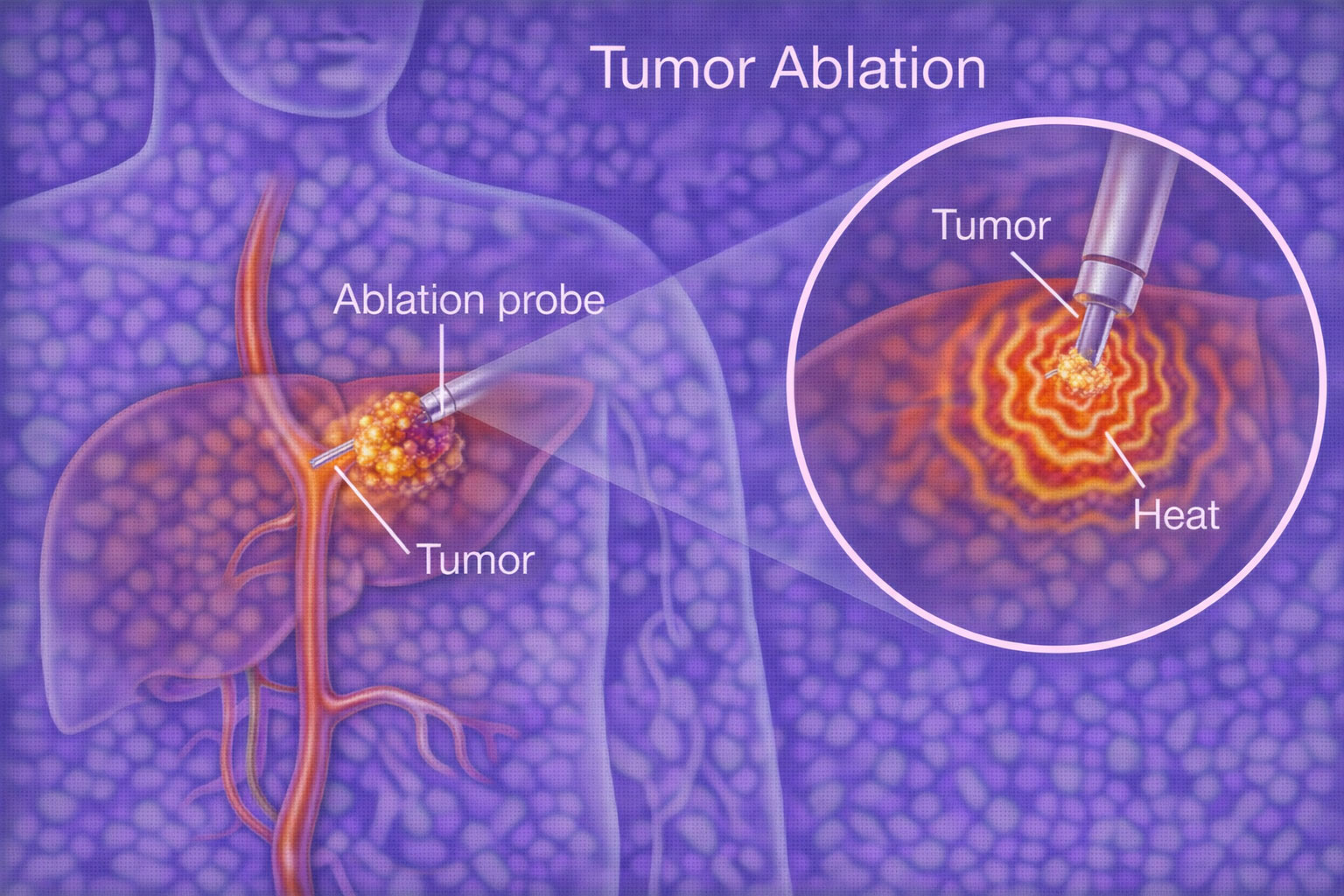
Tumor ablation uses heat or cold to destroy the tumor from inside, often through a thin needle placed through the skin—no large cuts, no stitches, and faster recovery.
👉Have a tumor and looking for a less invasive treatment option?

What Is Tumor Ablation?

Tumor ablation is a medical procedure that destroys a tumor using extreme heat or cold, delivered through a thin probe/needle placed directly into the tumor under imaging guidance (CT, ultrasound, or MRI).

Common types of tumor ablation:

  • Radiofrequency ablation (RFA) – uses heat
  • Microwave ablation (MWA) – uses heat
  • Cryoablation – uses extreme cold

Tumor ablation can be used for tumors in:

  • Liver
  • Lung
  • Kidney
  • Bone
  • Adrenal gland and other organs (in selected cases)
  • Minimally invasive
  • No big surgery
  • Short hospital stay
  • Faster recovery
  • Can be repeated if needed

Why Is Tumor Ablation Done?

Tumor ablation is done when:

  • The tumor is small or limited in number
  • Surgery is high risk or not possible
  • The patient wants a less invasive option
  • The tumor has come back after other treatments
  • The goal is to control pain or symptoms (palliative treatment)
  • To destroy cancer while preserving normal organ tissue

Main goals:

  • Destroy the tumor cells
  • Control or cure cancer in selected cases
  • Preserve organ function
  • Reduce pain or symptoms caused by the tumor
  • Offer treatment with less risk and faster recovery

How Is Tumor Ablation Done?

Tumor ablation is performed by an interventional radiologist using CT, ultrasound, or MRI guidance.

Step-by-step:

  • You lie comfortably on the procedure table
  • Local anesthesia and sometimes sedation or anesthesia is given
  • The doctor uses imaging to locate the tumor precisely
  • A thin needle/probe is inserted through the skin into the tumor
  • Heat or cold energy is applied to destroy the tumor cells
  • The probe is removed, and a small dressing is applied

What Are the Risks?

Tumor ablation is generally safe in experienced centers. Possible risks with approximate incidence include:

  • Pain or soreness at the treatment site – common (20–30%)
  • Mild fever for 1–2 days – common (10–20%)
  • Bruising or small bleeding – uncommon (5–10%)
  • Infection – rare (<1–2%)
  • Injury to nearby organs or structures – rare (<1–2%, depends on location)
  • Incomplete tumor destruction or recurrence – uncommon (10–20%, may need repeat treatment)
tumor ablation chennai

What Are the Alternatives?

Your treatment options depend on:

  • Your overall health and medical conditions
  • The size, number, and location of the tumor(s)
  • The type of cancer and whether it has spread
  • Your personal preferences and treatment goals

In many cases, a combination of treatments may be recommended.

Alternative 1: No Active Treatment (Active Surveillance)

  • Involves close monitoring with scans and tests
  • Avoids procedures or surgery
  • May be suitable for small, slow-growing tumors or patients unfit for treatment
  • Limitation: the tumor may continue to grow or spread over time

Alternative 2: Surgery

  • Involves removing the tumor or, in some cases, removing part or all of the organ
  • Often considered a definitive treatment for many cancers
  • However, surgery:
    • Is more invasive
    • Requires general anesthesia
    • Has longer recovery time
    • Carries a higher risk of complications compared to minimally invasive treatments

Alternative 3: Cancer Medicines (Systemic Therapy)

  • Includes targeted therapy, chemotherapy, or immunotherapy
  • Works throughout the body to control or shrink cancer
  • May be used alone or with other treatments
  • Can cause side effects and may not completely eliminate the tumor in one area

Alternative 4: Radiation Therapy

  • Uses high-energy radiation beams from outside the body to destroy cancer cells
  • Less commonly used for some tumors unless they have spread or cannot be treated locally
  • Usually given as a series of treatment sessions
  • Can cause fatigue and skin or tissue side effects in some patients

Choosing the Right Cancer Treatment

For selected patients, minimally invasive image-guided treatments such as tumor ablation can offer effective cancer control with less pain, fewer complications, and faster recovery compared to surgery. A personalized evaluation helps choose the best treatment plan.

📌 Tumor ablation is often chosen when a less invasive, targeted treatment is possible and effective.

What Happens After Your Procedure?

After tumor ablation:

  • You’ll be observed for a few hours or overnight
  • Mild pain or fever may occur and usually settles in 1–2 days
  • Most patients return to normal activities within a few days
  • You may need pain medicines for a short time
  • Follow-up scans are done to check if the tumor is fully destroyed
  • Sometimes, repeat ablation is done if a small part of tumor remains

Frequently Asked Questions (FAQs) – Tumor Ablation

Tumor ablation is a minimally invasive treatment that destroys a tumor using heat or cold delivered through a thin needle placed directly into the tumor under imaging guidance.

Tumor ablation is commonly used for small tumors in the liver, lung, kidney, bone, and adrenal gland, and in some other locations depending on the case.

Chemoports are recommended for patients who need:

  • Repeated chemotherapy sessions
  • Long-term IV treatment
  • Frequent blood tests
  • A more comfortable and safer option than repeated IV cannulas

No. Tumor ablation is a needle-based, minimally invasive procedure, not open surgery.

It is done under local anesthesia and/or sedation or anesthesia, so most patients feel little or no pain during the procedure. Mild pain afterward is common for a short time.

The procedure usually takes 30 minutes to 2 hours, depending on the size and location of the tumor.

Many patients go home the same day or after one night of observation.

In selected small and early tumors, ablation can be curative. In other cases, it helps control the tumor or reduce symptoms.

Success rates are high for small, well-selected tumors. The result depends on tumor size, type, and location.

Possible risks include pain, fever, bleeding, infection, injury to nearby organs, or incomplete tumor destruction. Serious complications are uncommon.

Yes. Tumor ablation can be repeated if a small part of the tumor remains or if a new tumor appears.

Some patients may still need surgery, chemotherapy, or other treatments, depending on the type and stage of cancer.

Tumor ablation is less invasive, has faster recovery, less pain, and usually shorter hospital stay compared to surgery.

Yes. When done by experienced specialists, tumor ablation is safe and widely used with a low risk of serious complications.

Most patients return to normal activities within a few days, depending on the treatment area and their overall health.

Yes. Tumor ablation is available in advanced cancer and interventional radiology centers across India.

Why Choose Tumor Ablation?

  • Minimally invasive
  • No big surgery or scars
  • Faster recovery
  • Preserves normal tissue
  • Short hospital stay
  • Can be repeated if needed
  • Proven, modern cancer treatment option

Looking for a Less Invasive Tumor Treatment?

If you have a small or limited tumor and want to avoid major surgery, tumor ablation may be a safe and effective option for you.

Get expert advice and find out if you’re a candidate for tumor ablation today.
Call Now Button