

Chennai-based Endovascular & IR Specialist, Dr. Ravindran Ramalingam offers minimally invasive, scar-free treatments ensuring faster recovery and minimal pain.

Endovascular &
IR Specialist

Center Address
- Gleneagles Health City, Perumbakkam, Chennai, TN
- Maruti Scans, Velachery, Chennai, TN

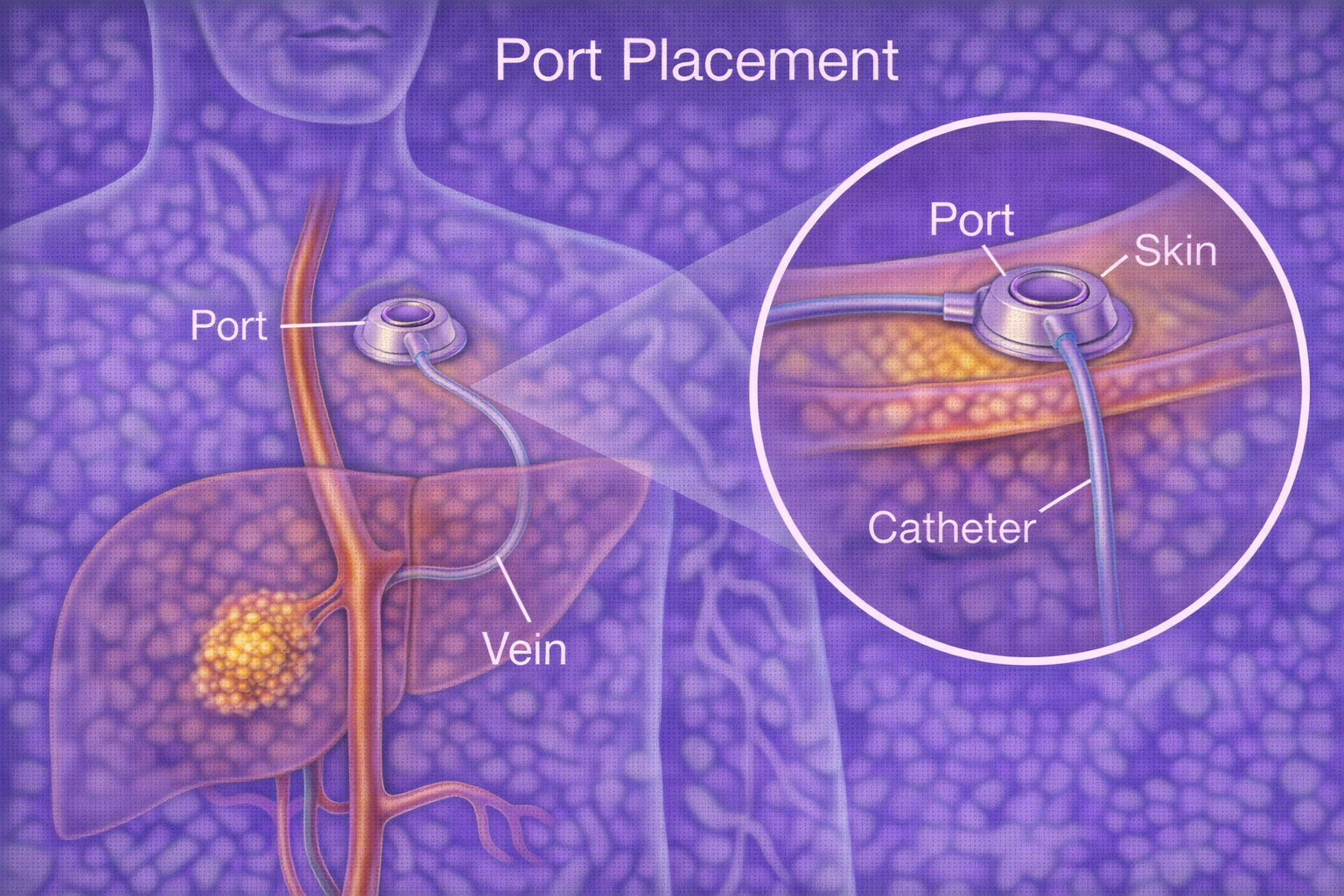
Port Placement

Chemoport Placement

A Safe, Comfortable Way to Receive Chemotherapy and Long-Term IV Treatments

If you or your loved one needs repeated chemotherapy, long-term IV medicines, or frequent blood tests, doctors often recommend a chemoport (also called a port-a-cath).

Chemoport placement is a small, minimally invasive procedure that puts a small device under the skin so medicines can be given safely, comfortably, and repeatedly—without repeated needle pricks in the arm.
👉Starting chemotherapy or long-term treatment?

What Is a Chemoport?

A chemoport is a small medical device placed under the skin, usually in the upper chest. It is connected to a thin tube (catheter) that goes into a large vein near the heart.

The port:

  • Allows easy, painless access to your veins
  • Is used for chemotherapy, IV medicines, fluids, and blood tests
  • Reduces repeated needle pricks
  • Is hidden under the skin and does not affect daily activities
  • Long-term use
  • Less pain and vein damage
  • Lower risk of vein irritation compared to repeated IV lines
  • Can stay in place for months to years

Why Is Chemoport Insertion Done?

Chemoport insertion is done when a patient:

  • Needs repeated chemotherapy sessions
  • Requires long-term IV medicines or nutrition
  • Has difficult or weak veins
  • Needs frequent blood tests
  • Wants a more comfortable and safer option than repeated IV cannulas

Main benefits:

  • Makes treatment easier and less painful
  • Protects veins from damage by strong medicines
  • Saves time during hospital visits
  • Improves overall treatment comfort and convenience

How Is Chemoport Insertion Done?

Chemoport placement is usually done by an interventional radiologist or surgeon under local anesthesia (sometimes with light sedation).

Step-by-step:

  • You lie comfortably on the procedure table
  • The skin is cleaned and local anesthesia is given to numb the area
  • A small cut is made near the upper chest
  • The catheter is guided into a large vein using X-ray or ultrasound guidance
  • The port is placed under the skin and connected to the catheter
  • The skin is closed with stitches or glue, and a dressing is applied
  • An X-ray may be done to confirm correct position

What Are the Risks?

Chemoport placement is generally very safe. Possible risks with approximate incidence include:

  • Pain or soreness at the site – common (20–30%)
  • Bruising or swelling – common (10–20%)
  • Infection – uncommon (1–3%)
  • Bleeding or hematoma – uncommon (2–5%)
  • Clot in the vein or catheter blockage – uncommon (2–5%)
  • Port movement or malfunction – rare (<1–2%)
  • Lung air leak (pneumothorax) – rare (<1%, when placed in chest veins)
Port Placement Chennai – Procedure, Benefits & Care

What Are the Alternatives?

Your options depend on:

  • What treatment you need (chemotherapy, antibiotics, nutrition, etc.)
  • How long you need IV access
  • The condition of your veins and your lifestyle

Your doctor will help you choose the most suitable option.

Alternative 1: No Port or Long-Term IV Line

  • Avoids placing any venous access device
  • Suitable only if your treatment does not require frequent or long-term IV therapy
  • Limitation: you may not be able to receive certain medications or treatments that need reliable vein access

Alternative 2: PICC Line (Peripherally Inserted Central Catheter)

  • A special long IV line placed through a vein in the arm and guided to a large vein in the chest
  • Suitable for medium- to long-term treatments
  • Requires regular care and dressing changes
  • Cannot be fully immersed in water
  • Has a higher risk of infection compared to an implanted port
  • Usually needs to be changed or removed every few months

Alternative 3: Regular IV Cannula

  • Placed into small veins in the hand or arm
  • Suitable for short-term treatments only
  • Small veins cannot tolerate some strong medicines
  • Needs to be replaced every few days
  • Can be uncomfortable due to repeated needle pricks

Choosing the Right Venous Access

An implantable venous port offers a safe, long-term, low-maintenance solution for patients who need repeated or prolonged IV treatments, with lower infection risk and better comfort compared to other options.

📌 For long-term chemotherapy, a chemoport is often the most comfortable and convenient option.

What Happens After Your Procedure?

After chemoport placement:

  • You can usually go home the same day or next day
  • Mild pain or tightness at the site may last 1–3 days
  • Keep the wound clean and dry as advised
  • Stitches (if any) are removed in 7–10 days
  • The port can usually be used for treatment within a few days (sometimes even the same day)
  • You can bathe and return to normal activities once healing is complete
  • The port needs periodic flushing to keep it working well

Frequently Asked Questions (FAQs) – Chemoport Placement

A chemoport (also called a port-a-cath) is a small device placed under the skin that allows doctors to give chemotherapy, IV medicines, fluids, and take blood samples easily and safely without repeated needle pricks in the arm.

Chemoports are recommended for patients who need:

  • Repeated chemotherapy sessions
  • Long-term IV treatment
  • Frequent blood tests
  • A more comfortable and safer option than repeated IV cannulas

No. It is a minor, minimally invasive procedure, not major surgery.

The procedure is done under local anesthesia, so you won’t feel pain during placement. Mild soreness afterward is common for a day or two.

The procedure usually takes 30 to 60 minutes.

Many patients go home the same day or after a short observation.

A chemoport can stay in place for months or even years, as long as it is needed and working properly.

Yes. After the wound heals, you can bathe, move your arm freely, and do normal daily activities.

The risk of infection is low, especially when the port is handled in a clean and proper way during treatment.

Possible risks include pain, bruising, infection, bleeding, clot formation, or rarely lung air leak (pneumothorax). Serious complications are uncommon.

This is rare, but sometimes the port may shift or the catheter may block. These problems can usually be fixed.

Yes. Once your treatment is complete, the chemoport can be removed with a small procedure.

For long-term treatment, a chemoport is much more comfortable, safer for veins, and more convenient than repeated IV lines.

Yes. Chemoport placement is widely available in cancer centers and major hospitals across India.

You should consider a chemoport if you need:

  • Long-term chemotherapy or IV treatment
  • Frequent blood tests
  • A comfortable and reliable vein access option

Why Choose Chemoport Placement?

  • Less pain from repeated needle pricks
  • Safer delivery of chemotherapy
  • Protects your veins
  • Comfortable for long-term treatment
  • Minimally invasive procedure
  • Improves overall treatment experience

Starting Chemotherapy or Long-Term IV Treatment?

A chemoport can make your treatment easier, safer, and far more comfortable.

Don’t struggle with repeated IV lines—choose a simple, long-term solution.
Call Now Button