

There is a moment most patients never get.
It happens between diagnosis and consent. A brief window where someone, ideally the doctor sitting across from them, says: before we talk about surgery, let me tell you what else is possible.
Most patients do not get that moment. They receive a diagnosis, a surgical recommendation, and a date. The alternative a procedure that reaches the same destination through a 2mm needle, without a single incision, without general anaesthesia, and without weeks of recovery is never mentioned. Not because it does not exist. Because the doctor they saw was a surgeon who offered surgical solutions.
The best interventional radiologist in Chennai is the specialist who fills that gap.
However, if you have been told you need surgery for varicose veins, fibroids, an enlarged prostate, chronic knee pain, or varicocele and you have not yet spoken to a vascular interventional radiologist in Chennai, you may be missing another treatment option. This page gives you the complete picture.
This page gives you the complete picture.
Why Choose a Non-Surgical Interventional Radiologist in Chennai?
No Cuts, No Scars, Home by Evening
Every IR procedure at this clinic has four things in common.
- Entry point: a needle puncture of 1 to 2mm. Nothing larger.
- Guidance: live X-ray or Doppler ultrasound imaging throughout, not guesswork, not anatomical memory.
- Anaesthesia: local with mild sedation; the patient remains awake, communicating, and comfortable.
- Discharge: walking out within hours of the procedure in most cases.
There is no surgical incision, no stitches, and no wound care at home. Beyond the small access point, the skin remains untouched and usually fades within days.
For working professionals across Chennai teachers, IT employees, business owners, parents the difference between a 3-day recovery and a 6-week recovery is not a minor clinical footnote. It is the difference between a procedure that fits into life and one that reorganises it entirely.
Interventional Radiologist vs Traditional Surgeon
However, most patients consult a surgeon before deciding on treatment. This is a speciality boundary issue, not a clinical one.
| Factor | Interventional Radiologist | Traditional Surgeon |
| Access method | 2mm needle puncture | Surgical incision |
| Anaesthesia | Local + mild sedation | General or spinal |
| Hospital stays | Same day/overnight | 2 to 7 days |
| Recovery | 1 to 5 days | 3 to 6 weeks |
| Scarring | No skin changes | Permanent surgical scar |
| High-risk patients | Specifically suited | Sometimes limited |
To understand this distinction in full clinical detail, read Interventional Radiologist vs Surgeon in Chennai: Who Should You See First?
And if you want to understand what an interventional radiologist is actually trained to do, Who Is an Interventional Radiologist? explains the speciality, the imaging tools, and the clinical scope in plain language.
Non-Surgical Treatments Offered by Dr Ravindran Ramalingam
Varicose Vein Treatment with EVLA
A laser fibre seals the diseased vein from inside, via a small access point at the knee or calf. 30 to 45 minutes. Walking begins the same afternoon. 95 to 98 per cent technical success at 12-month JVIR published data. No vein stripping. No surgical scar.
Peripheral artery disease: Angioplasty and stenting
Blocked leg arteries cause rest pain, non-healing wounds, or amputation risk. A balloon catheter opens the blockage from within the vessel. Blood flow is restored immediately. For diabetic foot patients in Chennai, this is frequently the procedure that prevents amputation when every other option has been exhausted.
A 62-year-old man from Tambaram arrived with a non-healing foot wound that had been present for three months. He had been told amputation was likely. Angioplasty restored arterial blood flow in a single session. The wound closed in over eight weeks. He walks without restriction today.
Uterine Fibroid Embolisation (UFE)
Microspheres delivered through a catheter block the arteries feeding fibroids. Without blood supply, fibroids shrink progressively over 2 to 3 months. The uterus remains completely intact. No hysterectomy. 90 per cent of patients report significant symptom relief at 12 months National Institutes of Health data. No overnight admission needed in most cases.
PAE Prostate Artery Embolisation
Guided in through the wrist via a 2mm access point, microspheres reduce blood supply to the enlarged prostate. The gland shrinks over 4 to 8 weeks. Urinary symptoms improve measurably. Zero retrograde ejaculation risk compared to 65 to 90 per cent with TURP surgery. PAE treatment in Chennai is performed as a dedicated outpatient procedure with same-day discharge.
A 58-year-old man from Velachery with a prostate volume exceeding 90 grams and severe IPSS symptoms underwent PAE. By week 6, uroflowmetry confirmed significant improvement. No catheter. No TURP. Back at his desk within 3 days.
Genicular Artery Embolisation (GAE) for Knee Pain
Abnormal blood vessels that have grown around an arthritic knee drive the chronic inflammation and deep night-time pain that osteoarthritis patients know well. Microspheres calibrated to target only those abnormal vessels are delivered via a catheter, reducing the inflammatory supply at its source.
The GAE procedure in Chennai takes about 60 to 90 minutes, and most patients go home the same day. Patients do not need an implant or joint replacement surgery. They can also avoid the weeks of post-operative physiotherapy that often follow knee replacement.
Published data from Cardiovascular and Interventional Radiology 2022 reports 70 to 80 per cent pain reduction at 12 months in patients with mild to moderate osteoarthritis.
A 54-year-old teacher from OMR had Grade 3 osteoarthritis and could not take three months away from work for knee replacement. GAE was completed in 75 minutes. At her three-month follow-up, pain scores had dropped from 8 to 2 out of 10. She resumed full-time teaching within the week.
Varicocele Embolisation for Men’s Health
Varicocele, enlarged veins within the scrotum, is one of the most correctable causes of male infertility and chronic scrotal discomfort. Embolisation treats it through a catheter placed via a small access point at the neck or groin. Nothing enters the scrotum. No surgical incision. No overnight admission is needed. Return to desk work in 1 to 2 days.
Sperm parameters improve in 60 to 80 per cent of treated men within 6 months. At the same time, embolisation can provide similar outcomes to surgical varicocelectomy for pain relief and fertility improvement, with a shorter recovery period.
For men in Chennai looking at the best varicocele treatment options, this difference is worth discussing before choosing surgical ligation.
How to Choose the Best Interventional Radiologist Near You
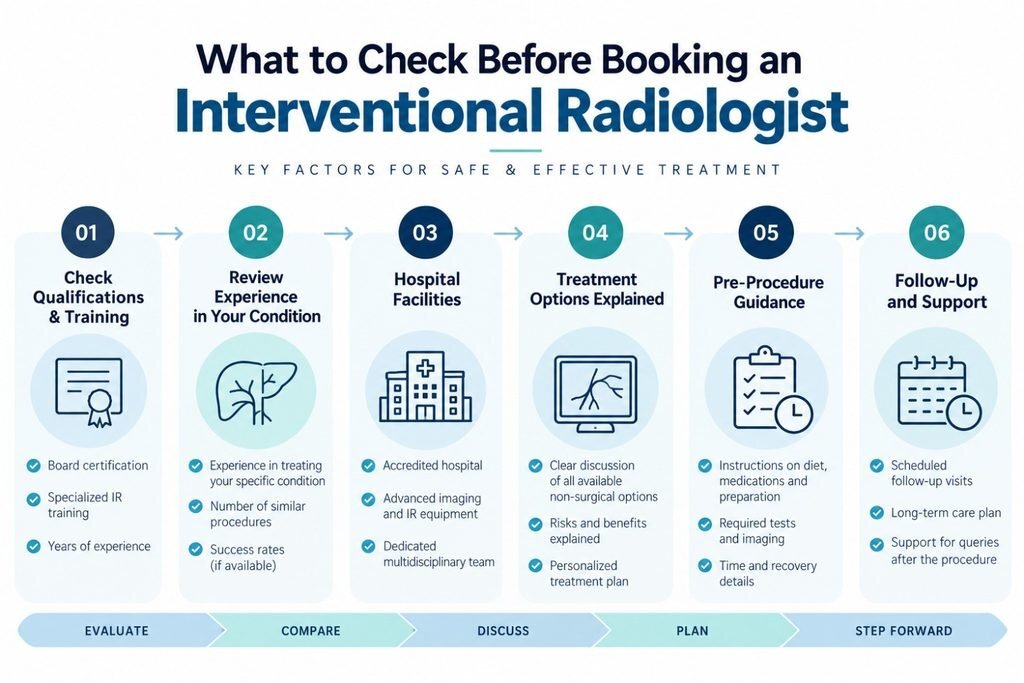
What to Check Before Booking an Interventional Radiologist
Most hospital websites list IR under a department alongside 15 other specialties. The doctor may perform IR procedures occasionally alongside diagnostic reporting and other duties.
A dedicated IR specialist performs image-guided procedures as their primary clinical work. The procedural volume, the complexity handled, and the imaging infrastructure available differ significantly.
Questions to Ask Before Your Consultation
- Is the doctor’s fellowship training specifically in interventional or endovascular radiology?
- Is there a dedicated DSA digital subtraction angiography suite on site?
- How many procedures of the type you need are performed each month?
Dr Ravindran Ramalingam: Endovascular and Interventional Radiology Specialist
Dr Ravindran practices at Gleneagles Hospital Perumbakkam, one of South Chennai’s best-equipped tertiary facilities for interventional radiology. The full range of procedures, EVLA, UFE, PAE, GAE, varicocele embolisation, angioplasty, thyroid RFA, and TACE, are performed at a dedicated IR suite with complete DSA imaging capability.
Published Treatment Outcomes and Benchmarks
- EVLA varicose veins: 95 to 98 per cent success at 12 months
- UFE fibroids: 90 per cent significant symptom relief NIH
- PAE prostate: 75 to 80 per cent clinical success at 5 years, European Urology, 2020
- GAE knee: 70 to 80 per cent pain reduction at 12 months
- Varicocele embolisation: 60 to 80 per cent sperm parameter improvement at 6 months
Cost and Insurance Breakdown
Procedure Cost Ranges in Chennai
| Procedure | Estimated Cost Range |
| EVLA varicose veins (one leg) | ₹40,000 to ₹65,000 |
| UFE uterine fibroids | ₹75,000 to ₹1,20,000 |
| PAE enlarged prostate | ₹80,000 to ₹1,30,000 |
| GAE knee pain | ₹70,000 to ₹1,10,000 |
| Varicocele embolization | ₹45,000 to ₹75,000 |
| Angioplasty peripheral artery | ₹60,000 to ₹1,50,000 |
| Thyroid RFA | ₹50,000 to ₹90,000 |
Costs vary by case complexity, bilateral vs unilateral treatment, and consumables. A specific estimate is provided after reviewing scan reports at consultation.
Insurance Coverage
Most major Indian health insurance policies cover IR procedures when:
- A documented clinical diagnosis with scanning evidence exists.
- Pre-authorisation is obtained before the procedure date.
- The procedure is medically indicated, not cosmetic.
Call your insurer and ask specifically whether EVLA, UFE, PAE, or varicocele embolisation is listed under your policy. Request pre-authorisation from the hospital insurance desk. Confirm cashless empanelment before your procedure date.
Frequently Asked Questions
Most IR procedures are covered under standard health insurance policies when a documented clinical diagnosis exists, and pre-authorisation is obtained. Purely cosmetic cases are typically excluded. Call your insurer and ask whether the specific procedure name is covered under your plan before booking.
A diagnostic radiologist reads your scan and sends a report. An interventional radiologist uses those same imaging tools- live X-ray, ultrasound, and CT to actively treat disease through a needle or catheter without opening the body. Two distinct roles, despite the shared speciality name.
No, in most procedures at this clinic, local anaesthesia with mild conscious sedation is sufficient. The patient remains awake and comfortable throughout. General anaesthesia is reserved for selecting complex cases only, determined after consultation and scan review.
Most patients return to desk work within 1 to 3 days. Physically demanding roles may need 5 to 7 days, depending on the specific procedure. Discharge instructions will give you a clear timeline based on what was performed.
No referral is required. You can book directly, bring your existing scan reports, and receive an independent clinical opinion on whether a non-surgical option is appropriate for your case.
You will be told directly and referred appropriately. The consultation is built around what is clinically right for your situation, not around steering every patient toward one treatment pathway.
Making the Right Choice, Not the Default One
Surgery is not wrong. For the right condition and the right patient, it remains the best answer in medicine.
But for a growing number of conditions varicose veins, uterine fibroids, enlarged prostate, knee arthritis, and varicocele surgery is no longer the only option. In many cases, patients can consider a minimally invasive treatment before surgery.
A dedicated interventional radiologist does not replace the role of a surgeon. The specialist gives patients another option before they sign a consent form. A 2mm access point can replace a larger incision. Home by evening can mean less disruption than spending a week in a hospital ward. More importantly, patients can make the decision after understanding the available treatment options.
Over the past decade, more patients have started asking about IR alongside conventional surgery. They are asking simple questions: Is there a non-surgical option? What will recovery look like? If I choose the less invasive route first, can I still have surgery later?
In most suitable cases, choosing IR first does not close the door to surgery. If the treatment does not provide the expected result or circumstances change, the patient can still discuss surgical options with their doctor.
So, if you or someone in your family has received a recommendation for surgery, consider speaking with an interventional radiologist before making the final decision.
You can consult Dr. Ravindran at Gleneagles Hospital Perumbakkam. He can review your condition and scan reports and explain whether a minimally invasive approach suits your case or whether surgery makes more sense.

Interventional Radiology In Chennai: Understanding Non-Surgical Pin-Hole Treatment – Irdoctor
16/09/2026[…] Not sure what to look for when choosing a specialist in the first place? Worth reading this before you book anything: Best Interventional Radiologist in Chennai — Non-Surgical Pin-Hole Treatment Specialist […]