

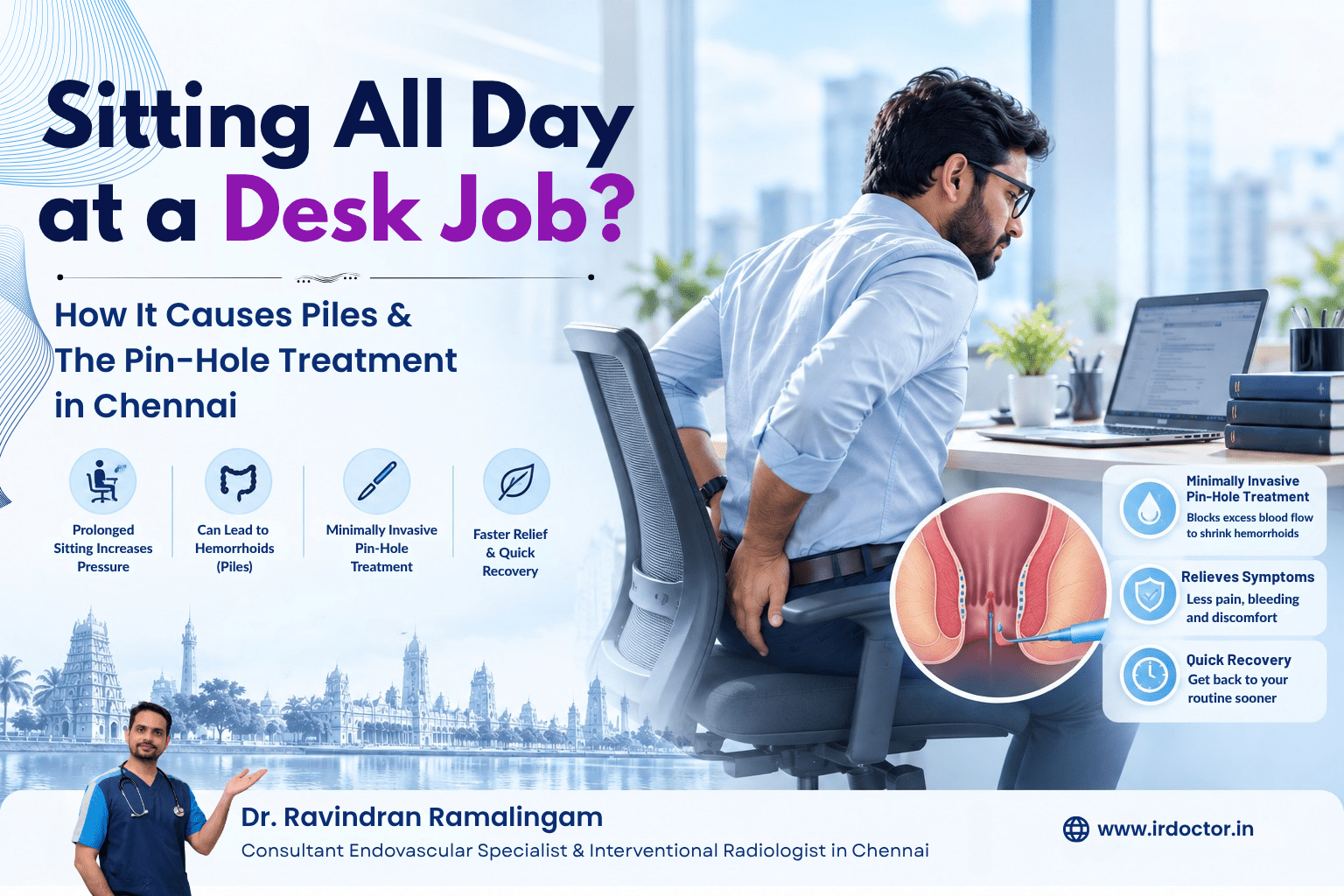
If you’ve been googling piles treatment without surgery, chances are you already know the basics, but what most people miss is why a desk job makes piles so much more likely in the first place. We’ve covered the non-surgical route in detail here: Piles Treatment Without Surgery: Hemorrhoid Artery Embolization Explained. This piece goes one step back to the chair you’re probably sitting in right now.
Quick answer: Long hours of sitting increase pelvic pressure and slow blood flow in the rectal veins, while low movement and low water intake cause constipation and straining together, the leading causes of piles in desk workers. The non-surgical fix is Hemorrhoid Artery Embolization (HAE), a pinhole procedure with no incisions and a 24-hour recovery time.
How Your 9-to-5 Desk Job is Triggering Piles (Hemorrhoids)
Nine hours in a chair doesn’t sound dangerous. It doesn’t feel dangerous either until the itching starts, or you see blood on the tissue paper and quietly panic. Piles rarely show up overnight. They build up over months of sitting, ignoring the urge to move, and skipping the bathroom because you’re “in the middle of something.”
The Vascular Trap: Continuous Pelvic Pressure and Blood Pooling in Rectal Veins
Your rectal veins were never built for eight-plus hours of constant pressure. Sitting compresses them, slows the blood flow back up, and lets blood pool exactly where it shouldn’t.
- Hard office chairs increase direct pressure on the pelvic floor.
- Crossed legs or slouched posture restrict circulation further.
- Repeated pooling, day after day, causes the veins to stretch and swell.
Sluggish Digestion & Dehydration: The Constipation and Straining Cycle at Work
Movement helps your gut move too. Sit still all day, skip water because you don’t want to keep walking to the washroom, and your bowel slows down with you.
- Low water intake hardens stool.
- Skipping fibre-rich meals slows transit time.
- Straining against hard stool is what actually tears and enlarges hemorrhoidal tissue, not the sitting alone.
Are You Ignoring the Signs? Bleeding, Itching, and Pain After Long Meetings
A lot of patients tell us the same thing: the discomfort got worse specifically after back-to-back meetings or long client calls. Watch for:
- Bright red bleeding after passing stool
- Persistent itching or irritation near the anus
- A soft lump you can feel while sitting
- Pain that worsens after long, uninterrupted sitting
These aren’t “just because I sat too long.” They’re early piles, and they get harder to treat the longer you wait.
Prevention Strategies for Office Workers
Small, boring habits do more for prevention than anything you’ll find in a pharmacy. Here’s what actually holds up over months of desk work.
3-Minute Movement Breaks Every Hour to Restore Blood Circulation
Set a reminder if you have to. Three minutes an hour is enough to draw blood from the pelvic region and get it moving again.
- Stand during phone calls instead of staying seated.
- Take the stairs at least once a day instead of the lift.
- Walk while thinking through a problem instead of sitting with it.
- Stretch your hips and lower back between meetings.
Desk-Side Hydration Rules to Prevent Hard Stools
Dehydration is one of the fastest routes to hard, straining-inducing stools.
- Keep a bottle within arm’s reach and sip throughout the day.
- Add fibre-rich snacks: fruits, nuts, whole grains instead of packaged snacks.
- Limit excess tea and coffee, which can worsen dehydration.
- Set a water-intake reminder alongside your meeting reminders.
The “Don’t Delay” Rule: Avoiding Bathroom Procrastination in the Office
Holding it in because you’re mid-meeting is one of the most common, and most avoidable, triggers we see in working professionals.
- Don’t skip the urge for “just five more minutes” of a call.
- Block short washroom breaks into your calendar like any other commitment.
- Treat this the same way you’d treat any other health habit: non-negotiable.
Treating the Vein, Not the Tissue: Why You Don’t Need Laser Surgery
Here’s where most people get stuck: they assume “surgery” is the only real fix. It isn’t. Piles are, at their core, a vascular problem: too much blood flowing into swollen veins. Treat the blood supply, and the swelling has nothing left to feed it. This is the same principle behind piles treatment without surgery through embolization.
Laser Surgery vs. Hemorrhoid Artery Embolization (HAE)
| What it targets | Burns and removes the swollen tissue directly | Blocks the abnormal artery feeding the pile |
| Cuts or incisions | Yes, tissue is directly treated | None done through a pinhole access point |
| Anesthesia | Usually general or spinal anesthesia | Local anesthesia, patient stays awake |
| Pain after procedure | Moderate to significant, common complaint | Minimal, most patients describe mild discomfort |
| Recovery time | 1–2 weeks, activity restricted | Back to desk work within 24 hours |
| Risk of incontinence | Small but real risk with tissue-based surgery | Not applicable; no tissue is cut |
Why Interventional Radiologists Treat Piles Differently Than General Surgeons
A surgeon is trained to remove tissue. An interventional radiologist is trained to work inside blood vessels using imaging to guide a catheter to the exact artery causing the problem, without ever opening the area up. It’s a completely different toolkit, and for piles, it’s often the less invasive one.
Avoiding the Fears of Traditional Surgery: Pain, Long Recovery, and Incontinence Risks
Most people who put off treatment aren’t avoiding the diagnosis; they’re avoiding the surgery itself.
- Fear of post-operative pain
- Fear of 1–2 weeks away from work
- Fear of incontinence risk from tissue-based procedures
- Discomfort even discussing the issue openly.
HAE removes a lot of that fear from the equation, because there’s simply no cutting involved.
Hemorrhoid Artery Embolization (HAE): The Desk Job-Friendly Solution
What is Non-Surgical Piles Treatment (HAE)?
HAE is a day-care procedure done through a tiny pinhole, usually in the wrist or groin. Using live imaging, Dr. Ravindran guides a thin catheter directly to the artery supplying blood to the hemorrhoid no cuts, no stitches, no wound to heal.
Shrinking the Piles by Blocking the Abnormal Blood Supply
Once the catheter reaches the right artery, tiny particles are released to block it. Cut off the blood supply, and the swollen pile gradually shrinks on its own over the following weeks, the way any tissue shrinks when it stops receiving excess blood flow.
Back to the Office in 24 Hours: No Cuts, No Stitches, No General Anesthesia
- No general anesthesia; local only; patient stays awake.
- No incision to protect or dress
- Most patients go home the same day.
- Back at the desk within 24 hours
You can’t afford two weeks of medical leave for piles surgery, and with HAE, you don’t have to plan for one.
Consult Chennai’s Leading Non-Surgical Piles Specialist
What to Expect During Your Outpatient Vascular Assessment
Your first visit typically includes:
- A review of your symptoms and history
- An imaging-based assessment of the affected arteries
- A straightforward conversation about whether HAE is right for your case no assumptions, no pressure
Book Your HAE Consultation with Dr. Ravindran Ramalingam Today
If long hours at your desk have left you dealing with pain, bleeding, or that nagging discomfort you’ve been putting off addressing, it’s worth getting it checked before it worsens. Dr. Ravindran Ramalingam specializes in piles treatment without surgery through Hemorrhoid Artery Embolization in Chennai. Book a consultation and get an honest assessment of your options.
Frequently Asked Questions
Most patients describe mild discomfort at most, not pain. There’s no incision, so there’s no wound-related pain during recovery either.
Both play a role. Genetics can make you more prone to weak vein walls, but prolonged sitting and straining are what actually trigger swelling in most working professionals.
Most patients are back at work within 24 hours, since there’s no incision, no stitches, and no general anesthesia to recover from.
Not necessarily. Bleeding piles are still commonly treated with HAE, provided the artery is accessible.
Conclusion
A desk job doesn’t cause piles on its own; the sitting, the skipped water, the delayed washroom breaks, and the straining all add up together. The good news is both ends of this problem are fixable. A few daily habits cut your risk. And if piles have already shown up, you no longer need to choose between ignoring the problem and taking two weeks off for surgery.
Piles treatment without surgery through Hemorrhoid Artery Embolization gives working professionals a real middle path: no cuts, no general anesthesia, and a desk you can be back at the next day. If any of the symptoms above sound familiar, don’t wait for them to get worse. Book a consultation with Dr. Ravindran Ramalingam and get a clear answer on where you stand.

Comments are closed