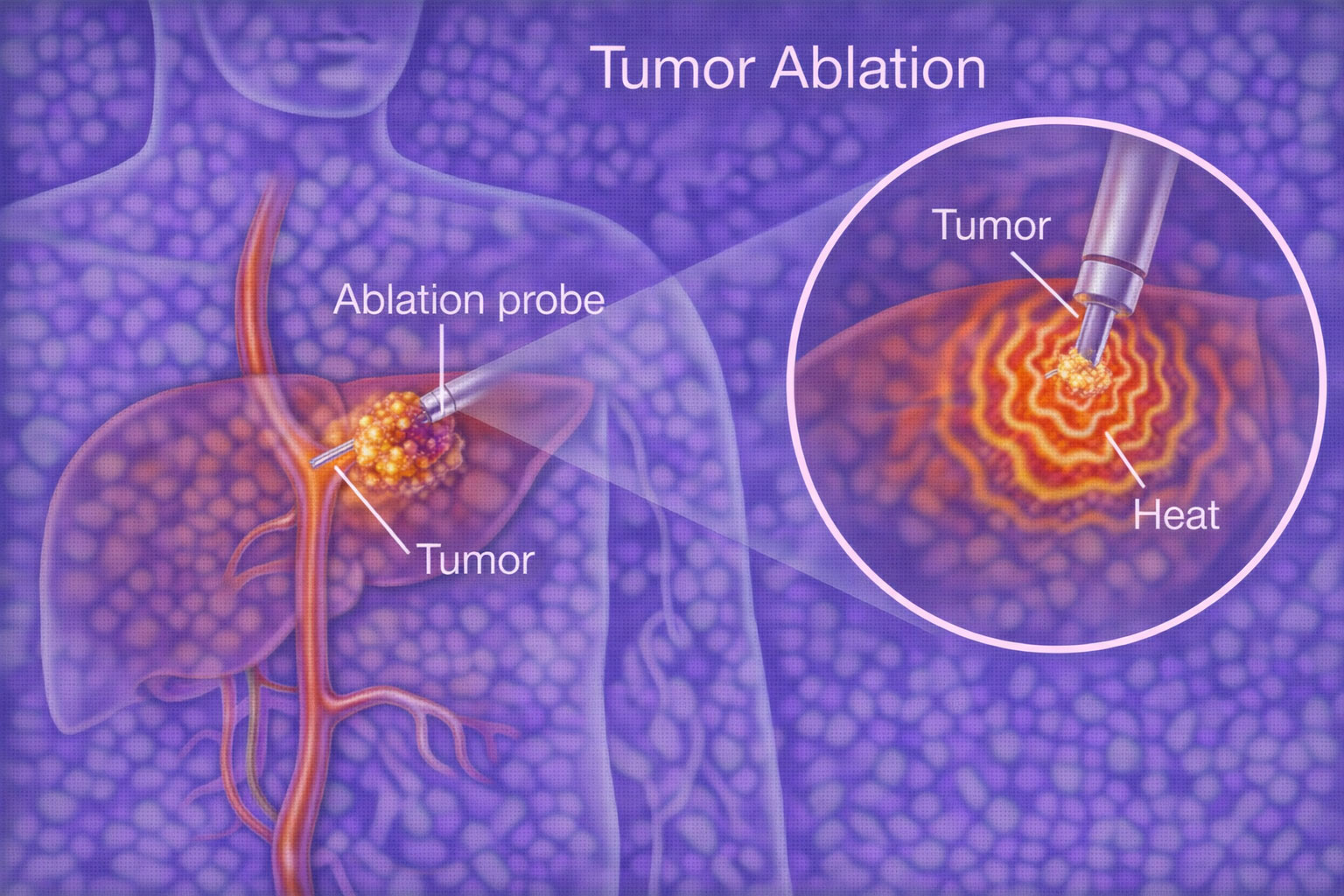
Tumor ablation is a medical procedure that destroys a tumor using extreme heat or cold, delivered through a thin probe/needle placed directly into the tumor under imaging guidance (CT, ultrasound, or MRI).
Common types of tumor ablation:
- Radiofrequency ablation (RFA) – uses heat
- Microwave ablation (MWA) – uses heat
- Cryoablation – uses extreme cold
Tumor ablation can be used for tumors in:
- Liver
- Lung
- Kidney
- Bone
- Adrenal gland and other organs (in selected cases)
For liver tumors where heat-based ablation is not sufficient alone, chemoembolization (TACE) delivers targeted chemotherapy directly into the tumor’s artery — sometimes combined with ablation for better results in selected cases.
Transarterial radioembolization (TARE) uses radioactive beads to destroy liver tumors from within — an alternative when ablation or TACE is not the best fit for the tumor’s size or location.
The same ablation technology used for liver and kidney tumors is also applied to the thyroid. Thyroid nodule ablation shrinks benign but symptomatic nodules using radiofrequency heat — no surgery, no scar.