Chennai-based Endovascular & IR Specialist, Dr. Ravindran Ramalingam offers minimally invasive, scar-free treatments ensuring faster recovery and minimal pain.

Endovascular &
IR Specialist

Center Address
- Gleneagles Health City, Perumbakkam, Chennai, TN
- Maruti Scans, Velachery, Chennai, TN

Renal Artery Angioplasty and Stenting

A Minimally Invasive Way to Improve Kidney Blood Flow and Control Blood Pressure 

The kidneys need good blood flow to work properly. When the renal artery (the artery supplying the kidney) becomes narrowed or blocked, it can cause high blood pressure, worsening kidney function, and fluid retention. 

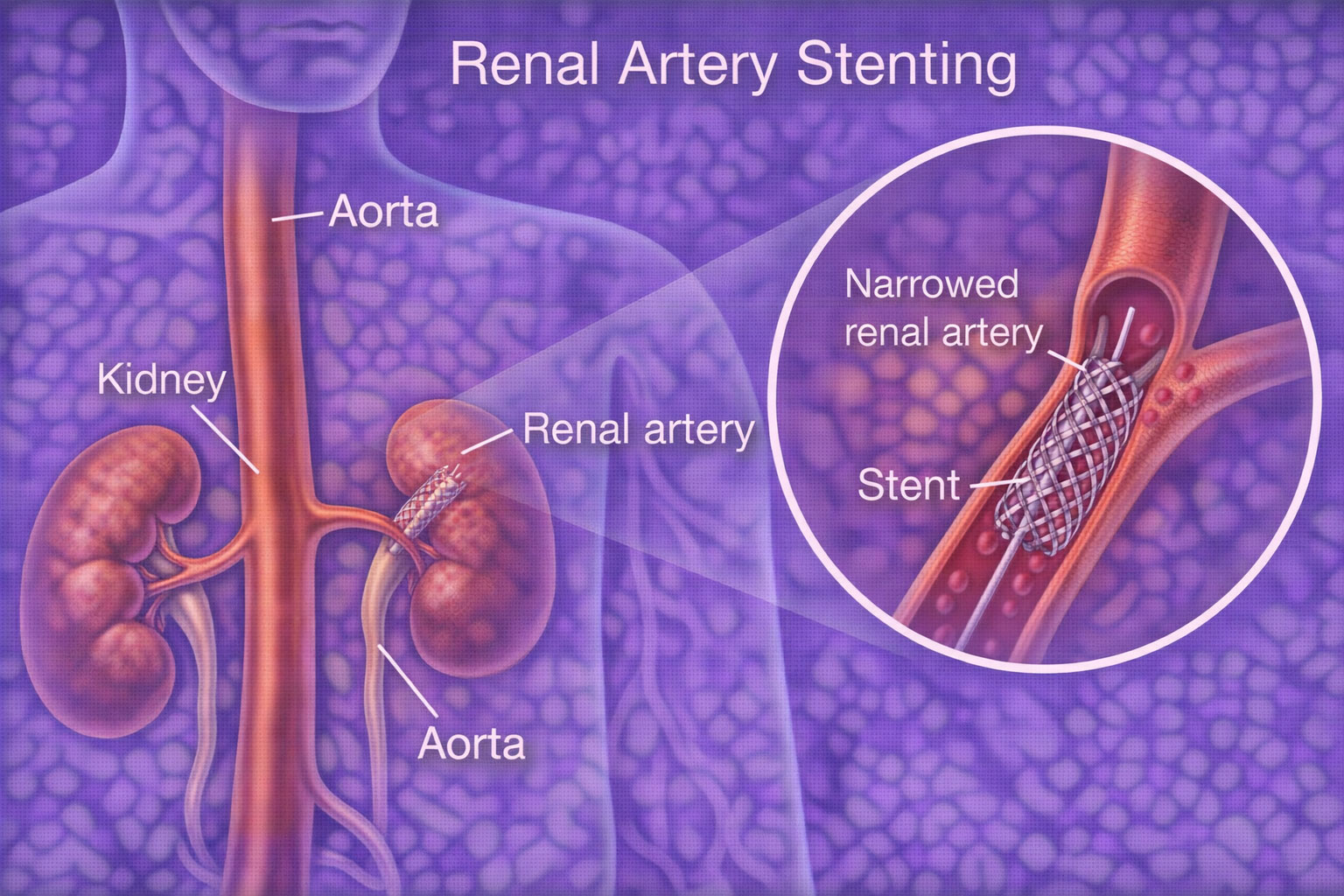
Renal artery angioplasty and stenting is a minimally invasive, image-guided procedure that opens the narrowed artery and restores blood flow—often without open surgery. 

👉 Have difficult-to-control blood pressure or worsening kidney function? 

What Is Renal Artery Angioplasty and Stenting?

  • Angioplasty uses a small balloon to open a narrowed renal artery. 
  • Stenting places a tiny metal mesh tube (stent) to keep the artery open after it is widened. 

This treatment: 

  • Improves blood flow to the kidney 
  • Helps control high blood pressure in selected patients 
  • May protect or improve kidney function 
  • Avoids major surgery in many cases 
  • No big cuts 
  • Small puncture in the groin or arm 
  • Faster recovery 
  • Often same-day or next-day discharge 

Why Is Renal Artery Angioplasty and Stenting Done?

This procedure is done when a person has renal artery stenosis (narrowing of the kidney artery) causing problems such as: 

  • High blood pressure that is hard to control with medicines 
  • Worsening kidney function without another clear cause 
  • Sudden fluid overload or repeated breathlessness due to kidney-related blood pressure issues 
  • Narrowing seen on scans along with symptoms or complications 

Common causes of renal artery narrowing: 

  • Atherosclerosis (fatty deposits in arteries) – most common 
  • Fibromuscular dysplasia (FMD) – more common in younger patients 

Goals of treatment: 

  • Improve blood flow to the kidney 
  • Help control blood pressure 
  • Prevent further kidney damage in selected patients 

How Is Renal Artery Angioplasty and Stenting Done?

The procedure is performed by an interventional specialist in a cath lab under X-ray guidance. 

Step-by-step: 

  • You lie comfortably; local anesthesia (and sometimes light sedation) is given 
  • A small puncture is made in the groin or arm artery 
  • A thin tube (catheter) is guided to the renal artery 
  • Contrast dye shows the exact narrowing 
  • balloon is inflated to open the artery (angioplasty) 
  • stent may be placed to keep it open 
  • Blood flow is checked, and the catheter is removed 
  • A small dressing is applied 

What Are the Risks?

Renal artery angioplasty and stenting is generally safe in experienced centers. Possible risks with approximate incidence include: 

  • Bruising or pain at puncture site – common (10–20%) 
  • Bleeding or small hematoma – uncommon (5–10%) 
  • Allergic reaction to contrast dye – rare (<2%) 
  • Temporary worsening of kidney function – uncommon (3–5%, higher in patients with weak kidneys) 
  • Re-narrowing of the artery (restenosis) – uncommon (10–20% over time) 
  • Artery injury or clot – rare (<1–2%) 

What Are the Alternatives?

Your treatment options depend on: 
  • Your blood pressure control and symptoms 
  • The severity of renal artery narrowing (stenosis) 
  • Your overall health and other medical conditions 
  • Your personal preferences 
Your clinician will help you choose the safest and most effective option. 

Alternative 1: Medical Treatment Only (No Procedure) 

  • Focuses on controlling blood pressure with medicines 
  • Often the first-line treatment for many patients 
  • May include lifestyle changes along with medications 
  • Avoids any invasive procedure 
  • Limitation: may not be enough if blood pressure remains uncontrolled or kidney function worsens 

Alternative 2: Renal Artery Denervation 

  • minimally invasive procedure used mainly for resistant hypertension 
  • Suitable when there is no or only mild narrowing of the kidney arteries 
  • Uses energy to disrupt nerves around the renal arteries that contribute to high blood pressure 
  • Can help lower blood pressure in selected patients 
  • Does not open blocked arteries, but works on nerve signals instead 

Alternative 3: Surgical Repair or Bypass of Renal Arteries 

  • Involves open surgery to repair or bypass the blocked kidney arteries 
  • Often provides a durable, long-lasting result 
  • However, compared to minimally invasive treatments, surgery: 
  • Has a higher risk of complications 
  • Requires general anesthesia 
  • Involves a longer hospital stay and recovery period 
  • Is more stressful on the body, especially in older or high-risk patients 

Choosing the Right Treatment 

Many patients benefit from minimally invasive renal artery angioplasty and stenting, which can improve blood flow to the kidneys with less risk and faster recovery compared to open surgery. A personalized evaluation helps determine the best approach to control blood pressure and protect kidney function. 

📌 Many patients do well with medicines alone. Angioplasty/stenting is chosen for selected patients who have symptoms or complications. 

What Happens After Your Procedure?

After the procedure: 

  • You’ll be observed for a few hours or overnight 
  • You may have mild soreness at the puncture site for 1–2 days 
  • Most patients go home the same day or next day 
  • Blood pressure and kidney function are monitored closely 
  • You’ll usually continue blood pressure and blood-thinning medicines 
  • Follow-up visits and scans help ensure the artery stays open 

Some patients notice better blood pressure control over weeks to months. 

Frequently Asked Questions (FAQs) – Renal Artery Angioplasty and Stenting

Renal artery angioplasty and stenting is a minimally invasive procedure used to open a narrowed kidney artery with a balloon and sometimes place a small metal stent to keep the artery open and improve blood flow to the kidney. 

It is done in selected patients to: 

  • Help control hard-to-treat high blood pressure 
  • Improve or protect kidney function 
  • Treat complications caused by renal artery narrowing (renal artery stenosis) 

Renal artery stenosis means narrowing of the artery that supplies blood to the kidney, usually due to fatty deposits (atherosclerosis) or a condition called fibromuscular dysplasia (FMD). 

No. It is a catheter-based, minimally invasive procedure, not open surgery. 

It is done under local anesthesia and sometimes light sedation, so most patients feel little or no pain during the procedure. 

The procedure usually takes 45 to 90 minutes, depending on the complexity of the narrowing. 

Many patients go home the same day or after one night of observation. 

It may improve blood pressure control in some patients, but many people will still need blood pressure medicines after the procedure. 

The procedure is very successful in opening the artery. The benefit on blood pressure or kidney function depends on the cause and stage of disease. 

Possible risks include bruising or bleeding at the puncture site, allergic reaction to contrast dye, temporary kidney function changes, artery injury, or re-narrowing of the artery. Serious complications are uncommon. 

Yes, re-narrowing (restenosis) can happen in some cases, but follow-up and repeat treatment are possible if needed. 

Yes. Most patients continue blood pressure medicines and may need blood-thinning and cholesterol-lowering medicines. 

Many patients do well with medicines alone. Angioplasty/stenting is used in selected patients who have complications or do not respond well to medicines. 

Yes. Renal artery angioplasty and stenting is available in advanced cardiac and vascular centers across India. 

You should consider specialist evaluation if you have: 

  • Difficult-to-control high blood pressure 
  • Worsening kidney function without a clear reason 
  • Sudden fluid overload or repeated breathlessness related to kidney problems 
  • Narrowed renal artery seen on scans with symptoms 

Why Choose Renal Artery Angioplasty and Stenting?

  • Minimally invasive 
  • No big surgery or scars
  • Faster recovery
  • May improve blood pressure control 
  • May help protect kidney function 
  • Proven, modern treatment in selected patients 

Struggling With Uncontrolled Blood Pressure or Kidney Problems?

If you have hard-to-control blood pressure or worsening kidney function and scans show renal artery narrowing, you may benefit from a specialist evaluation.

Renal artery angioplasty and stenting can restore blood flow and protect your kidneys—without major surgery.
Call Now Button